
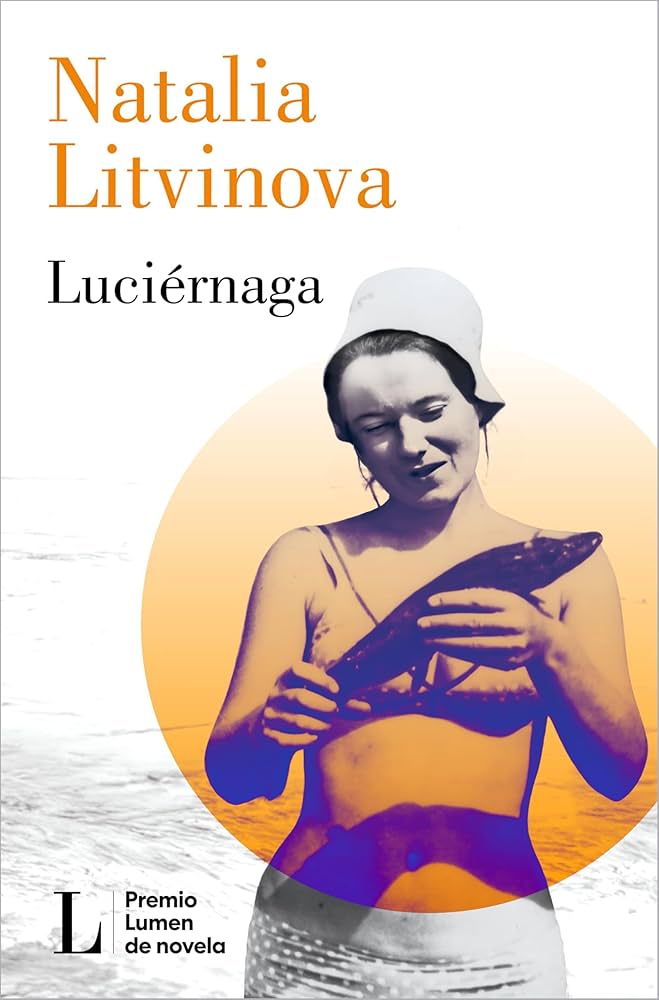
After growing up in Belarus under the radiation of Chernobyl, Natalia emigrates to Argentina as a child. Years later, in the midst of an adult crisis and back in her mother’s home, she reconstructs the silenced history of her family — a lineage of women shaped by war, exile, and radiation — in order to understand who she is and where she comes from. Firefly, winner of the 2024 Lumen Prize, is an intimate and visually powerful drama about inherited trauma, migration, and identity.
Being born under a radioactive cloud leaves a permanent mark. Firefly begins with this premise to introduce Natalia, a girl who grows up in post-Chernobyl Belarus, in a world where danger is invisible, everyday, and hereditary. Years later, now an adult and exiled in Buenos Aires, the same woman tries to understand who she is and where she comes from, reconstructing a family memory made of silences and trauma, marked by survival.
The novel unfolds as a mosaic of times and voices in dialogue. During her early years, Natalia grows up in the city of Gomel, in a society collapsing after the fall of the Soviet Union. Supermarkets are empty, adults trade food coupons, and children play with fruit and mushrooms picked in contaminated areas. At school, classmates dare each other to bite radioactive apples. Radiation becomes part of everyday life: red rain falls, people compulsively shower after going outside, and mothers fatten their children so they can better withstand a threat no one explains.
The book portrays this childhood through a direct gaze that is sometimes cruel, sometimes comic, where dark humor coexists with fear. Natalia watches adults remain silent and minimize everything, while children sense the danger before fully understanding it. The family lives amid economic precarity, health paranoia, and constant surveillance of the body: vitamins, imported milk, layered clothing, bans on sunlight.
The accumulated pressure leads to an irreversible decision: emigration. In 1996, Natalia, her brother, and her parents leave Belarus and arrive in Buenos Aires. Exile is not presented as salvation, but as a new form of uprooting.
The second major section of the book shifts into allegory. As an adult, Natalia speaks with her grandmother Catalina in a swamp where women from different generations extract peat. This suspended space acts as a physical condensation of historical memory. Catalina survived the Nazi occupation, was deported to Germany as forced labor, and upon returning was punished by the Soviet regime with years of work in the marshlands. There, stagnant water, female bodies, and disturbed earth compose a persistent image of twentieth-century violence.
Natalia tells her grandmother what she herself could not live through: the fall of the USSR, Chernobyl, the exodus. The conversation is not realistic: Natalia’s arms grow longer, the swamp changes texture according to the women’s moods, memories float like organic matter. This section introduces a poetic, corporeal register that transforms memory into landscape.
In the final part, the story returns to present-day Buenos Aires. Natalia is separated and moves back into her mother’s house. During a move, she opens boxes and reviews photographs, documents, and objects brought from Belarus: passports, diplomas, plane tickets. Each item triggers a memory. Her father reappears — he later returned alone to his homeland and died there. The stigma of being called “fireflies” also emerges: irradiated children.
Living again with her mother reactivates old wounds and silences. Natalia realizes she fully belongs neither to the country she left nor to the one that received her. Through writing and the family archive, she reconstructs the history of the women in her lineage and understands that her identity is made of fragments, displacements, and marked bodies.
The novel blends autobiographical realism, childlike dark humor, and allegorical passages to build a deeply visual story about childhood in catastrophe, the transmission of trauma, and the migrant experience. It is a story of women who survive, of girls who grow up among invisible ruins, and of an adult who, from another continent, tries to put damage in order.
RELEVANT INFORMATION: Firefly, by Natalia Litvinova, has been one of the most significant novels in Spanish-language literature in 2024. It won the Lumen Novel Prize and was selected as one of the 50 best books of 2024 by Babelia.
With this novel — which reflects on transgenerational trauma, exile, and identity — Litvinova honors her family’s memory and captivates readers with strong, authentic female characters and a poetic, emotional narrative voice. A deeply feminine and contemporary story that intertwines the intimate with the historical.
Comparable films include Still Alice, for its portrayal of illness, and The Pianist, for its dramatic depiction of how tragedy shapes a person’s life.
The author is a poet and editor. She lives in Buenos Aires, where she teaches poetry workshops and has published several books. Her work has appeared in Germany, France, Spain, Argentina, Brazil, and the United States. Firefly is her first novel.
Critical reception:
“It is intensity, poetry, feminism, and inspiration for other women in and beyond literature.” – El Español
“Singular […]. Litvinova portrays two countries with lyricism, a fine sense of humor, and a simple style […], sometimes sad and always moving.” – El Cultural
“A brilliant novel in every sense. […] A marvelous jumble guided by a very special voice with impeccable rhythm.” – The Objective
AUDIOVISUAL POTENTIAL: TV series, miniseries, feature film, TV film
AVAILABLE LANGUAGES: Spanish
Adquirir los derechos
Para ponerte en contacto con nosotros completa el siguiente formulario y te responderemos en breve.
