
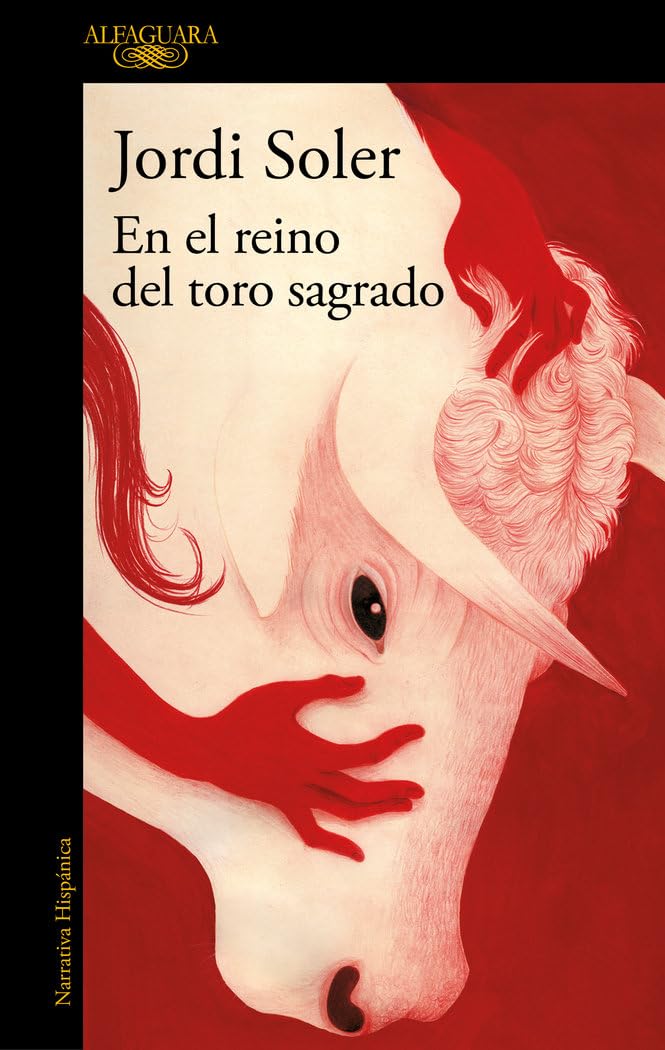
An unattainable woman and a legendary white bull become the obsession of a powerful and feared man, determined to possess or destroy them. Jordi Soler reinvents the myth of Pasiphaë in rural Mexico, a land marked by popular religion, myth, and violence.
In Los Abismos, a small Mexican enclave marked by legends and myths, Artemisa Athanasiadis, a wealthy, beautiful, and admired woman, becomes the center of all attention when she grows obsessed with a white bull to which the town attributes a sacred nature. Fascinated by the animal, Artemisa develops an obsessive relationship that leads her to visit it at night and secretly caress it. Rumors say she takes pleasure in riding it. Meanwhile, those around her begin to isolate her. Her friend and confidant Wenceslao, a local inventor marginalized because of his sexual orientation, tries to protect her but eventually distances himself, unable to endure the destructive influence the bull exerts over his friend.
Artemisa’s past reinforces her status as a local myth: the daughter of a Greek man with a reputation as a swindler, she was once the lover of the feared Teodorico, the most powerful drug lord in Veracruz, a man who worshipped her obsessively without ever fully dominating her. After breaking off their relationship, Artemisa chose to marry Jesuso, a humble young man who was later murdered under suspicious circumstances. Despite the passing of years and the distance between them, Teodorico never managed to forget Artemisa, keeping her belongings like relics and holding onto the hope of seeing her again.
That opportunity arises when Artemisa decides to negotiate with him in order to keep the white bull, owned by Teodorico, and to finance a new invention by Wenceslao: a flying machine. Accompanied by her former friend, Artemisa goes to Teodorico’s palace, where the reunion rekindles a relationship marked by desire, power, and humiliation. Teodorico takes advantage of the meeting to reveal hidden truths: her father’s involvement in drug trafficking and her family’s financial dependence on him. This revelation destroys Artemisa’s last vestige of pride, and she leaves the palace humiliated. The definitive break with Wenceslao and the failure of the negotiation leave Artemisa exposed.
Some time later, Teodorico carries out his revenge: he commissions Wenceslao—without revealing the ultimate purpose of the work—to build a mechanical cow designed to imprison Artemisa inside it. Teodorico’s men, along with Teodorico himself, force Artemisa to confine herself within the device, completely immobilized and exposed to a brutal sexual act by the white bull, sealing her tragic fate and consolidating Teodorico’s absolute power.
RELEVANT INFORMATION: Jordi Soler is a Mexican novelist and poet whose work has been translated into fourteen languages and recognized with major international literary awards. In the Kingdom of the Sacred Bull is his latest novel, a story with a dense, highly symbolic atmosphere that explores two forms of power: the power that seduces and the power that subjugates. The plot originally fuses Greco-Latin and pre-Hispanic traditions with contemporary elements such as drug trafficking, in a narrative that oscillates between magical realism, social drama, and thriller, offering a critical and poetic perspective on violence, desire, and power.
The novel has strong audiovisual potential, especially for film, although it could also be adapted as a miniseries. The triangular relationship between Artemisa, Teodorico, and Wenceslao provides a powerful dramatic core, with complex and contradictory characters who move between love, obsession, power, and betrayal. Artemisa stands out as a memorable female character, in the line of mythic figures: a woman who is strong, desired, vulnerable, and dangerous at the same time. The story contains scenes of great visual and symbolic intensity. The balance between realism and myth, violence and eroticism makes In the Kingdom of the Sacred Bull a distinctive proposal with international projection.
What the press says:
“If, as in Antiquity, writers were those wise men we turned to for enlightenment about the mysteries of life, there would surely be lines of pilgrims on the Barcelona street where Jordi Soler lives.” — Xavi Ayén, La Vanguardia
“His magnificent prose has been forged from the language of that background, a dense and euphonic Mexican Spanish veined with Castilian from other latitudes. […] A universal story that I do not think could be told with greater force.” — Domingo Ródenas de Moya, El País
“Soler brings to the surface the deep forces of nature, the spirit of the land, to show how they intertwine with people’s souls.” — C. Rubio Rosell, Zenda
“Jordi Soler is, above all, a poet.” — Xavier Houssin, Le Monde
“A magical and overwhelming imagination.” — Jorge Semprún
“An author impossible to forget.” — Jesús Martínez Gómez, Mercurio
“Even those in his own profession consider Jordi Soler one of the great prose writers of the Spanish language. […] In In the Kingdom of the Sacred Bull he displays his mastery to the point of taking the reader’s breath away, as if the bull were about to charge at anyone who approaches the novel.” — Juan Cruz, El Periódico
AUDIOVISUAL POTENTIAL: TV Series, Miniseries, Feature Film, TV Film.
AVAILABLE LANGUAGES: Spanish.
Adquirir los derechos
Para ponerte en contacto con nosotros completa el siguiente formulario y te responderemos en breve.
