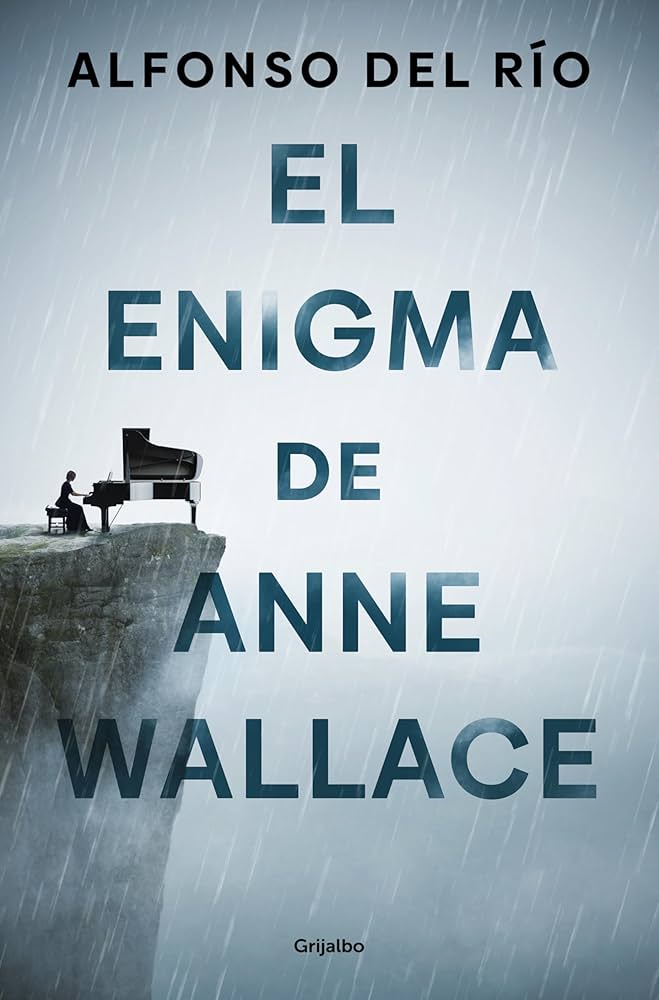
In 1987, after a failed attack during the Prince of Asturias Awards, seven award recipients are trapped in a hotel in Oviedo. As he investigates, an inspector discovers that the key to the case may lie with Anne Wallace, a brilliant and enigmatic pianist around whom all suspicions converge.
Oviedo, 1987. During a private cocktail reception for the Prince of Asturias Awards, at the Hotel de La Reconquista, a bomb explodes just a few meters from the Prince. There are no fatalities, but the impact is immediate: the seven award recipients are confined inside the hotel. No one enters. No one leaves. The culprit must be among them.
Among the honorees is Anne Wallace, an internationally renowned pianist affected by a neurodegenerative disease. Her body fails her, but her mind remains sharp. Anne perceives the world through details—subtle gestures, uncomfortable silences, glances others overlook. From the very beginning, she suspects that the attack is not what it seems.
The case is assigned to Lucas Bieda, an unorthodox but extremely intelligent inspector. His priority is to reconstruct the attack. Initial clues point to ETA, but something does not add up. There is no claim of responsibility, and the explosive appears designed to cause chaos rather than casualties.
As Bieda interrogates the award recipients, the investigation takes an unexpected turn. A body appears on a nearby beach, murdered with an object from the hotel itself. The victim turns out to be a KGB agent who had been monitoring one of the honorees, the physician Andrei Kulakov, who fled the USSR after developing medical research of enormous strategic value. Shortly afterward, Kulakov is also found dead in his hotel room.
What initially seemed like an attack becomes a murder investigation. The killer is still inside the hotel, and Bieda narrows the circle: each suspect carries a possible motive—terrorist extortion, financial secrets, international pressure—while the shadow of Soviet intelligence looms over everything.
It is then that Anne begins to connect the dots. Her way of observing allows her to detect patterns invisible to others. Thanks to her, Bieda reconstructs the true sequence of events and discovers something startling: Anne had been unknowingly used as the carrier of the murder weapon.
The investigation ultimately points to the writer Harry Crane as the murderer of Kulakov. He sought revenge for the death of his sister, caused by the doctor’s experiments. To cover up the crime, Crane hired ETA, exploited the interest of the KGB, and turned Anne Wallace into the invisible vehicle for the poison. When the case is resolved, a final dilemma emerges: revealing the truth would expose connections between terrorism, espionage, and prestigious public figures. To avoid a political scandal, an official false version is imposed, leaving the crime unpunished. The murderer goes free, Anne Wallace regains her freedom, and Bieda understands that sometimes solving a case does not mean achieving justice.
RELEVANT INFORMATION: Alfonso del Río is a Spanish writer, lawyer, and columnist who combines legal practice and university teaching with literary creation. Following the success of La ciudad de la lluvia and El lenguaje oculto de los libros, he has become one of the most prominent and promising voices in Spanish thriller fiction.
His third novel, El enigma de Anne Wallace, is a classic thriller with a closed-space whodunit structure, in which the investigation advances step by step through suspicion, twists, and constant revelations. Its single setting heightens tension and the psychological interplay among characters.
The morally unsettling ending adds thematic depth and turns the story into an elegant, adult mystery with strong audiovisual adaptation potential.
AUDIOVISUAL POTENTIAL: In development.
AVAILABLE LANGUAGES: Spanish.