
Bound together by an old sewing machine, four generations of women from the same family carry a legacy of silence and violence from post–Civil War Spain to the present day, when they must decide whether to perpetuate silence or transform pain into justice. The most acclaimed novel by bestselling author Ana Lena Rivera.
One family. Four generations of women. And a sewing machine passed from mother to daughter, loaded with secrets, guilt, and silence. This is the story of how violence, fear, and resilience are inherited, transformed, and ultimately confronted.
The narrative unfolds across four major time periods interwoven throughout the story. The origin lies in mining Asturias during the Civil War and the postwar years, where Aurora, the great-grandmother, grows up amid poverty and repression. Raped during the war and forced to kill in self-defense, Aurora learns that survival means keeping silent.
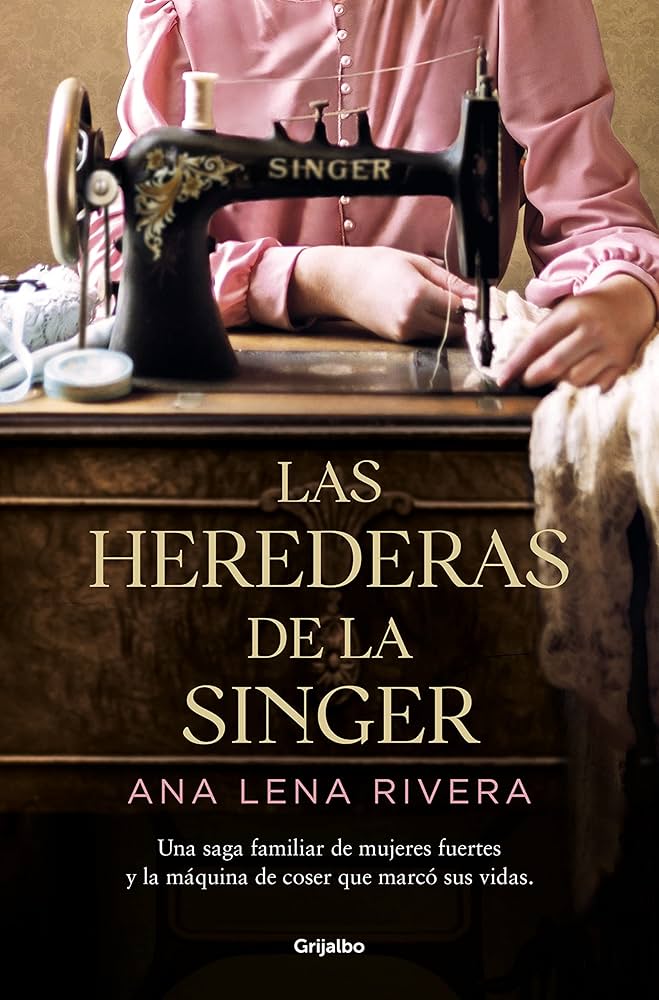
The Singer sewing machine, a wedding gift and work tool, preserves a literal trace of the crime: a bloodstain embedded in the wooden surface of its table, disguised for decades as a simple wood grain. Turned into a tangible secret, the machine accompanies years of silence, repression, and guilt. Francoism, the Women’s Section, and religion do not free Aurora; they reinforce the mandate of silence and allow the trauma to pass to her daughter without ever being named.
This legacy falls upon Águeda, her daughter, who grows up in the 1940s and 1950s learning that silence is a form of protection. Raised to obey and renounce, Águeda inherits the Singer and sewing as her only path to stability. Her relationship with her mother is marked by contempt and lack of affection, but also by deep dependence. Unknowingly, she repeats the inherited model: sacrificing everything so that the next generation may have a better life.
The third stage takes place in Madrid in the 1980s and 1990s, centered on Ana, the granddaughter. Thanks to Águeda’s efforts, Ana gains access to education, social mobility, and a comfortable marriage. However, this well-being is only a façade. Ana carries an unspoken sexual abuse, a cold and controlling marriage, and a total loss of identity. The unspoken trauma of her grandmother and her mother’s submission resurface as guilt, eating disorders, and emotional dependency.
The final period unfolds in contemporary Spain (2010–2022) and centers on Alba, the great-granddaughter. Openly lesbian, feminist, and combative, Alba breaks the chain of silence for the first time. After suffering a gang rape, she decides to report it publicly and turn the family wound into political action. Her decision forces her mother to verbalize her own abuse and her great-grandmother, now elderly, to confess the crime that haunted her all her life. The Singer ceases to be an inherited domestic object and becomes a public symbol of memory, resistance, and reparation.
The story does not progress linearly, but through echoes: each generation repeats, transforms, or challenges what it has received. It is a female family saga spanning a century of Spanish history, where inheritance is not only material but emotional and moral. A powerful intergenerational drama, with a luminous ending, that transforms inherited pain into a possibility for justice and reconstruction.
RELEVANT INFORMATION: Ana Lena Rivera is a Spanish writer recognized for her suspense fiction and historical novels. With hundreds of thousands of copies sold, she has established herself as a bestselling author in the current literary landscape.
The Heirs of the Singer is a dramatic, intense, and deeply emotional novel that connects intimate memory with Spain’s collective history through a family saga. It combines family drama, historical memory, and contemporary social issues, addressing universal themes—violence, silence, identity, reparation—from a modern perspective, and offers a moving, realistic, and provocative portrait of what it meant to be a woman in Spain during the 20th century and how this has decisively shaped contemporary female experience.
It works especially well as an audiovisual product, with clear time jumps and strong emotional arcs, complex female characters with great dramatic weight, and a dialogue with current social debates without losing its appeal to a broad audience.
What the critics say: “An ambitious, choral story that will delight followers of the Asturian author.” – Luis Santillán, Cuadernos del Sur
“Neither this novel—nor any novel—is for women. It is for readers eager for a good plot.” – Ana Ranera, El Comercio
“A family plot involving several generations of women. That alone makes The Heirs of the Singer, by Ana Lena Rivera, of interest to me.” – Paloma Abad, Vogue
AUDIOVISUAL POTENTIAL: TV series, Miniseries, Feature film, TV film.
AVAILABLE LANGUAGES: Spanish.
Adquirir los derechos
Para ponerte en contacto con nosotros completa el siguiente formulario y te responderemos en breve.
