
A struggling cleaner is offered the opportunity of a lifetime: an executive promotion in exchange for killing his boss’s mother. Driven by an overdrawn bank account, he accepts. But after committing the crime, he discovers that the system does not reward loyalty—it only exploits those willing to get their hands dirty.
A thirty-five-year-old cleaner, burdened with a mortgage, a work uniform, and a miserable salary, works at a real estate agency that turns cramped rooms into “charming lofts.” One day, he is summoned to the CEO’s office. There, over cognac, motivational clichés, and corporate humiliation, the boss tells him he cleans toilets because he lacks character—but hints that he might have a future in the company.
At home, his wife reviews unpaid bills like autopsy reports and reminds him they cannot go on like this. When he mentions the possibility of a promotion and she announces an unexpected pregnancy, the couple sees—for the first time—a way out of their misery.
That way out comes with a condition: the CEO wants him to kill his own mother. The elderly woman is sick and extremely wealthy; he needs his inheritance to cover the company’s financial holes and keep selling apartments as if nothing were wrong. In exchange, he promises the cleaner a deputy directorship, an executive salary, and a brand-new life.
Tired of barely surviving, the wife runs the numbers and concludes the deal makes sense. They need to stop counting coins; the boss needs liquidity; and his mother, after all, has lived her life. The cleaner accepts and—accompanied by his alter ego, a conscience that shows up late and unhelpful—breaks into the house and suffocates the old woman, trying to think about the nursery for his future child.
The promotion comes quickly. A new suit, visits to luxury apartments, plans for the future. They begin playing upper-middle class: house hunting, discussing schools, behaving as if they finally belong to the world they used to clean.
Until the CEO reveals his real plan: the company is bankrupt. There has been embezzlement, and it will shut down. He will take whatever money remains and flee the country before Monday, using the weekend to prevent employees and suppliers from reacting in time.
The protagonist—who has just killed for the company—realizes he is about to be left with nothing. He tries to negotiate, speaking of his unborn child and his mortgage, but his boss only thinks of airports and offshore accounts.
Desperate, in the nearly empty apartment he has just bought with his wife, he hangs a rope from a beam in the living room and lets himself drop. He begins to suffocate, kicking for the chair that has fallen aside. At that moment, the real estate agent—who has a spare key and occasionally hides there when his wife throws him out—walks in. Without drama, he nudges the chair back under him with his foot. The protagonist steadies himself, removes the rope, and downplays the suicide attempt.
The scene devolves into an absurd conversation about life insurance policies, commissions, and whether—or not—it’s convenient to commit suicide in a newly purchased property.
The play ends without redemption or poetic justice. The protagonist does not die—but neither does he rebel. He accepts defeat and adopts the same corporate language that destroyed him. A ferocious black comedy about precarity, ambition, and a system that turns ordinary people into commodities.
RELEVANT INFORMATION: Francisco Nortes is a Spanish actor, playwright, and stage creator whose career spans theater, film, and television. He gained public recognition for his roles in television series and stage productions. His work has earned him the Premio Berlanga for Best Actor and a nomination for the Premios de la Unión de Actores in the category of Best Breakthrough Actor.
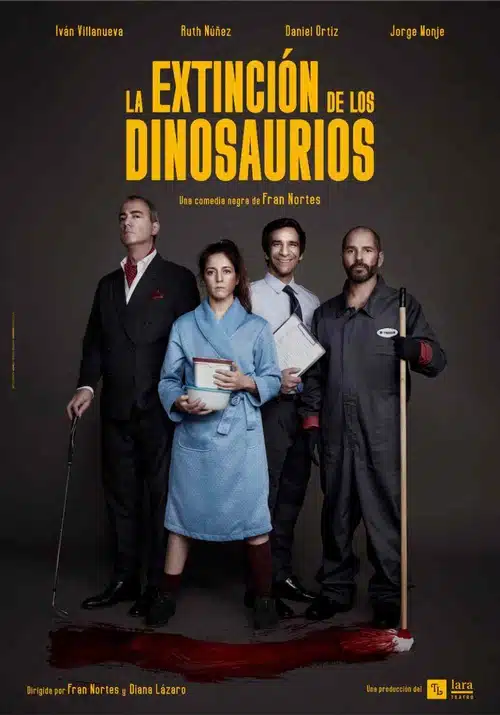
In parallel with his acting career, Nortes has developed a trajectory as a playwright. In 2014, he successfully premiered La extinción de los dinosaurios, a dark comedy that blends humor and social critique through everyday situations pushed to the extreme.
The story advances through sharp dialogue and clearly drawn characters who function as both dramatic and comic engines. Its scene-based structure, brisk pacing, and acidic tone make it easy to imagine as a film or miniseries. It holds strong audiovisual potential as a satirical comedy.
Critical acclaim:
“The text proves that dark comedy can be as revealing as drama. Exaggerated, biting, and tender at once, this piece laughs at collapse—personal or collective—with rare intelligence.” — Paula Gómez, Revista Red Carpet.
“An incisive and engaging theatrical proposal that combines dark comedy, dramatic tension, and solid performances, leaving the audience surprised and reflecting on life’s ethical dilemmas.” — Alberto Sanz, Más Escena.
“An immoral and sincere game, as true as pure theater itself.” — Luis De Luis Otero, Prensa Social.
“What’s good about this play is that it makes you reflect while enjoying and laughing through a wonderful script.” — Alejandra Marín, Teatro Madrid.
“Fran Nortes, with his narrative mastery, invites reflection and dialogue about the complexity of the human condition.” — Clara Ortega, El País.
AUDIOVISUAL POTENTIAL: TV Series, Miniseries, Feature Film, TV Movie.
AVAILABLE LANGUAGES: Spanish.
Adquirir los derechos
Para ponerte en contacto con nosotros completa el siguiente formulario y te responderemos en breve.
