
During the pandemic, Lucas and Javier are confined in a convent while one of their parents fights COVID. Amid oppressive rules, secrets, and nighttime escapes, the confinement threatens to destroy their relationship.
Lucas travels with his boyfriend Javier to Jovita, a small town in Córdoba, when Javier’s parents contract COVID. The idea is to support them, to stay close during the illness. But upon arrival, quarantine locks them into an unexpected place: the convent of the Sisters of Saint Joseph of Pinerolo, now turned into an isolation center.
The room they are assigned is tiny, almost suffocating: ten square meters, a bunk bed, a crucifix nailed to the wall, and an image of Saint Joseph holding the child—always present, always watching. Outside, the silent corridors of the convent; inside, a coexistence that begins to strain from day one.
Lucas doesn’t fit in. A man from Buenos Aires working in insurance, he carries a past marked by religion and abandonment. He smokes secretly by the window, responds with irony to the convent’s rules, and clashes head-on with the stern authority of the Mother Superior, Sister Amedea. He is also hiding something important: he left for the trip without informing his workplace, and the consequences are beginning to catch up with him.
Javier, on the other hand, tries to hold things together. He clings to his phone, to calls with Pipo, the town’s doctor, searching for updates on his parents. The worry runs through him, but he manages it in silence, as best he can.
The days blur into one another. The confinement weighs heavily. The room seems to shrink. Their relationship begins to fracture in small gestures, in arguments that grow, in increasingly long silences. Lucas starts sneaking out at night, slipping through the convent’s dark corridors. Outside, he finds something like air: an unexpected friendship with Carolina, an eight-year-old girl who has lived there since losing her parents, and a quiet complicity with Sister Rosa, the only one who seems to truly see him.
But everything builds up—lies, exhaustion, anguish. When Javier discovers the nighttime escapes, the tension explodes. The argument is brutal, unfiltered. And Lucas, overwhelmed, breaks the one thing that seemed untouchable: the image of Saint Joseph.
That same night, the worst news arrives. Osvaldo, Javier’s father, is intubated. The farewell call happens at a distance, mediated by a screen. Shortly after, he dies.
Amid the grief, Lucas and Javier manage to send Claudia, Javier’s mother, the photo album they had brought as a final gesture. That night, they go down to the convent’s vegetable garden. They don’t speak much. They work the soil with their hands. They cry. For the first time since they arrived, something settles.
The next day, the convent shifts its rhythm. The sisters cook bagna càuda to celebrate the order’s anniversary and to say goodbye to them. In the kitchen, among steam and pots, Lucas and Javier begin to move together again. Carolina joins them. Sister Amedea, softer now, shares that a family is expected to adopt the girl.
They all sit around the same pot. They share the food, the silence, what remains. Javier is still broken, but he looks at Lucas and, for the first time in days, thanks him.
Amid loss, confinement, and everything that has been broken, something begins to heal.
RELEVANT FACTS: José Ignacio Scasserra is an Argentine writer, philosophy professor, and academic, considered one of the leading emerging voices in Argentine literature.
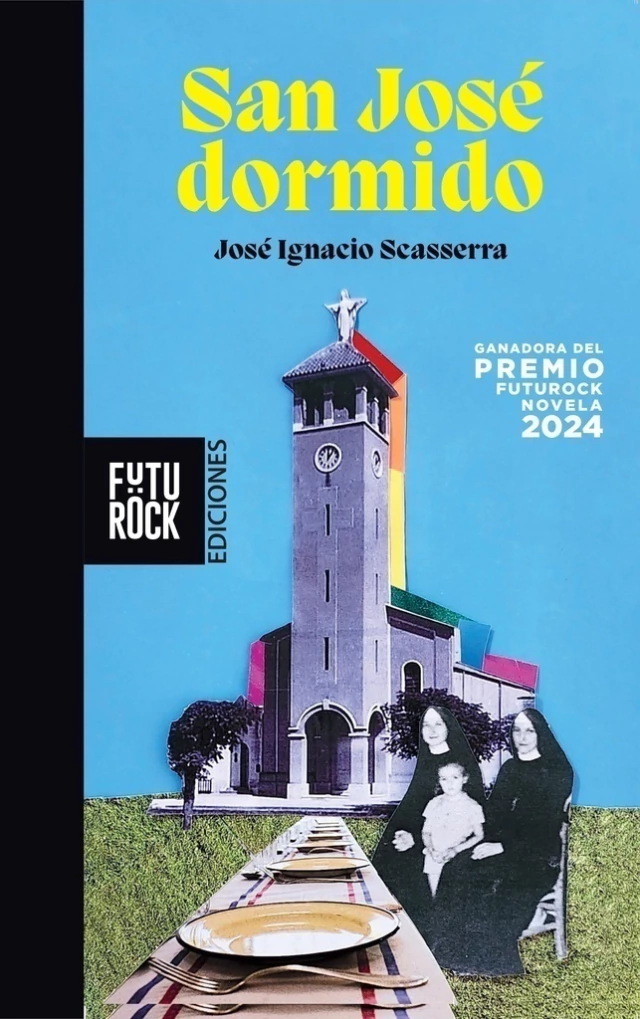
His novel San José dormido was awarded the Futurock Novel Prize 2024. Set during the pandemic, it explores encounter, faith, and coexistence within a powerful narrative microcosm: the convent. With its rules, silences, and religious imagery, it becomes both an oppressive and luminous setting where characters in crisis converge.
For audiovisual adaptation, the novel offers an almost theatrical staging and a growing tension that works as an emotional thriller. It is an intimate story with a strong emotional charge, ideal for a film or a short miniseries format.
AUDIOVISUAL POTENTIAL: TV Series, Miniseries, Film, TV Movie
AVAILABLE LANGUAGES: Spanish
Adquirir los derechos
Para ponerte en contacto con nosotros completa el siguiente formulario y te responderemos en breve.
