
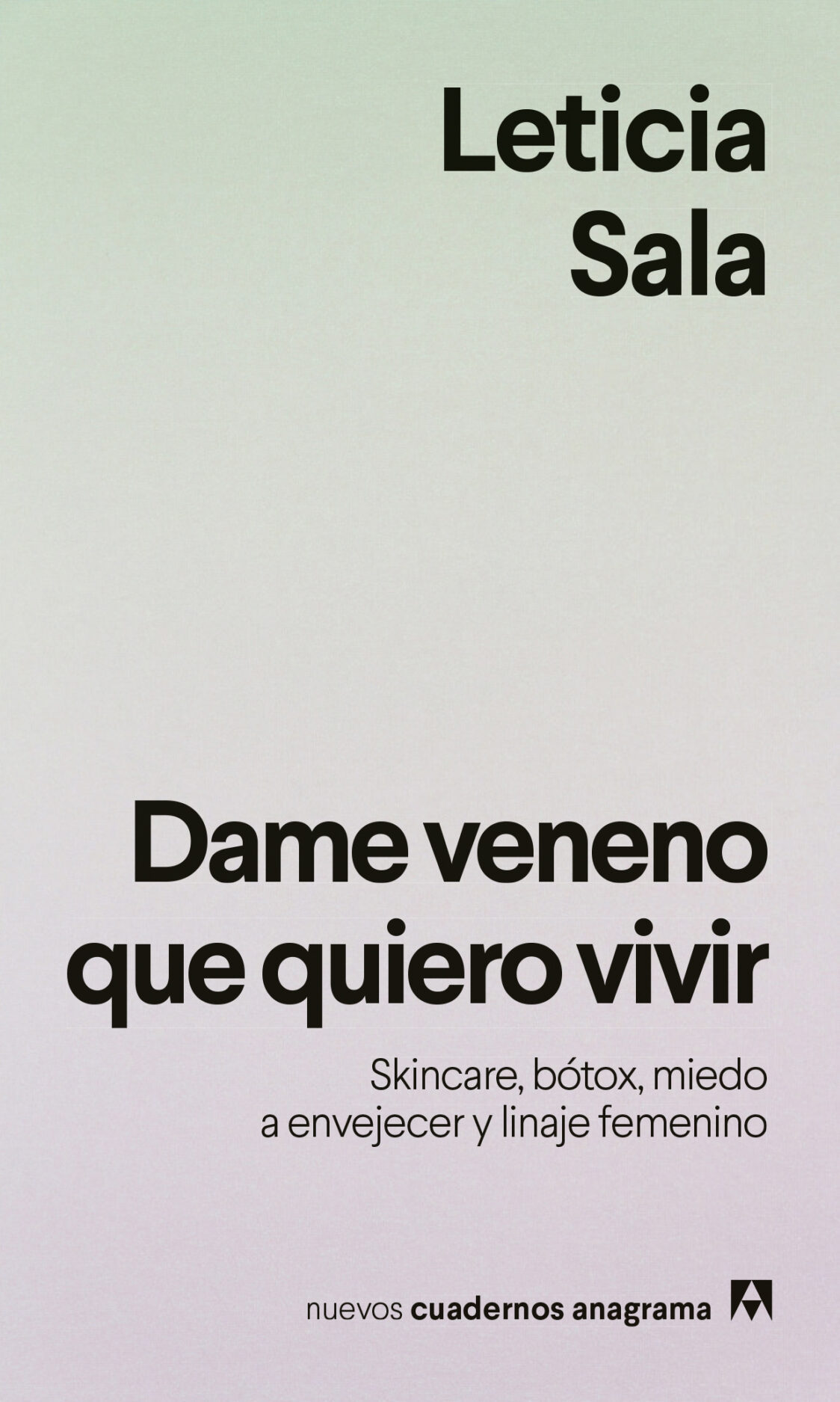
Drawing from her own experience in front of the mirror, Leticia Sala explores skincare as a cultural phenomenon that reflects some of the central tensions of contemporary female experience: beauty, feminism, motherhood, and fear of aging. A reflection on how we look at female skin and the expectations, pressures, and social meanings placed upon it.
Give Me Poison So I Can Live is a narrative essay about skincare as a social, political, and emotional phenomenon that encapsulates some of the major tensions of contemporary female experience: feminism, motherhood, generational inheritance, new beauty standards, visibility, and the fear of aging. The author begins with an intimate conflict: the desire to look good while simultaneously suspecting she is participating in and reproducing a system she did not choose.
The book begins in the author’s childhood, in her fascinated observation of her mother’s skin and care rituals, and moves toward the present, where it is now her own daughter who watches her in front of the mirror. From this point, Leticia Sala opens a reflection on how girls learn very early to observe, name, and monitor the female face. A seemingly simple question—why doesn’t the father use creams?—triggers an inquiry that goes beyond the domestic sphere and connects to broader cultural structures.
As she delves into the world of skincare, the author portrays a landscape in which endless routines, Botox, fillers, aesthetic clinics, and the language of self-care have become normalized to the point of near invisibility. The essay incorporates data on the expansion of the cosmetic industry and the inequalities generated by a market that moves enormous amounts of money, revealing the economic logics that sustain these standards.
One of the central axes of the book is Botox, analyzed as a cultural symbol, a toxic substance, and an emotional drug. Sala brings together studies and arguments about its impact on expressiveness, emotional recognition, and communication, and questions what this loss of facial language implies for social life, empathy, and relationships between mothers and children. The result is also a reflection on how an increasingly homogeneous beauty is produced and imposed.
The essay also addresses the early influence of skincare on girls, the aesthetic violence exercised by certain medical and commercial discourses, and traces a genealogy of beauty ideals through their poisons, fashions, and emblematic figures.
In its final section, the book opens into a philosophical and anthropological reflection on female aging and the right to be seen. In contrast to a culture that marginalizes older women, Leticia Sala argues for restoring their visibility, authority, voice, and a beauty of their own. An essay that fundamentally questions not only how we look at skin, but what system of values is activated in doing so.
RELEVANT INFORMATION: Leticia Sala is a Spanish writer and poet, recognized as one of the most distinctive voices in contemporary narrative and poetry emerging from the digital era. She has published several short story collections and a novel, and her writing is characterized by an intimate perspective on love, identity, and everyday life in contemporary society.
Give Me Poison So I Can Live is an essay with strong potential to become a documentary about a deeply contemporary issue: the culture of self-care and the cosmetic industry. The project could also explore the role of social media and how it fuels a persistent sense of aesthetic inadequacy across all ages.
From an intimate, sensory, and feminine perspective, the documentary would aim to open a deeper conversation that goes beyond mere critique. Through the author’s voice and a diversity of testimonies, the narrative would intertwine with current debates on feminism, aging, mental health, and wellness capitalism.
AUDIOVISUAL POTENTIAL: TV Series, Miniseries, Film, TV Movie
AVAILABLE LANGUAGES: Spanish
Adquirir los derechos
Para ponerte en contacto con nosotros completa el siguiente formulario y te responderemos en breve.
