
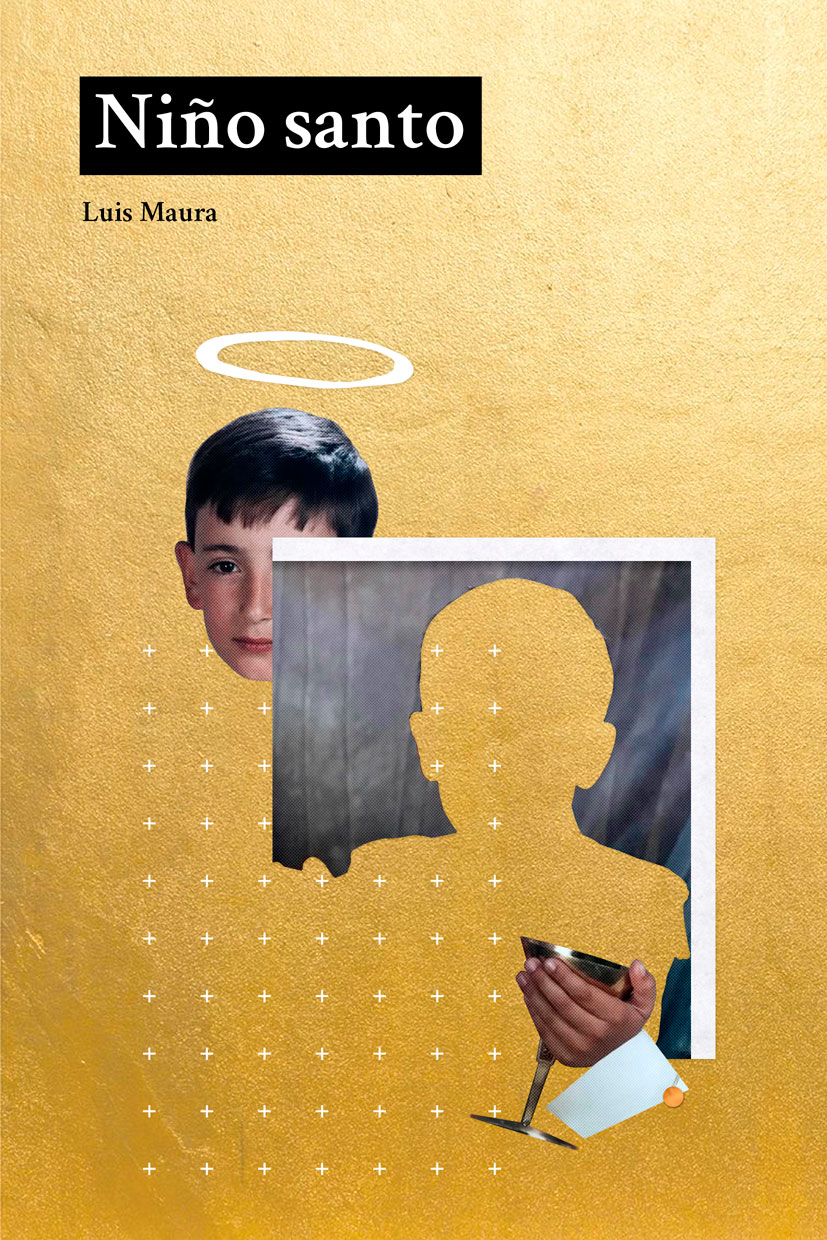
While his classmates dream of becoming footballers or astronauts, Pedro, an eleven-year-old boy, dreams of becoming a saint. Encouraged by his deeply Catholic mother, his faith becomes his only refuge from school bullying and his father’s violence. But when he begins to feel attracted to the boy who humiliates him in public, his life falls apart.
Pedro is a sensitive boy growing up in a small village in Toledo during the 1990s. He lives in a household marked by constant tension between his parents: his mother, María, deeply religious, finds comfort in faith, while his father, Santiago, a violent carpenter, despises the Church and everything it represents. Pedro feels closer to his mother and, from a very young age, develops an obsession: he wants to become a saint.
In the church, he finds a refuge. He becomes an altar boy and begins to spend most of his time there, assisting at Mass and learning every gesture of the ritual. Religion gives him a framework to understand the world, but it also introduces him to a logic of guilt and sacrifice. Before the Christ of Humility—a life-sized sculpture with a semi-nude, wounded, exposed body—Pedro experiences a fascination he cannot name: a mix of devotion, tenderness, and an emerging physical attraction that unsettles him.
At school, the situation is very different. His classmates—especially Diego, Antonio, and Mario—detect his difference and turn him into a target of mockery and aggression. At first they call him “altar boy,” but soon the insult escalates to “faggot.” They surround him in the playground, push him, and humiliate him publicly. Pedro does not respond: he learns to accept pain as part of his calling. If he wants to be a saint, he must suffer. The bullying stops being occasional and becomes a routine that gradually erodes his identity.
His only safe space is the attic of his house, a secluded room filled with old religious frescoes. There, he plays at being a saint, organizes his holy cards as if they were relics, and builds a world of his own, isolated from the outside. That balance breaks when he discovers his brother Lucas’s pornographic magazines. For the first time, he is confronted with explicit images of male bodies. Arousal appears immediately, but so do fear and guilt: he feels he has crossed a boundary incompatible with the sanctity he seeks.
The summer he turns twelve marks a turning point. Mario, one of the boys who bullies him at school, appears in the church as a new altar boy, sent by his parents to correct his behavior. His presence invades the only space where Pedro felt safe. Their relationship becomes ambiguous and contradictory: in public, Mario continues to humiliate him; in private, he begins to seek him out, to get close to him, in a tension-filled proximity Pedro cannot decipher.
During a stormy night, in the church bell tower, that tension erupts. Isolated from the world, surrounded by wind and rain, Mario kisses Pedro and they engage in a furtive sexual encounter. For Pedro, the moment is deeply transformative: on one hand, it confirms what he is beginning to understand about himself; on the other, he experiences it as an intolerable transgression, a betrayal of God. The experience leaves him trapped between desire, confusion, and guilt.
At the same time, his family life collapses. His mother falls ill with cancer and her condition rapidly worsens. The illness fills the house with an atmosphere of waiting and pain. Desperate, Pedro turns to faith more intensely than ever and makes a promise to the Virgin: he will renounce his feelings and any desire if his mother survives. However, reality prevails, and the disease progresses relentlessly.
The situation explodes when Lucas discovers one of the encounters between Pedro and Mario and decides to tell their father. That same night, Santiago—drunk and overwhelmed by rage and grief—confronts Pedro. The scene becomes an explosion of violence: he repeatedly beats him with a belt while shouting “faggot,” unloading all his contempt and frustration onto him. The assault only stops when the mother, already very weakened, intervenes to protect him. Shortly after, she dies.
His mother’s death definitively shatters Pedro’s world. Faith, which until then had sustained him, loses all meaning. He feels betrayed by God. In an act of rupture, he destroys all his holy cards and abandons any religious aspiration. He is left without refuge: without his mother, without faith, without a safe place in his own home.
Faced with this situation, his teacher, Miss Mari Sierra, intervenes and secures him a scholarship to the seminary in Toledo. The proposal appears as a way out: a place to start over, far from his father. Pedro accepts, not out of vocation, but out of the need to escape. During the journey, he clings to an idea that helps him endure the change: he imagines that Mario will also be there, that they will reunite, and that, far from the village, their relationship might exist without the violence that defined it.
That expectation is shattered on the first day.
At the seminary, Pedro is received by a group of older students who organize a hazing ritual. The situation quickly turns into a brutal assault: they take him to the showers, strip him by force, beat him, and subject him to sexual touching and abuse amid laughter. The scene takes place in a closed space, with no escape. Among the aggressors is Mario, who not only fails to defend him but actively participates, sealing both the humiliation and the betrayal.
Pedro is left lying on the floor, completely broken, physically and emotionally. Mario’s betrayal destroys the last emotional bond he clung to. In that state, he is found by Father Rufino, who takes him to his room, cares for him, and stays by his side while he sleeps.
In that final moment, Pedro experiences one last gesture of comfort. In his mind, his mother appears, kisses him, and whispers that he will be able to go on. It is not a full recovery or clear redemption, but a minimal point of support.
Pedro ends up completely devastated, but alive. He has lost his faith, his family, and the only person he had loved. And yet, for the first time, he finds a way to tell what has happened to him.
KEY INFORMATION: Luis Maura is a Spanish writer, actor, and teacher. His work explores identity, memory, and queer experience in rural settings. Throughout his career, he has received several awards, including first prize in the Young Artists competition of Cáceres (2010) and third prize in the II Pocket Theatre Festival (2018).
Holy Child is a story about bullying, religion, guilt, and sexual awakening that reflects on the search for identity in rural environments, the influence of family in childhood, and masculinity. With strong audiovisual potential, the book offers a raw and sensory portrayal of rural Spain: the enclosed spaces of the church and attic, the harshness of the Manchego landscape, and the quiet violence of family relationships find in cinematic language a perfect vehicle to convey the tension between repression and awakening, between the sacred and the profane, that runs throughout the work.
AUDIOVISUAL POTENTIAL: TV Series, Miniseries, Film, TV Movie
AVAILABLE LANGUAGES: Spanish
Adquirir los derechos
Para ponerte en contacto con nosotros completa el siguiente formulario y te responderemos en breve.
