
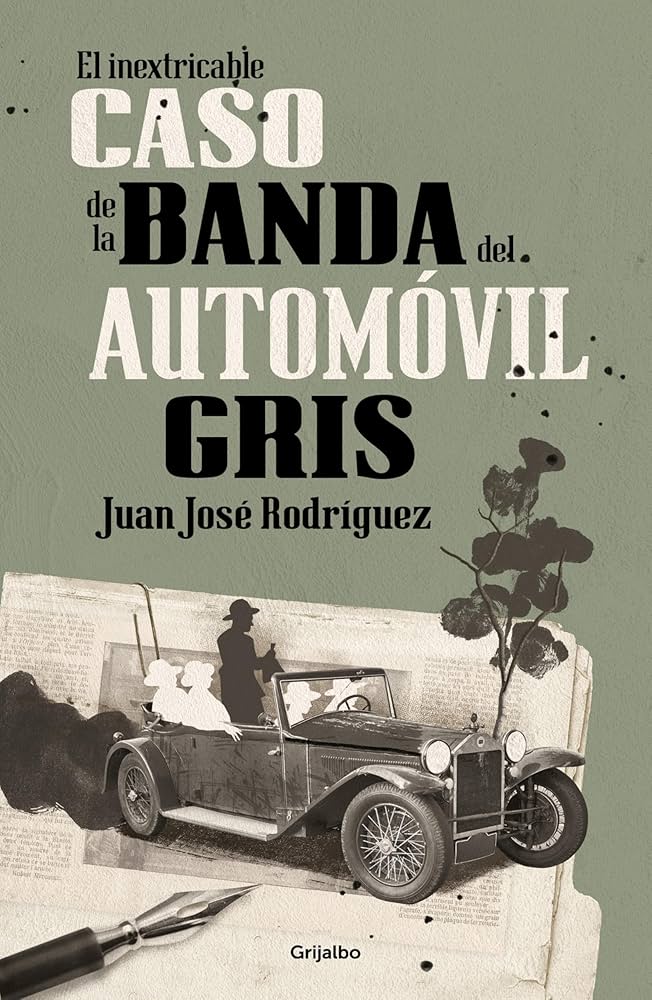
Mexico, 1915. In the midst of the Mexican Revolution, a gang of robbers terrorizes the country aboard a gray Lancia Torpedo. Corrupt generals protect them in exchange for a share of the loot. One hundred years later, two journalists uncover this true story of conspiracies and unpunished crimes — and reveal a chilling truth: organized crime was born at the very heart of the political, social, and cultural system. Who protects the thieves when the thieves are the system itself?
In present-day Mexico City, a young journalist arrives hoping to make a name for himself in the cultural world. But his plans change completely when he discovers a set of forgotten diaries belonging to his great-grandfather, Francisco Versolari, hidden away in his aunt’s house. Written during the years of the Mexican Revolution, the journals recount the story of a criminal gang that terrorized the capital aboard a gray automobile — one of the country’s first modern organized crime syndicates. Captivated by the power of the story, the journalist decides to investigate further, convinced that behind this seemingly distant episode lies the origin of a form of violence that still defines Mexico today.
The diaries begin in 1913, amid the chaos of the Decena Trágica. A group of criminals escapes from Belén prison during the bombardments rocking Mexico City. Among them are figures who will soon become legends of a new kind of crime: Higinio Granda, an ambitious leader; El Pifas, an expert safecracker; and several ruthless men capable of exploiting the collapse of public order.
Two years later, in a capital dominated by political instability and constantly shifting military factions, the gang perfects a method built on audacity and impersonation. Posing as soldiers and carrying forged search warrants, they raid the homes of the wealthy elite, carrying out systematic robberies under the guise of official operations. Their automobile allows them to strike quickly and disappear just as fast, introducing a new criminal logic based on mobility, planning, and impunity.
But the gang’s true power lies not in its ingenuity, but in its relationship with the authorities. High-ranking military officers and government officials quietly support the robberies in exchange for a percentage of the loot, turning the gang into an unofficial extension of the political system itself. The stolen money circulates through elite circles — even within the entertainment industry — exposing a world where crime, politics, and culture operate hand in hand.
As the gang’s operations grow bolder, public pressure mounts. Eventually, after a robbery targeting an influential figure, the government decides it needs to stage justice. Some gang members are captured and executed; others die under suspicious circumstances. Witnesses capable of implicating powerful officials are silenced. The case is officially closed without uncovering the real chain of responsibility, cementing a culture of impunity that will endure for generations.
In the present day, the journalist reconstructs the story with the help of a fellow reporter who uncovers new leads — particularly involving an actress and producer tied to political power. Together, they discover that the story of the gang was adapted into a film almost immediately after the events, a production backed by political interests designed to manipulate public perception and sanitize the reputations of those involved. Their investigation reveals not only that the crimes themselves were covered up, but that the official narrative surrounding them was carefully manufactured, establishing an early precedent for the relationship between power, media, and the construction of truth.
As the investigation deepens, the line between past and present begins to blur. The journalist encounters a descendant of the gang who seems to possess an unusually detailed memory of the events, but his sudden disappearance suggests that the same violent structures are still operating today. The final clue leads to a hidden cache containing the gang’s original loot, preserved for decades alongside documents explaining how their descendants survived thanks to that fortune — confirming that the network never truly disappeared.
The story ultimately argues that the Gray Automobile Gang is not merely a historical episode, but the blueprint for a system that continues to this day: an alliance between organized crime and political power, sustained by corruption, violence, and the manipulation of public narratives. The names, vehicles, and circumstances may change, but the machinery remains intact, turning this revolutionary-era story into a key to understanding modern Mexico.
RELEVANT INFORMATION: Juan José Rodríguez Ramos is a Mexican author whose work blends literary fiction with elements of urban realism and investigative intrigue. Throughout his career he has received major literary recognitions, including the Gilberto Owen National Short Story Prize and the prestigious Mazatlán Prize for Literature.
El inextricable caso de la banda del automóvil gris (The Inextricable Case of the Gray Automobile Gang) combines historical investigation, chronicle, essay, and fiction. The novel is based on real events documented through diaries, archives, and newspaper reports from the period. Beyond reconstructing a nearly forgotten episode, the story draws a direct parallel between the corruption and violence of revolutionary Mexico and those of the present day.
Its dual timeline — alternating between revolutionary-era Mexico and a contemporary journalistic investigation — provides a rich narrative structure filled with political intrigue, criminal conspiracies, and morally complex characters. The result is a story with clear audiovisual potential, positioned somewhere between a political drama and an investigative thriller.
AUDIOVISUAL POTENTIAL: TV Series, Miniseries, Film, TV Film.
AVAILABLE LANGUAGES: Spanish.
Adquirir los derechos
Para ponerte en contacto con nosotros completa el siguiente formulario y te responderemos en breve.
