
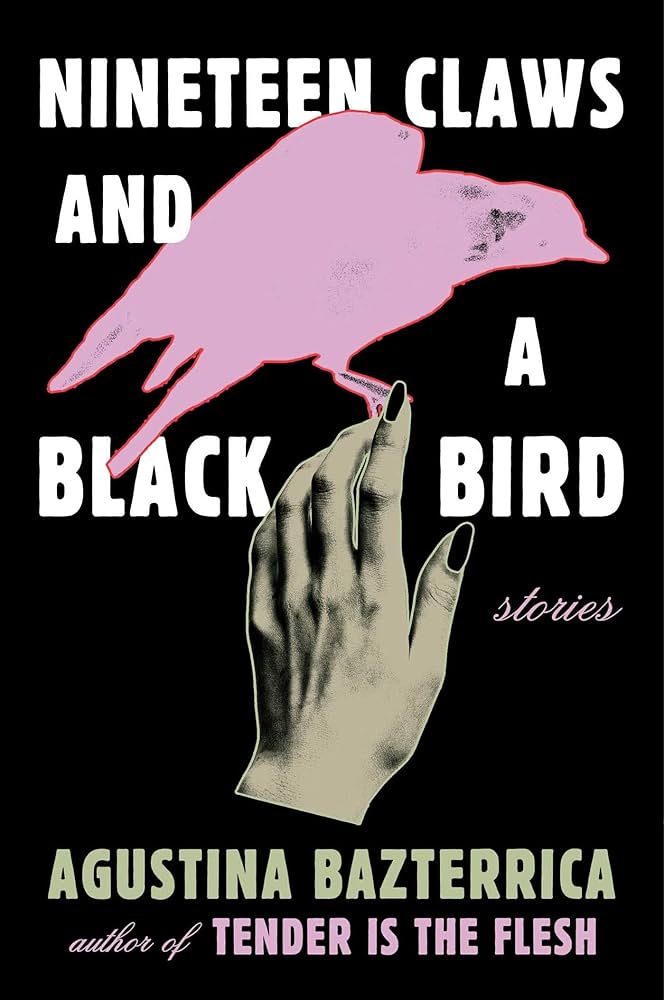
Argentine bestselling author Agustina Bazterrica turns paranoia, repressed desires, and intimate traumas into disturbing nightmares, populated by characters who cross—without resistance—the boundary between the real and the monstrous. Nineteen fierce stories that reveal just how strangely familiar the abyss can feel.
With nineteen stories that move with surgical precision from the most visceral horror to the most corrosive humor, Agustina Bazterrica immerses us in a universe where everyday fears twist into something unrecognizable and delirious fantasies turn into nightmares of terrifying clarity.
Her stories relentlessly question love, friendship, and family bonds, while exposing those unspoken desires we prefer to keep hidden. Every page invites the reader to peer into the abyss of the absurd and the macabre.
In Unamuno’s Boxes, a woman gets into a taxi whose driver, Pablo Unamuno, has such perfectly manicured nails that they unsettle her. She observes every detail of the vehicle—the pink pacifier, the bracelet with the name Amanda, the obsessive cleanliness—and as he drives, she begins to construct a sinister fantasy: she imagines Unamuno as a serial killer who cuts his victims’ nails and stores them in transparent boxes. In her mind, she even envisions a meticulous ritual involving Amanda, whom he would have cared for and beautified before killing.
When they arrive, the woman pays with deliberate slowness. A coin falls between the seats, into a lidded compartment. Unamuno opens it to retrieve it, revealing its contents: manicure tools and two transparent boxes. The moment seems to confirm her suspicions, though the objects could also have a perfectly normal explanation.
Instead of fleeing, the protagonist reacts unexpectedly: she grabs the driver’s arm and orders him to start driving and take her “where he knows.” The story transforms everyday paranoia into a voluntary surrender to horror, with sharp dark humor and a protagonist who chooses to cross the line.
In Roberto, a girl tells her friend Isabel that she has a black rabbit between her legs, whom she calls Roberto. Isabel—foolish and treacherous—tells their teacher, Mr. García. He calls the girl in alone, kisses her, tells her she is the prettiest, and asks her to show him the rabbit. Despite her shame, he lifts her skirt and lowers her underwear. Then he sees Roberto. The rabbit moves its ears and bares its teeth. Terrified, Mr. García runs away. The girl remains still, and Roberto falls asleep again.
In Rosa Bombón (Candy Pink), a woman abandoned by her lover follows a series of destructive steps to process her pain. First, she smashes a reproduction of Sunflowers and throws the Mona Lisa out the window. Then she burns photos of the couple in the microwave, boils a lucky cat figurine, and writes on the mirror in red nail polish: “I love you, miserable and beautiful dog.”
She calls her ex repeatedly until a female voice answers and he says: “Come on, love, give me the phone, little ant.” She hangs up slowly. She decides it’s time. She takes the revolver he once gave her and places it against her temple. In the instant the bullet pierces her skull, she imagines a pink calm—cotton-candy pink.
In Tierra (Land), Camila stands over her father’s grave in the cemetery. Her mother has left her there after burying him. Camila remembers how her father forced her to stay still for hours, how he entered her room, and how he made her mother cry.
One day, her mother left insect poison on the kitchen table. Camila put three spoonfuls into a glass of wine and gave it to her father. He drank it in one gulp, clutched his throat, turned red, screamed, and dropped dead.
Now, at the cemetery, her mother spat at her, climbed onto the cart, and left without looking back. Camila knows she will not return. The sun burns her body. She slowly buries herself with her own hands: first her legs, then her arms, until red ants crawl across her eyes. She is getting closer to her father.
In The Lonely (Las solitarias), a woman runs on December 31 to catch the last subway of the night. The downtown streets are empty. She manages to board just as the doors close. The carriage is completely empty.
At one station, a man smelling of wine boards, dressed in a torn black suit. He sits across from her, stares intensely, and says: “They are waiting for you.” Then he gets off.
The subway continues, but as it passes two closed stations, the lights go out and the train stops. The woman steps down onto the tracks and walks in total darkness until she finds a sealed station. She climbs onto the platform and sees two figures sitting at the edge: two men with their backs turned, so pale they glow in the dark. They turn their heads, look at her, and open their mouths as if a scream were trapped inside. Then she knows—they are the ones who were waiting. There is no escape.
These are just five of the nineteen stories that make up Nineteen Claws and a Dark Bird. The rest continue exploring the same veins of intimate horror, dark humor, and a discomfort that settles deep into the bones. Bazterrica offers neither comfort nor moral lesson—only nineteen doors leading to the same place: that unsettling space where the ordinary decays and the monstrous becomes strangely familiar.
RELEVANT INFORMATION: Agustina Bazterrica is an Argentine writer and author of the global bestseller Tender Is the Flesh, which has had dozens of editions in the United States and has been translated into more than 20 languages. The Unworhty is her latest novel, and both works are currently being adapted for audiovisual formats.
She has received more than thirty awards for her distinguished literary career since 1998, including the Premio Clarín de Novela and the Ladies of Horror Fiction Awards.
Nineteen Claws and a Dark Bird has a structure perfectly suited for the anthology format: each story is a self-contained unit with imagery that is as powerful as it is disturbing. Bazterrica’s narrative, which alternates visceral horror with pitch-black humor, translates naturally to audiovisual storytelling. Its potential is immense—from an anthology series to a feature film interweaving the stories through shared atmospheres.
Critical acclaim:
“These stories, marked by a sense of strangeness and unease, take us to the heart of our fears, our darkest fantasies, and the sharpest humor. Texts that question love, friendship, family relationships, and unspoken desires.” — Carlos Castrosín, Qué Leer
“With both rawness and sensitivity, she compels readers to confront what usually remains hidden, confirming her place as one of the most powerful voices in contemporary Spanish-language literature. She writes and speaks without anesthesia.” — Rosa Sánchez de la Vega, El Cultural
“A journey into the darkest humor and wildest fantasies led by one of the most genuine contemporary figures in Spanish-language literature.” — Esther Ferrero, Efecto Doppler (Radio 3)
AUDIOVISUAL POTENTIAL: TV Series, Miniseries, Film, TV Film.
AVAILABLE LANGUAGES: Spanish, English, Portuguese, Dutch, Czech.
Adquirir los derechos
Para ponerte en contacto con nosotros completa el siguiente formulario y te responderemos en breve.
