
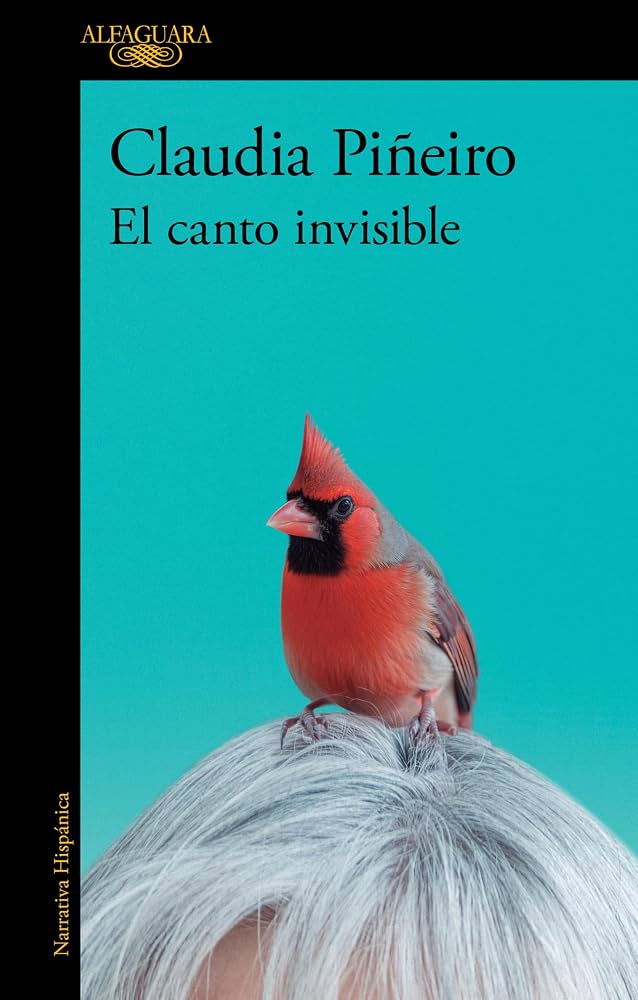
An editor’s final promise to her best friend becomes a journey into a hidden past. When 64-year-old Julia sets out to complete the unfinished manuscript of a celebrated ornithologist about birdsong, she begins to uncover secrets that force her to question whether she ever truly knew the woman she loved most. Through birds, family secrets, and wounds buried for decades, the novel builds a deeply emotional drama about friendship, memory, and the different ways of listening, even to those who remain silent. Following international successes such as Elena Knows, Thursday Night Widows, and All Yours, Claudia Piñeiro once again demonstrates her extraordinary ability to transform intimate conflicts into universal stories.
Following the tragic death of her best friend, a 64-year-old editor retreats to a country house she has inherited in order to complete the last book they worked on together. What begins as an attempt to honor her friend’s memory gradually becomes the discovery of a secret capable of forever changing the meaning of their friendship.
Julia Muntaner and Marina Martinelli shared more than forty years of friendship, books, and confidences. When Marina, a renowned ornithologist specializing in bioacoustics, is killed in a traffic accident after a political argument in the street, Julia is devastated. As her final wish, Marina leaves her a country estate on the outskirts of Buenos Aires and the responsibility of completing the book she had spent years writing: an essay on birdsong.
Living alone on the property, Julia begins editing the manuscript. She soon realizes, however, that she is reading far more than a scientific book. Through her research on birds, Marina reflects on the difference between hearing and listening, on invisible voices, and on the necessity of paying attention to what the world chooses to ignore. Little by little, Julia understands that the book was never really about birds alone. Marina was writing, without ever saying so directly, about herself.
As she navigates her grief, Julia becomes acquainted with Sandro, the man responsible for maintaining the estate. His connection to Marina appears far too deep to have been merely professional. Convinced that the two shared a secret love affair, Julia begins to feel betrayed by a friend who seemingly concealed a crucial part of her life.
At the same time, Julia must deal with Santino, her teenage grandson, whose fascination with digital business ventures, financial influencers, and a radically different worldview places him at odds with everything she and Marina believed in. The conflict becomes even more painful when Julia discovers that Santino was present on the day of Marina’s death and was part of the group of young people with whom she argued shortly before the accident.
As the manuscript progresses and the generational divide becomes increasingly apparent, Julia finds herself obsessed with a single question: who was Sandro really to Marina?
The answer arrives at the end and transforms the entire story.
Sandro was not Marina’s secret lover.
He was her son.
At the age of sixteen, Marina became pregnant by a boy she never saw again. Her parents forbade her from having an abortion and forced her to hide throughout her pregnancy in the very same country house Julia now inhabits. After giving birth, she was compelled to surrender the baby through a clandestine adoption arranged by her family. Years later, mother and son managed to find each other again, reconstructing the truth and forging a relationship impossible to define, marked by silence, loss, and the mutual understanding of having lived lives that never entirely belonged to them.
The revelation forces Julia to reevaluate a lifetime of shared memories. She comes to understand that the woman who dedicated her career to studying birdsong never found the courage to give voice to her own story. She also regrets that even she, Marina’s closest friend, failed to perceive, or truly listen to, what Marina had kept hidden.
Once the manuscript is complete, Julia stops searching for answers and begins imagining the future. She rebuilds her relationship with Santino, reconciles herself with Marina’s memory, and transforms the country estate from a place of grief into a space of connection. Finally, just before returning to the city, she immerses herself in the water of an old Australian tank and listens to the song of a thrush. For the first time since her friend’s death, she is no longer editing, investigating, or questioning.
She is simply listening.
RELEVANT INFORMATION: Claudia Piñeiro (Argentina, 1960) is one of the most internationally successful and widely translated bestselling authors in the Spanish-speaking world, as well as a screenwriter and playwright. Several of her novels have been adapted for film and television, becoming major successes. Among the most notable adaptations are Cathedrals, Thursday Night Widows, El tiempo de las moscas, The Kingdom, Elena Knows, and Betibú.
Throughout her career, she has received numerous awards, including the Clarín Prize, the Latin American Prize for Children’s and Young Adult Literature, and the Pléyade Prize. She has also been a finalist for the Planeta Argentina Prize and the La Sonrisa Vertical Prize, and was selected in the Edebé Publishing Competition.
The Invisible Song combines emotional drama, intimate mystery, and generational conflict to build a story about what remains hidden even between people who love each other deeply. The novel explores how friendship can transcend absence, how secrets shape entire lives, and how listening can become an act of empathy and healing. Audiovisual references include The Lost Daughter and Mare of Easttown, both for their portrayal of women over sixty marked by contradictions, past wounds, and profound emotional complexity, and for their ability to transform intimate conflicts into stories with universal resonance.
AUDIOVISUAL POTENTIAL: TV Series, Limited Series, Feature Film, TV Movie.
AVAILABLE LANGUAGES: Spanish.
Adquirir los derechos
Para ponerte en contacto con nosotros completa el siguiente formulario y te responderemos en breve.
