
When celebrated Chilean writer Carmen Ávila vanishes without a trace, Rosa Alvallay, a 54-year-old private investigator marked by exile and the wounds of the past, takes on a case that soon becomes a labyrinth of secrets, contradictions, and old scars. But the deeper she delves into the writer’s life, the more she suspects that behind her disappearance lies a truth that no one seems willing to accept.
On November 26, 1997, Chilean writer Carmen Ávila disappears after attending the Miami Book Fair. She leaves no trace behind. Unable to find any answers, the police eventually close the case. Her husband, Tomás Rojas, a prestigious university rector, is convinced she has been kidnapped by Colombian guerrillas. Refusing to accept uncertainty, he hires Rosa Alvallay, a Chilean private investigator. What begins as the search for a missing woman gradually evolves into something far more complex: the portrait of a woman shaped by loss, violence, and a desperate need to escape.
As Rosa advances in her investigation, she discovers that no one truly knew Carmen. Every person who was part of her life offers a different version of her. Tomás insists she is still alive; her stepdaughter believes she simply chose to leave. The family’s housekeeper remembers a reserved woman who spent hours locked away in her study and seemed detached from the intense social life her husband tried to impose upon her. A writer friend reveals that Carmen hated Pamela Hawthorne, the famous heroine of her novels, even though the public often confused the two. The inevitable question emerges: who was this admired author, beloved by thousands of readers and yet unable to endure her own life?
To answer it, Rosa reconstructs Carmen’s past from the very beginning and uncovers a life marked by abandonment and violence. After being abandoned by her parents, Carmen spent her childhood with her grandmother in southern Chile. At the age of eleven, she witnessed one of her aunts murder the elderly woman. Shortly afterward, a paternal aunt took her to San Francisco, tearing her away from the only home she had ever known. As an adult, she settled in Mexico, where she fell in love with Santiago Blanco, a married writer with whom she had a son, Vicente. Santiago never left his family. Carmen eventually returned to the United States, where she became the victim of a brutal gang rape that drove her to attempt suicide. After surviving, she returned to Chile, married Tomás, and managed to regain custody of Vicente. Yet the stability she seemed to have found soon revealed its fragility. Tomás repeatedly cheated on her, often with people close to her. Behind the image of success and recognition was a woman trapped in a life from which anyone would want to flee.
The investigation takes a decisive turn when Rosa realizes that Santiago was the great love of Carmen’s life and that the kidnapping theory is nothing more than a false lead. Following this intuition, she travels to Mexico and locates the writer in Oaxaca. There she finds a blue-walled house occupied by a woman named Lucía Reyes. Inside are Chilean medications, a novel inscribed with intimate words, and a computer containing an unfinished manuscript. The scars on her wrists and her altered voice finally confirm what has become impossible to deny:
Lucía is Carmen.
The writer had seized an unexpected twist of fate to reinvent herself. After surviving a plane crash in Guatemala, she interpreted the experience as an opportunity to begin again. Following the Miami Book Fair, she traveled to New York using false documents, altered her appearance, and settled in Oaxaca. Santiago helped her disappear and bought a house nearby. Carmen abandoned her name, her fame, her marriage, and even her country in order to escape, once and for all, everything that was suffocating her.
Rosa then understands that revealing Carmen’s whereabouts would mean taking away the freedom she had fought so hard to achieve. Instead, she destroys every note that could lead anyone to her and lies to Tomás, claiming she has found evidence linking Carmen voluntarily to a guerrilla group.
Upon returning to Chile, Rosa decides to transform the entire experience into a novel. While the world continues to wonder what happened to Carmen Ávila, the writer lives quietly in her blue house, far removed from the woman she once was and, for the first time in her life, at peace with herself.
RELEVANT INFORMATION: Marcela Serrano is a Chilean writer and visual artist, regarded as one of the most important voices in Latin American literature since the 1990s. Her work is characterized by a strong feminist perspective and explores relationships between women, female identity, memory, and the social and political tensions of Latin America.
The author of twelve novels, she won the Sor Juana Inés de la Cruz Prize in 1994 for Those Who Love Each Other So Much (Nosotras que nos queremos tanto), received the Santiago Municipal Literature Prize, and was a finalist for the Planeta Prize. Her works have been translated into numerous languages and several have been adapted for film.
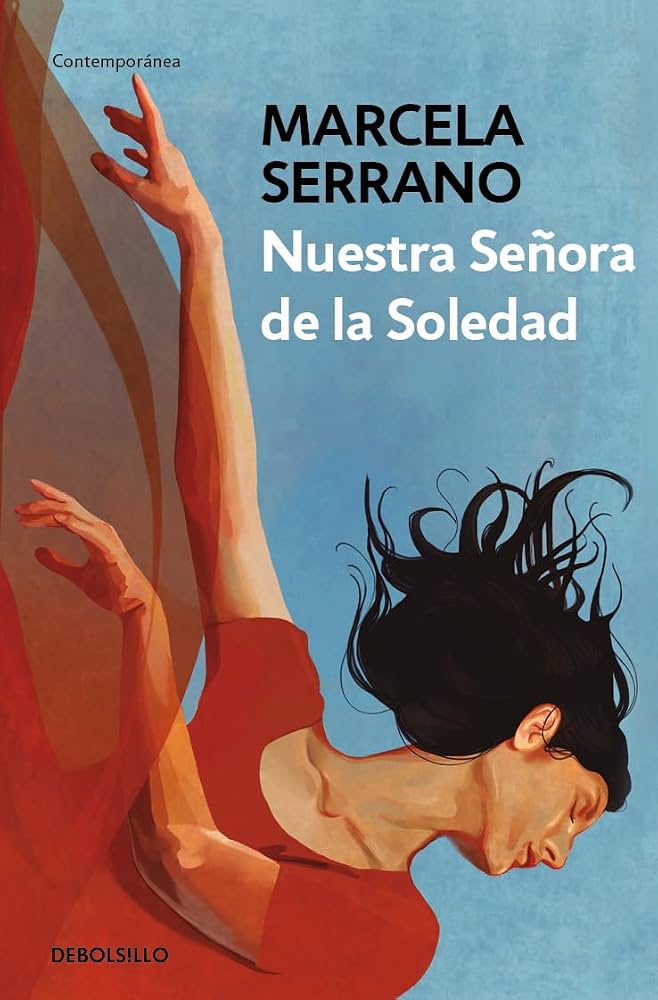
Our Lady of Solitude is a crime novel that gradually reconstructs the past of a woman marked by trauma, loneliness, and a desire to disappear. Through a structure that combines investigation, testimony, memories, and travel, the novel intertwines mystery and introspection, maintaining suspense until its conclusion.
Its melancholic atmosphere, richly rendered settings, and complex protagonist give it remarkable audiovisual potential, both as a suspense-driven limited series and as a visually and emotionally powerful feature film.
AUDIOVISUAL POTENTIAL: TV Series, Limited Series, Feature Film, TV Movie.
AVAILABLE LANGUAGES: Spanish, Portuguese, Italian, German, Greek, Chinese, Russian.
Adquirir los derechos
Para ponerte en contacto con nosotros completa el siguiente formulario y te responderemos en breve.
