
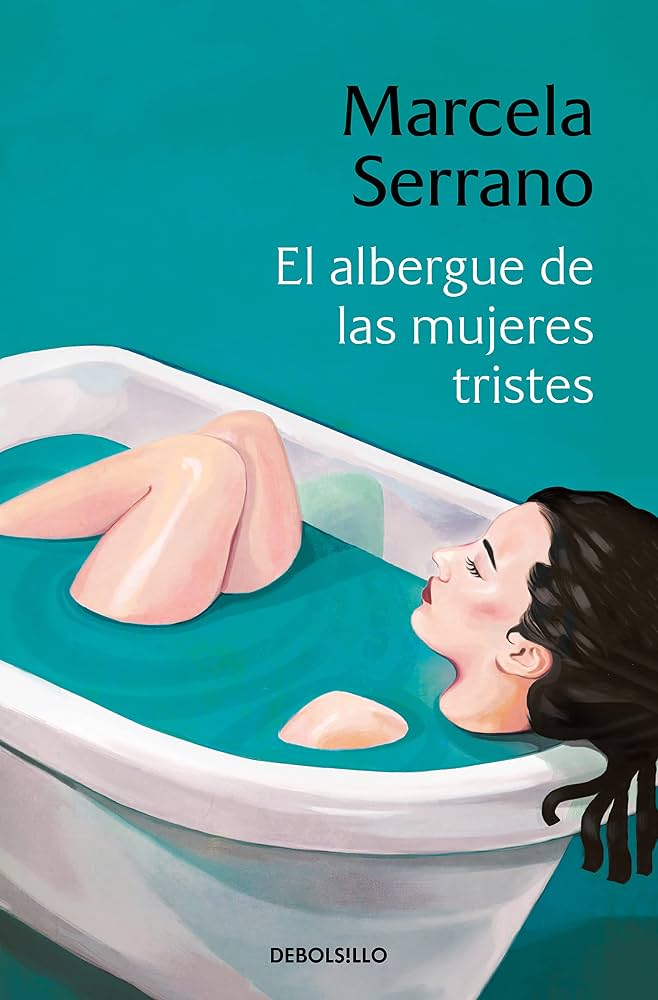
On a remote island, a unique refuge brings together women seeking to heal the wounds left by love. Floreana arrives carrying the weight of her sister’s death and an impossible romance, hoping to rebuild her life. But an unexpected love affair will force her to choose between protecting herself from pain or risking everything for love once again. One of the most beloved novels by Marcela Serrano, one of the great voices of Latin American literature.
Following the death of her sister Dulce and a painful romantic breakup, Floreana, a forty-year-old Chilean historian, travels to a remote island in southern Chile in search of a place where she can recover from the sadness that has gradually taken over her life. There she arrives at the Shelter for Sad Women, an unusual community founded by Elena, a renowned psychiatrist who abandoned the comforts of her former life to dedicate herself to helping women facing emotional, family, or personal crises. Over the course of several months, the residents live together, share their experiences, and try to understand the wounds that brought them there.
Among the nearly twenty women living at the Shelter, Floreana meets Constanza, an economist trapped for years in a clandestine affair with a married man; Toña, an actress struggling with the aftermath of addiction and a complicated relationship with her mother; and Angelita, a wealthy and seemingly self-assured woman who has just discovered her husband’s infidelity. Despite their differences, all of them share a profound sense of loss and disenchantment. Listening to their stories, Floreana realizes that the suffering that brought her to the island is not unique. Gradually, she begins to question the ideas about love, emotional dependency, desire, and loneliness that have shaped her life.
The women’s conversations reveal failed marriages, destructive relationships, abandonment, romantic obsessions, and impossible expectations. For Floreana, other people’s pain becomes a mirror. As the weeks pass, she comes to understand that her time on the island is not about forgetting the past, but about discovering who she is beyond the romantic relationships that have defined much of her identity.
During one of her visits to the nearest village, she meets Flavián Barros, the doctor who cares for the island’s inhabitants. Intelligent, attractive, and reserved, Flavián has spent years hiding there after the collapse of his marriage and a personal crisis that drove him away from city life. An immediate connection develops between them, fueled by long conversations and growing emotional intimacy. Floreana discovers a vulnerable man beneath his calm exterior, while Flavián finds in her a level of understanding he believed he had lost forever.
Their relationship deepens when Floreana accompanies Flavián on a journey to another settlement in the archipelago to respond to a medical emergency. Forced to spend more time together, they share memories, fears, and wounds they had long kept hidden. Their attraction becomes increasingly evident, reaching a point of no return during a local festival, where they dance together and finally allow feelings they had tried to suppress to emerge. Yet the intensity of the experience also awakens Floreana’s fears, and she begins to suspect that she may be on the verge of repeating the mistakes of her past.
At that moment, Elena reveals an unexpected truth: years earlier, she herself had been deeply in love with Flavián. Although they shared an important relationship, they were never able to build a life together because he was incapable of fully committing. Over time, they transformed their love into friendship, but Elena remains convinced that Flavián still lives under the shadow of his fear of loss. The revelation fills Floreana with doubt and leads her to wonder whether her own story is destined to end the same way.
Convinced that the relationship has no future and terrified of being hurt again, Floreana decides to leave the Shelter before completing her stay. When the time comes to say goodbye, Flavián finally breaks his customary reserve: he kisses her and asks her to stay. Yet almost immediately, he withdraws his words. Unable to overcome his contradictions and frightened by the prospect of loving again, he insists that leaving is for the best. Devastated by his indecision, Floreana boards the bus that will take her back home.
During the journey, however, something changes within her. For the first time, she realizes that her entire life has been shaped by a fear of abandonment, a need to be loved, and a tendency to run away whenever things become difficult. Thanks to her time at the Shelter, she understands that she no longer wants to make decisions motivated by fear. Regardless of Flavián’s reaction, she chooses to pursue what she truly wants. Before reaching her destination, she gets off the bus and starts the journey back to the island.
Meanwhile, the other women also find their own ways to rebuild their lives. Some return home with a renewed understanding of themselves; others dare to embark on unexpected paths. Among them, Toña and Angelita discover an emotional relationship that opens the possibility of a different future for both.
RELEVANT INFORMATION: Marcela Serrano is a Chilean writer and visual artist widely regarded as one of the leading voices in Latin American literature since the 1990s. Her work is characterized by a strong feminist perspective and explores relationships between women, female identity, memory, and the social and political tensions of Latin America.
The author of twelve novels, she won the Sor Juana Inés de la Cruz Prize in 1994 for We Loved So Much (Nosotras que nos queremos tanto), received the Santiago Municipal Literature Prize, and was a finalist for the Planeta Prize. Her works have been translated into numerous languages and, in some cases, adapted for the screen.
The Shelter of Sad Women is an introspective ensemble novel that interweaves the stories of women wounded by heartbreak, loneliness, and loss. Its wintry atmosphere, the southern Chilean landscape, the erotic tension between Floreana and Flavián, and its rich cast of female characters from different ages and social backgrounds give it considerable audiovisual potential, whether as a visually striking drama series or as an intimate feature film.
CRITICAL ACCLAIM
“Her novels are wise and lucidly feminine. Reading Marcela Serrano is like looking into the eyes of all the women in the world.” — Arturo Pérez-Reverte
“Marcela Serrano is an heir to Scheherazade… Thanks to writers like Marcela, life will never have the last word.” — Carlos Fuentes
“Marcela Serrano once again surprises her readers with that remarkable narrative ability.” — Las mujeres y los libros
“The simplicity of this Chilean writer’s prose in capturing the emotions and feelings of women is mesmerizing.” — El Libro Durmiente
AUDIOVISUAL POTENTIAL: TV Series, Limited Series, Feature Film, TV Movie.
AVAILABLE LANGUAGES: Spanish, German, French, Italian, Portuguese, Arabic.
Adquirir los derechos
Para ponerte en contacto con nosotros completa el siguiente formulario y te responderemos en breve.
