
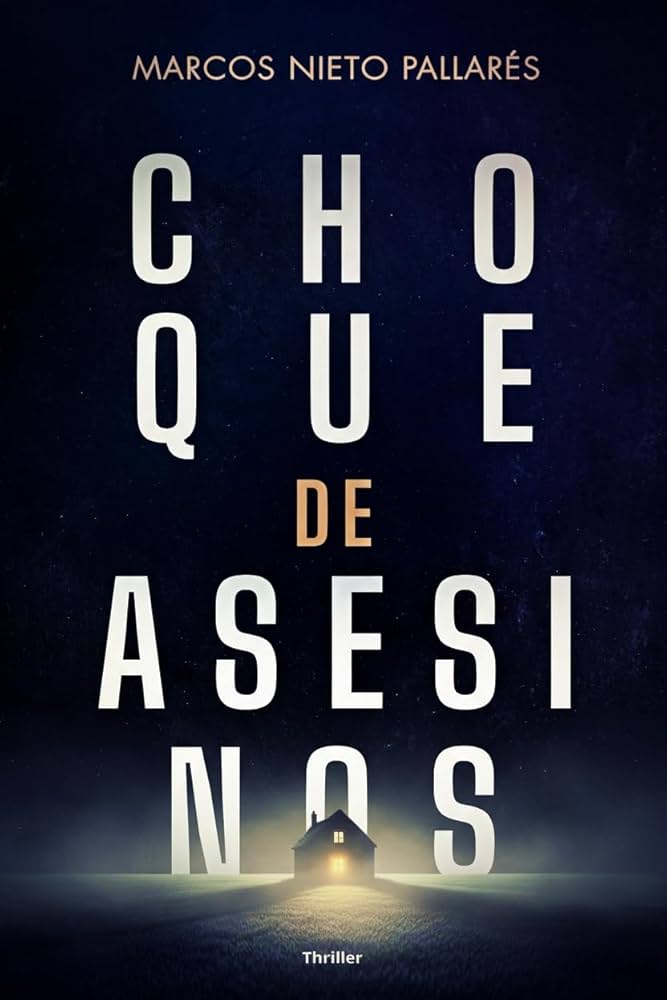
A series of ritual murders leaves behind bodies marked with a score, as if they were part of a macabre game. While everything points to two killers competing to prove who is the best, the investigation begins to reveal that the true mind behind the horror may be far more invisible and calculating than anyone imagines.
The body of the young Emma Cook appears in an abandoned house. The scene does not correspond to a conventional crime. Emma has been tortured with a medieval instrument known as the Heretic’s Fork; in addition, the little toes on her feet are missing, and there is a disturbing inscription on her back: “1-0”. Shortly afterwards, an image of another kidnapped victim appears on social media accompanied by a disturbing hashtag: #ElasesinoDLI (“#ThemurdererDLI”).
Detectives Trenton Brody and Grace Dallas take on the case, while journalist Sam Shore, determined to boost his career through this investigation, begins receiving direct messages from the killer himself, who seeks media attention. When a prestigious psychiatrist is found murdered through a completely different ritual and with a new score —“1-1”— engraved on the body, the investigation takes a turn: could there be two serial killers competing against each other? From that moment on, each new murder reinforces that idea. The methods change, the rituals refer to different eras and cultures, and the score continues to advance as though each death were responding to the previous one.
Journalist Sam Shore becomes part of that system when his business card is found next to one of the victims. However, he is not murdered. Instead, he publishes an article claiming that ElasesinoDLI broke into his apartment, forced him to watch a video of one of the victims and announced a long period of silence.
The pause is not random but the result of a deliberate decision: the killer himself controls the rhythm of the game. And so it happens: for two years, no new murders are committed.
During that time, a parallel investigation revisits the case from another angle. A former detective hired by Emma Cook’s grandfather follows the trail of a dark web network where videos related to the crimes are circulating. Through that circuit, he manages to identify several possible suspects and focuses his attention on one of them, Tony Fletcher.
The trail leads him to an isolated cabin. There he finds evidence linking Fletcher to the murders, but the confrontation takes a turn when the detective is captured. Before dying, he manages to pull from Fletcher an ambiguous answer regarding his responsibility: “Yes and no.” The implication is clear: Fletcher is part of something bigger.
Based on the evidence recovered and the trail left by that last investigation, the police finally manage to locate and arrest Fletcher. His confession matches the known crimes and provides details impossible to invent. The official version prevails: the killer has been identified and the case is closed.
But four years later, a new crime reproduces exactly the same pattern and logic. It is not an imitation; it is a continuation.
The investigation is reopened. In prison, Fletcher reveals that he never acted on his own initiative and claims to have been contacted through the dark web by Will Mann, who provided him with precise instructions on how to commit the murders without being detected. His role was to carry out the crimes and claim responsibility for them, while Mann remained hidden, controlling the process from the shadows.
Brody and Dallas, the detectives from the first investigation into this series of murders, track Mann down to an isolated cabin. The final confrontation ends with his death at Dallas’s hands, covered up by Brody as a shootout. With him disappears the figure who seemed to give meaning to the entire structure.
However, the definitive explanation arrives years later, unexpectedly. A young woman named Debra Morrisson discovers the diary of her grandfather, David Lee Jones. In its pages, an even deeper and more painful truth is revealed. He was the one who conceived the system from the beginning, the mind that designed the murders not as isolated acts but as a replicable mechanism capable of being carried out by others. The idea of a possible competition —the logic of the score, the succession of methods— was part of that design, a way of manipulating and directing those who would later enter the game.
Neither Fletcher nor Mann were the beginning, but merely links in a chain that someone had set in motion long ago.
A truth that never becomes public, because Debra decides to conceal it and carry that legacy herself, attempting to compensate for it with a life devoted to doing good.
RELEVANT INFORMATION: Marcos Nieto Pallarés is a Spanish crime and thriller writer who has captivated tens of thousands of readers with his complex plots, fast-paced storytelling, the psychological dimension of his works, and his complex, tormented characters.
Clash of Killers stands out for its ensemble structure and a highly commercial premise that creates a constant hook of tension and mystery. Its dark atmosphere and investigative approach give it strong audiovisual potential, comparable to series such as True Detective, offering an immersive, tense, and deeply addictive experience.
WHAT READERS SAY
“An electrifying thriller by the author of The Game of Evil. It could be a season of True Detective.” Los mejores libros
“Marcos Nieto Pallarés lays out the pieces of a disturbing thriller, captivating readers with an absorbing narrative, constant unexpected twists, and an astonishing ending.” Goodreads User
“An addictive thriller that begins with a bloody chain of crimes, immersing the reader in a suffocating atmosphere of pure tension and mystery.” Goodreads User
AUDIOVISUAL POTENTIAL: TV Series, Miniseries, Feature Film, TV Movie.
AVAILABLE LANGUAGES: Spanish.
Adquirir los derechos
Para ponerte en contacto con nosotros completa el siguiente formulario y te responderemos en breve.
