
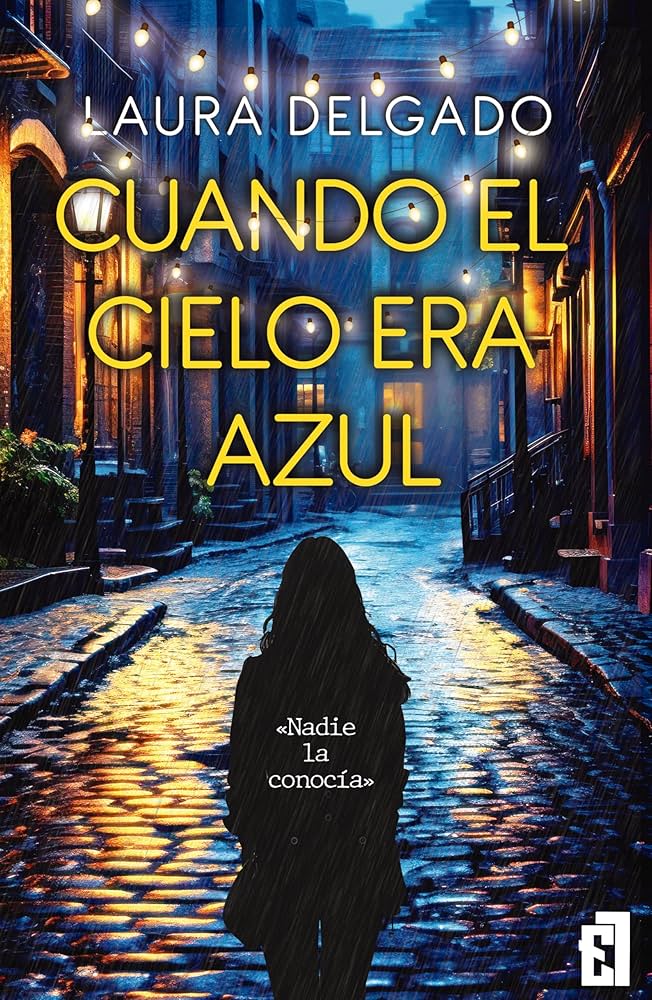
The murder of a young woman in a town in Gran Canaria shatters the life of her mother, a mayor in the midst of a political rise. When she discovers that the culprit exists but lies beyond the reach of the law, she must decide how far she is willing to go.
The day Elisa is found murdered, the entire town is celebrating the start of Christmas. Her mother, Lourdes, newly elected mayor, is about to switch on the lights from the town hall balcony when the crime breaks into the middle of the festivities. Elisa’s body is found in a nearby municipal park, brutally beaten, while just a few meters away the music, lights, and celebration continue. What should have been a political triumph becomes a family tragedy and an uncontrollable public scandal.
Elisa was a twenty-year-old violinist, sensitive and seemingly fragile, who had just returned home for Christmas. However, her death uncovers a secret life that no one wanted—or knew how—to see: large cash withdrawals, several hidden mobile phones, an active identity on the darkest corners of the internet, an unwanted pregnancy, and a relationship of dependency marked by manipulation and fear. The investigation reveals that Elisa had been blackmailed for months after being secretly recorded, and that this pressure led her to a nighttime meeting in the park, where she decided to put an end to the extortion.
The investigation is led by Sara Santana, a lieutenant in the Guardia Civil, a rigorous professional who maintains a personal relationship with the victim’s family. From the outset, her work is hindered by media pressure, self-serving leaks, and the political weight of Lourdes, who turns her daughter’s murder into a public crusade for citizen safety. The case thus becomes a battlefield between judicial truth, media narrative, and political interests, where every decision carries public consequences.
As the investigation progresses, clues begin to point toward the family circle. However, the evidence is insufficient and the system stalls when the suspect does not fit the image of a culprit that society is willing to accept. The truth is finally revealed: the murderer is Elisa’s cousin, a twelve-year-old boy who had been blackmailing her for some time and who beat her to death when she decided to stop paying. His age makes him legally not criminally responsible, placing him beyond the reach of penal justice.
The revelation destroys the family. Lourdes must face not only the loss of her daughter and the public exposure of the case, but also the certainty that the law will offer no reparation. Unable to accept that impunity and fully aware of the consequences, she decides to take justice into her own hands and kills the culprit, deliberately assuming her political and personal downfall.
When the Sky Was Blue is a psychological thriller laden with reflections on guilt, responsibility, and the limits of justice. A story in which the mystery does not lie in who committed the crime, but in how far individuals and institutions are willing to go to protect their image, their power, or their own—and who is willing to pay the final price for the truth.
RELEVANT FACTS: Laura Delgado is a Spanish writer of erotic and romantic fiction who in recent years has chosen to explore the thriller genre.
Her short stories have won several awards, most notably First Prize in the 5th International Patricia Sánchez Cuevas Short Story Contest. As a novelist, she has also been a finalist for the EXIT Literary Agency’s Novella Prize and the 8th Romantic Novel Contest by Editorial Kiwi.
When the Sky Was Blue stands out for combining elements of crime thriller with family drama, shifting the focus from “who did it” to the personal implications of a case like the one portrayed.
The novel addresses highly contemporary themes such as digital hypersexualization, media exposure, gender-based violence, and public shaming, all organically integrated into the plot. From an audiovisual perspective, it offers enormous potential: an impactful opening, morally ambiguous characters, and a dark, realistic tone that connects with social thriller storytelling.
AUDIOVISUAL POTENTIAL: TV series, Miniseries, Feature film, TV film.
AVAILABLE LANGUAGES: Spanish.
Adquirir los derechos
Para ponerte en contacto con nosotros completa el siguiente formulario y te responderemos en breve.
Error: Contact form not found.
