
In a country devastated by an epidemic, three men bound by jobs connected to death discover that the disease is merely the excuse for an organized extermination. As they travel along empty highways, burned villages, and clandestine slaughterhouses, they decide to confront a State that is erasing entire communities. A story by Ana Paula Maia, one of the most powerful voices in contemporary Brazilian literature.
After an epidemic of unknown origin empties entire towns and drastically reduces the population, the rural world becomes a silent territory crossed by deserted highways and vanishing communities. The disease spreads, the State imposes isolation zones, and the radio repeats religious messages announcing the end of times. In this devastated landscape, three men survive by performing jobs tied to death, unaware that they are about to be trapped in the definitive collapse of social order.
Bronco Gil leaves his job as a dishwasher when he accepts a contract: to kill a woman accused of robbing an influential client. He carries out the task without hesitation and delivers the body to a ranch where corpses are bought and resold, confirming that death has already become part of a clandestine economy. He then resumes his westward journey, accompanied by evangelical broadcasts speaking of the rapture and the separation between the saved and the damned.
In the same region works Edgar Wilson, responsible for removing dead animals from the highways. During one of his routes, he stops at an unfinished bridge that ends in an abyss. There he speaks with a solitary man, a former construction worker, who recounts a series of deaths during the building process and claims something evil inhabits the void. Shortly afterward, the man throws himself into the precipice before Edgar’s eyes.
Back at the depot where dead animals are ground up, Edgar meets Tomás, a former priest now assigned to sanitary duties. Together they discover human remains mixed among the animal carcasses, a sign that the control system has begun to fail. Soon after, one of the workers attempts suicide and confesses to having killed his two infected children to spare them greater agony. The disease causes fever, delirium, and rapid deterioration; the infected are isolated by the authorities, and many never return.
Rumors fill the highways, military helicopters circle overhead, and small towns begin disappearing from the map. In a roadside bar, Edgar, Tomás, and Bronco finally cross paths and realize that each of them has heard, at different times and from dying mouths, the same unsettling phrase:
“The gates of heaven and hell are opening at the same time. Everything in between will be destroyed.”
The epidemic no longer seems to be only a health crisis: something greater is advancing across the territory.
Confirmation arrives when Edgar receives a radio call from the service headquarters where he works and is sent to kilometer 18 on the highway. There he finds an Army truck stopped in the middle of the road and two young soldiers in shock. When they open the container, they discover not corpses but infected people still alive, being transported to be incinerated at the regional slaughterhouse. Edgar understands then that the State has stopped trying to contain the disease—it is eliminating entire communities.
The three men kill the soldiers and take the truck. During their escape, they pass through a small town recently burned by the army and rescue a young girl hiding among the corpses. With her on board, they head toward the slaughterhouse where the mass cremations are carried out.
There, the man in charge admits he collaborated out of fear and reveals that another community will be destroyed that very night. Edgar, Bronco, and Tomás attempt to get ahead of the operation, but when they arrive, they find the village completely empty. From a distance, they watch as the military reduces it to ashes.
From that moment on, the territory begins to lose coherence: maps no longer match the landscape, highways lead nowhere, and night falls abruptly, as if time itself were shutting down. With no possible escape, they hear the same prophecy one last time from a dying man.
The world ceases to respond to any recognizable logic.
As the landscape disintegrates and communities vanish, it becomes clear that the apocalypse does not arrive as an explosion, but as a process: bodies eliminated, towns erased, and men forced to keep moving across a land that no longer offers refuge.
RELEVANT INFORMATION: Ana Paula Maia is a Brazilian writer, screenwriter, and musician. Her work includes screenplays, theatrical monologues, and novels. She has received the Cercador Prize and the PEN Translates Award, and was longlisted for the Republic of Consciousness Prize. She has also been recognized by The Guardian and Foyles as one of the best translated books into English in 2023 and has received the Prêmio São Paulo de Literatura for best book of the year. Her works have been translated into German, Croatian, Spanish, English, and Italian.
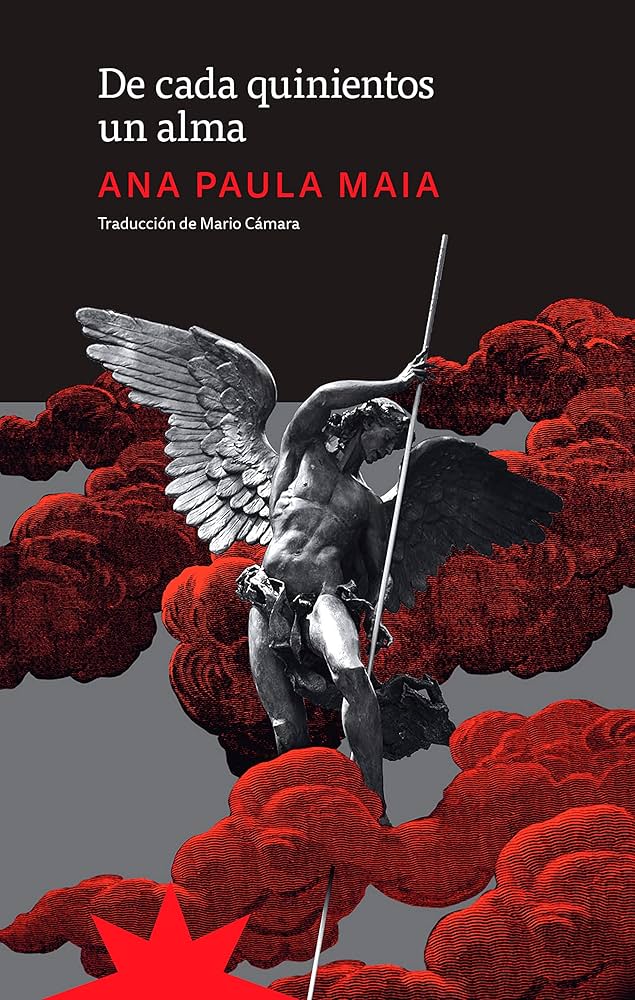
Her novel De cada quinientos un alma is a powerful work of apocalyptic and social fiction that captivates through its tone and oppressive atmosphere. The novel employs striking and recognizable imagery, ideal for a forceful audiovisual adaptation. Built around a small cast of characters, precise dialogue, and a plot charged with mystery and constant tension, it lends itself naturally to a series or film with strong visual and emotional impact.
AUDIOVISUAL POTENTIAL: TV Series, Miniseries, Feature Film, TV Movie.
AVAILABLE LANGUAGES: Spanish, Portuguese.
Adquirir los derechos
Para ponerte en contacto con nosotros completa el siguiente formulario y te responderemos en breve.
Error: Contact form not found.
