
At thirty years old, Persephone receives the worst possible diagnosis: she has only a few weeks left to live. Accompanied by her new friend Aure, she embarks on a race against time to complete her bucket list and say goodbye on her own terms. If leaving is inevitable, living is mandatory.
Persephone is thirty years old and has just heard the worst words of her life: a rare disease is killing her and she has only weeks to live. She leaves the hospital overwhelmed with uncertainty, but a waiter named Diego gives her the most important lesson: “Be selfish, live for yourself, because time is running out.” That night, her heart heavy with doubt over whether to tell her boyfriend Luca, she decides she will make the most of every second.
Her first act of rebellion is getting a tattoo. She walks into a tattoo studio run by Jaco, an attractive and mysterious man who practices shibari, the art of rope bondage. Jaco offers her a phrase in Latin: Memento mori (“remember you will die”). She tattoos it on her wrist, convinced it will become her superpower against fear. That same night, she tries to reconnect with her boyfriend Luca through shibari, but the passion between them has long since faded. Gradually, their relationship begins to crack.
The next day, she is fired from her job because of an ambitious coworker. Just as she is thrown out, Aure appears a girl who was meant to replace her and who, outraged by the situation, also quits. Between them, an explosive, joyful, and sincere friendship is born. Persephone confesses her illness, and rather than pitying her, Aure pushes her to cross off everything on her bucket list.
Meanwhile, the doctor offers her an experimental treatment with barely a 20% chance of success. Persephone hesitates, and seeing her mother happy without knowing the truth tears her apart. She decides to break up with Luca to avoid hurting him and postpones her decision in order to focus on living.
Aure organizes the perfect day for her: they go skydiving, rent out a movie theater just for themselves, volunteer at a soup kitchen, and plant an apple tree together. It becomes the best day of her life. And Aure tops it off by taking her to Jaco’s studio for a shibari photo session. There, naked and bound with ropes, Persephone feels free, powerful, and desired. After the shoot, she and Jaco have dinner in his car, and she confesses her secret dream: opening a shop of special stuffed animals, with clothing and accessories so that each one is unique. Jaco encourages her to do it. They end up making love, and for a moment, everything feels perfect.
But when she returns home, guilt consumes her. She does not want anyone to witness her dying. She decides to reject the treatment, write a book as her legacy, and leave alone for a village near Amsterdam. She says goodbye to Aure with a broken embrace and asks her not to look for her.
Months later, Aure receives a box. Inside is Persephone’s published book, along with a full dossier to set up the stuffed animal shop, all her savings, her grandmother’s stuffed toy, Jaco’s rope, letters for Luca, her family, and Aure—and her ashes. Persephone had planned everything.
Later, Aure writes her a letter that she burns beside the apple tree: the book is a success, its profits go to research into rare diseases and to the soup kitchen, Jaco has created an exhibition with the photos from the session, and Luca contributed with his own. Everyone remembers her with pride. And Aure, with tears and a smile, begins searching for a place to open the stuffed animal shop. Because the superpower of Memento mori lives on.
RELEVANT INFORMATION: Fran López Castillo is a Spanish writer of romance fiction. Throughout his career, he has sold tens of thousands of copies through self-publishing, outside traditional publishing circuits, and has won the Special Bestselling Author Award from Editorial Círculo Rojo, the Alumni Cultural Award from the University of Castilla-La Mancha, and the National Young Author Award from Onda Cero (2025). He also maintains an active presence on social media, where he has tens of thousands of followers.
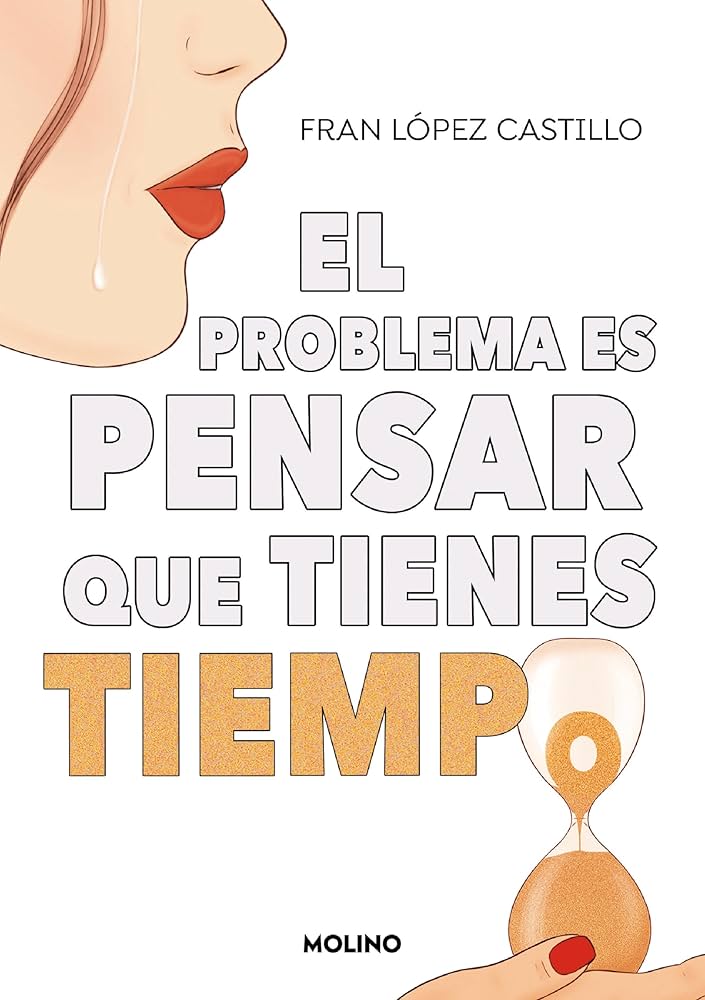
The Problem Is Thinking You Have Time is a life-affirming and empowering novel that reflects on the importance of making the most of time and living on one’s own terms. It carries strong emotional and dramatic weight, with a protagonist who struggles not against an external villain but against her own fears, guilt, and social pressure—yet it is also deeply hopeful and an ode to friendship. It offers strong audiovisual potential thanks to its powerful scenes and its dynamic narrative structure.
AUDIOVISUAL POTENTIAL: TV Series, Miniseries, Film, TV Film.
AVAILABLE LANGUAGES: Spanish.
Adquirir los derechos
Para ponerte en contacto con nosotros completa el siguiente formulario y te responderemos en breve.
