
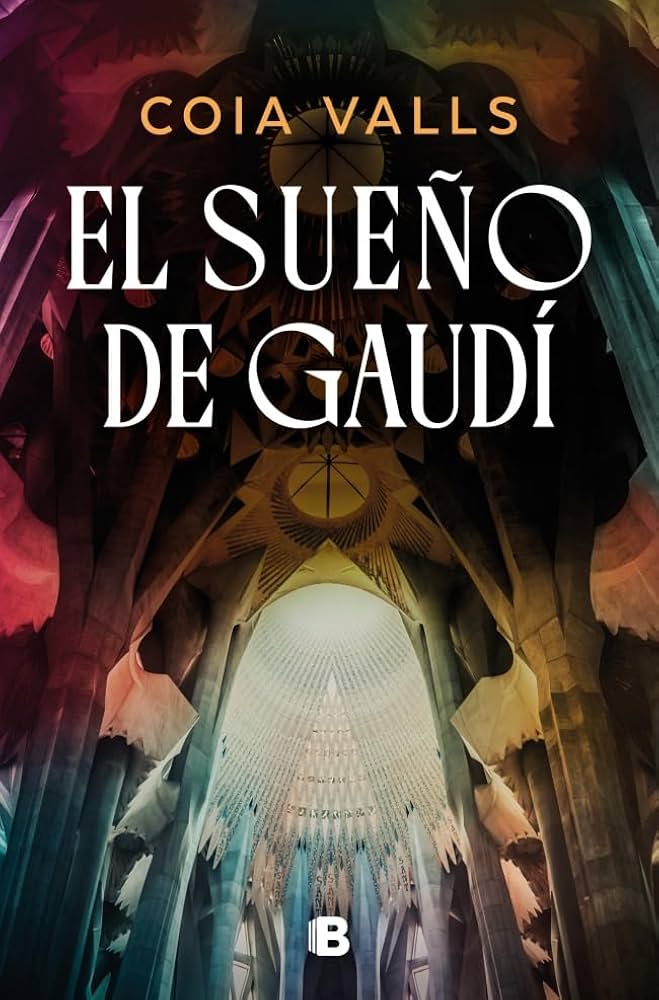
While Antoni Gaudí imagines a work meant to last longer than a single lifetime, a family is built at the same pace as the Sagrada Familia. Two parallel stories that ultimately become one in this luminous, multi-voiced novel about memory, legacy, and the need to leave something behind that will outlive us.
The Dream of Gaudí tells the story of the construction of the Sagrada Familia through a family saga spanning five generations of women linked to the temple. The narrative revolves around two central figures: Anna Vilanova, a girl raised among the scaffolding of the Sagrada Familia in its early years, and Anna Maria, her descendant, tasked with reconstructing that memory more than a century later.
The novel opens in the present day with Anna Maria, who cares for her father, a former journalist and photographer suffering from Alzheimer’s disease. As his memory fragments and fades, she works as a researcher specializing in the Sagrada Familia, a building she knows in depth not only through her profession, but also through the family history that binds her to it. The contrast between the deterioration of personal memory and the permanence of the temple poses the book’s central conflict: what happens to stories when there is no one left to remember them.
Anna Maria safeguards old photographs, letters, and press clippings passed down through her family. These materials, together with her journeys through the temple, lead her into the past and allow the reconstruction of the lives of the women in her family, whose experiences unfold in parallel with the construction of the Sagrada Familia.
The historical journey begins in 1883, when Antoni Gaudí takes over the direction of the Sagrada Familia following the resignation of the previous architect. Young, deeply religious, and guided by a radical vision, Gaudí conceives the temple not as a conventional commission, but as a mission destined to grow slowly, outside fashions, money, and immediate recognition. Sustained solely by popular donations, the construction exists in a constant state of precariousness and generates tension with patrons and collaborators who doubt the project’s viability. Even so, the architect’s devotion and his ability to involve the workers turn the endeavor into a shared purpose.
Although the narrative is choral, Gaudí occupies a central position. His creative and spiritual process, marked by obsession, solitude, and sacrifice, becomes one of the main driving forces of the story, always under the awareness that he will never live to see the Sagrada Familia completed.
In parallel, the novel follows the life of Anna Vilanova, daughter of a Sagrada Familia laborer and the origin of the family lineage. From a young age, Anna moves among scaffolding and stone blocks, bringing lunch to her father and helping with small tasks. Intelligent and precocious, the temple becomes for her a space of learning, belonging, and future possibility. Through her gaze, the everyday lives of the workers are portrayed: the harshness of the trade, camaraderie, economic instability, and the quiet pride of taking part in a construction destined to outlast them.
In this environment, Anna meets Guillem, the son of the master builder. Their relationship begins in childhood and evolves over the years into a love story marked by waiting, discretion, and resilience. While Gaudí designs a temple intended for future generations, Anna and Guillem build a life together shaped by poverty, early motherhood, constant work, and the sacrifices imposed by their time. Their bond, like the Sagrada Familia itself, is sustained by patience and perseverance.
Throughout the narrative, the novel moves through key moments in Barcelona’s history: the Universal Exhibition of 1888, the arrival of electric light, the city’s rapid transformation, and the social tensions of the turn of the century. In contrast to a modernity oriented toward immediacy, Gaudí defends an organic and symbolic architecture conceived to endure.
Economic hardship is a constant, and on more than one occasion the construction of the Sagrada Familia is on the verge of coming to a halt. Gaudí responds with unshakable faith, convinced that the temple must rise from trust rather than haste. This tension between idealism and reality runs through both the architect’s decisions and the lives of the workers and families who depend on the project’s continuity.
In the final section, the narrative returns to the present. As Anna Maria’s father definitively loses his memory, she understands that her own work—researching, reconstructing, and narrating—is also a form of construction. Just as previous generations raised the Sagrada Familia for a future they would never know, she assumes her role as heir and transmitter of a memory built across five generations. The temple thus reveals itself as a work unfinished by vocation, a place where time, lives, and memories are inscribed in stone.
The Dream of Gaudí is a story about the value of slowness, collective effort, and imperfection, transforming the construction of the Sagrada Familia and the transmission of family memory into a reflection on legacy, resilience, and the need for beauty in a world that moves too fast.
RELEVANT INFORMATION: Coia Valls is a Catalan writer and actress with a solid career in contemporary narrative and historical fiction. With degrees in Pedagogy and Speech Therapy, she began her literary career in adulthood and has become one of the most widely recognized voices in historical fiction in the Catalan sphere.
Her work has received major literary awards, including the Néstor Luján Prize for Historical Fiction, and has also been recognized by readers. Her novels have been translated into several languages and have enjoyed broad critical and popular acclaim.
In addition to her work as a novelist, she has taken part in various stage productions and in the film Ventre blanc, by writer and filmmaker Jordi Lara.
Across her body of work, Coia Valls consistently explores themes such as memory, legacy, the passage of time, and personal stories intertwined with major historical events, always from a deeply human perspective.
AUDIOVISUAL POTENTIAL: TV Series, Miniseries, Feature Film, TV Film.
AVAILABLE LANGUAGES: Spanish.
Adquirir los derechos
Para ponerte en contacto con nosotros completa el siguiente formulario y te responderemos en breve.
Error: Contact form not found.
