
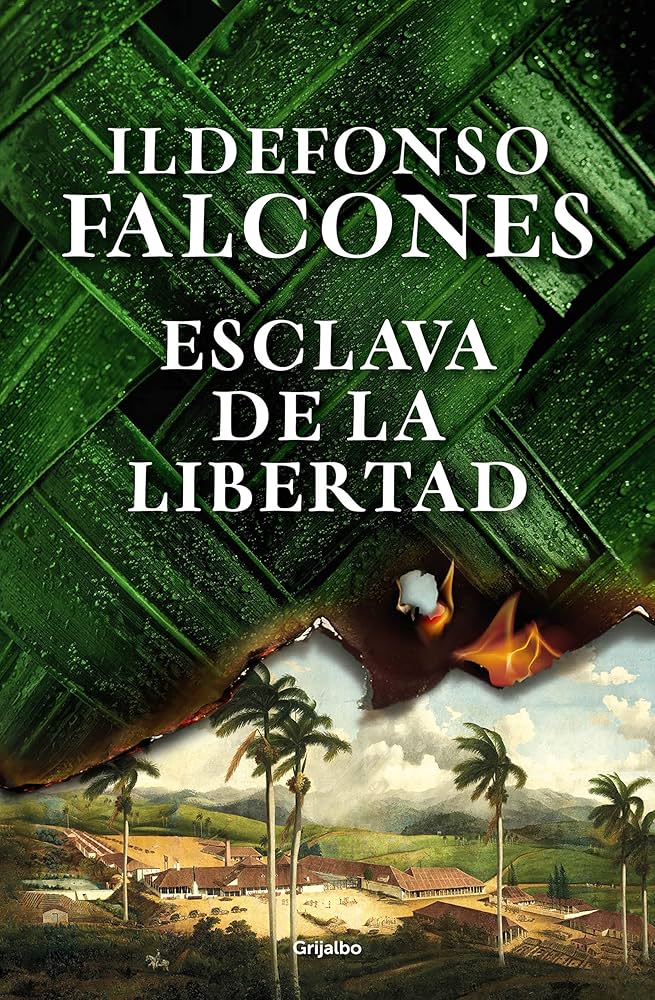
In nineteenth-century Cuba, a young slave possessed by the goddess Yemayá rises up against the man who enslaved her. One hundred and sixty years later, in Madrid, her descendant uncovers the origins of a banking empire built on slavery and unleashes a legal battle that shakes the elite. Two women, two eras, one legacy that cannot be silenced.
In 1856, Kaweka, an eleven-year-old Yoruba girl, is torn from her African village to be sold as a slave in Cuba. During the voyage aboard a slave ship, she loses her sister, and is purchased by the powerful Marquis of Santadoma to work on his sugar plantation, La Merced.
But Kaweka is no ordinary slave: she has been possessed by the goddess Yemayá since childhood, granting her healing gifts and a spiritual connection that soon turn her into a healer and a respected figure among her people. For years she survives the brutality of slavery—forced labor, punishment, rape—while her influence within the community continues to grow.
At the plantation she meets Modesto, an emancipated slave who works as a nurse. Through him she discovers love and desire, and Modesto proposes buying her freedom. However, before that can happen, Kaweka, called by the gods, flees to the mountains and gives birth to her daughter Yesa, the result of their relationship.
From the palenque where she takes refuge, she organizes her community of escaped slaves while resisting the constant persecution of the Marquis of Santadoma, whose son she had allowed to die when she was still a slave, triggering his thirst for revenge.
When the Ten Years’ War breaks out, Kaweka becomes a sergeant in the rebel army. She leads hundreds of freed slaves, attacks sugar plantations, burns estates, and spreads terror among the landowners. But the war does not bring the promised freedom: the white generals make peace with Spain and free only twelve thousand slaves, leaving two hundred thousand still in chains.
Crippled and physically defeated, but never surrendered, Kaweka gives herself up to the marquis to save Modesto, the only man she has ever loved. Before dying, she reveals that Yesa is his daughter and gives him the necklace of the goddess Yemayá so that he may find her. Her spirit merges with the goddess, and her cry for freedom echoes through the centuries.
One hundred and sixty years later, in Madrid in 2018, Lita, a young mixed-race woman who has studied economics and works at Banca Santadoma, lives trapped between her ambition and the burden of her origins: her mother, Concepción, has served the family all her life, and Lita has grown up under the stigma of being “the maid’s daughter.”
A trip to Cuba changes everything. Standing before the Virgin of Regla, Yemayá possesses her, and Lita falls into a trance, connecting with her spiritual heritage. There she discovers a family truth hidden for generations: her mother, Concepción, is the illegitimate daughter of a Santadoma, born from the relationship between the marquis’s son and her grandmother, a mixed-race woman. The family always knew and kept it secret.
Armed with letters, photographs, and Kaweka’s necklace, Lita returns determined to demand justice. The current marquis, Don Enrique, responds with violence: he humiliates her publicly, fires her from the bank, calls in her debts, and expels her mother from the house where she has served all her life.
But Lita fights back. She joins forces with Afro-descendant associations, leaks the story to the press, and unleashes a media scandal that shakes the Santadomas and threatens their financial empire. Investors withdraw, Banca Santadoma enters into crisis, and a planned sale to foreign capital is seriously jeopardized.
Amid growing media pressure, the family convenes a decisive press conference in which they publicly offer one hundred and twenty million euros to bring the conflict to an end. Possessed once again by Yemayá, Lita rejects the money and declares that no bank built on the blood of slaves should continue to exist.
Finally, Concepción wins the paternity lawsuit, is recognized as an heir, and obtains part of the Santadoma fortune, which she decides to allocate to a foundation for people of Afro-descendant heritage. The family is left ruined and socially discredited.
Lita, now an international activist, travels the world denouncing racism and the colonial legacy, always carrying Kaweka’s necklace as a symbol of a struggle that continues.
Two women, two centuries, one shared cry: freedom is not negotiated, it is conquered. And sometimes, the debt of the past is collected in the present.
RELEVANT INFORMATION: Ildefonso Falcones is a Spanish writer and lawyer, considered one of the most successful authors of historical fiction in the Spanish language. His novels have become an unprecedented publishing phenomenon in Spain, with millions of copies sold worldwide, translations into dozens of languages, and publication in more than forty countries. In addition, his acclaimed novels The Cathedral of the Sea and Heirs to the Land have already been successfully adapted into television series.
Throughout his career he has received several major distinctions, including the Premio Euskadi de Plata (2006), the Premio Qué Leer for Best Spanish Book of the Year (2006), the Premio Fundación José Manuel Lara for Bestselling Novel (2006), the Premio Giovanni Boccaccio for Best Foreign Author (2007), the Premio Fulbert de Chartres (2009), and the Premio Roma de Literatura Extranjera (2010).
Slave of Freedom is a historical drama that intertwines two timelines separated by more than a century and a half, connecting the brutal reality of slavery in colonial Cuba with the contemporary struggle against racism in twenty-first-century Spain.
Through a powerful and moving narrative, the novel weaves a story of resistance, loss, and survival that spans generations. Its combination of historical epic, personal drama, and social critique gives it extraordinary audiovisual potential as a story of female empowerment, revenge, and the search for justice. The novel is driven by memorable characters and supported by a political backdrop that resonates strongly with the challenges of the present day.
WHAT THE PRESS AND READERS SAY
“An epic adventure between Cuba and Madrid.” El Cultural
“A dazzling novel about two courageous women.” Todoliteratura
“A fascinating story that recounts the passionate struggle for freedom.” Culturalia
“Ildefonso Falcones is an author who hooks readers. He knows very well how to connect with them.” Anika Entre Libros
AUDIOVISUAL POTENTIAL: TV Series, Miniseries, Feature Film, TV Movie.
AVAILABLE LANGUAGES: Spanish, Catalan, Danish, Dutch, Italian, Polish, Portuguese, Serbian.
Adquirir los derechos
Para ponerte en contacto con nosotros completa el siguiente formulario y te responderemos en breve.
