
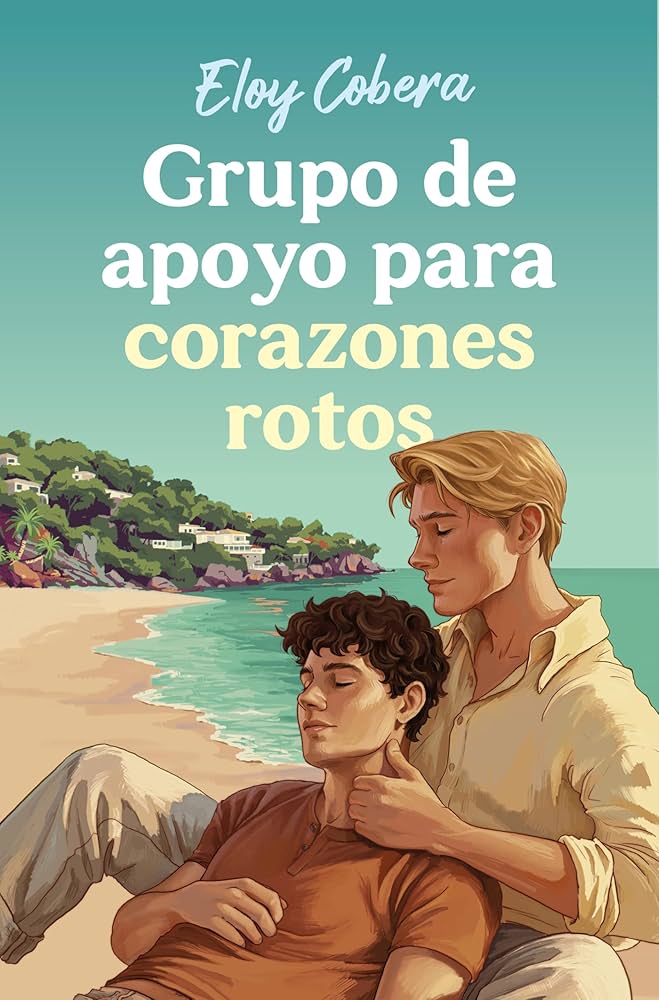
Two heartbroken boys make a pact: spend twenty-one days pretending to be a couple to get over their exes. But love begins to grow between them, the exes reappear, and misunderstandings explode. And they soon discover that, to learn how to love each other properly, sometimes you have to break all the rules—even your own.
Rodrigo is twenty-three and has just lost the only thing that gave meaning to his life: his four-year relationship with Lucas. Completely heartbroken, he flees Madrid for La Herradura, the coastal town where his grandmother Gris lives, hoping to escape the pain rather than face it.
Gris, who knows him better than anyone, quickly realizes that her grandson doesn’t need to hide—he needs to start living again. She urges him to go out, meet people, stop revolving around his breakup. Rodrigo resists… until he meets Harry.
Their first encounter is awkward and charged with tension: Rodrigo, with his analog camera, accidentally photographs Harry on the beach, and Harry reacts by calling him a “stalker” in mocking Spanglish. What could have been an uncomfortable misunderstanding turns into a game. Rodrigo tries to find him again, and when he does, the attraction is immediate and impossible to ignore.
Both are running away from someone. Harry is trying to forget Ava; Rodrigo, Lucas.
On the night of San Juan, amid alcohol, the sea, and confessions, they seal a pact: spend twenty-one days together pretending to be a couple to get over their exes. The agreement has clear rules: no talking about the future, no expectations, no falling in love. Just live in the present. But the experiment quickly stops being a game.
Through escapes, confessions, and growing intimacy, Rodrigo and Harry constantly cross the boundaries they set for themselves. What was meant to be a game becomes something increasingly real, intense, and hard to control.
Then Lisa, Harry’s twin sister, appears and introduces the first major crack: she warns Rodrigo that Harry’s relationship with Ava is cyclical and addictive, that he always goes back to her, and that Rodrigo may just be another phase in that pattern. For the first time, Rodrigo questions whether he is building something real or simply filling a temporary void.
Meanwhile, in parallel, Gris’s story begins to unfold. Rodrigo discovers that, in her youth, she was in love with a woman named María—a relationship she could never live openly due to the social context of the time. Through letters, photographs, and memories kept for decades, Rodrigo understands that his grandmother also experienced an intense love she had to abandon. This generational mirror begins to reshape how he understands his own bond with Harry.
Determined to help her, Rodrigo encourages a reunion between Gris and María. That process not only returns a part of his grandmother’s story to her, but also shows him a new way of understanding love: not as dependence or fear of loss, but as a brave choice—even when it involves risk.
With this new perspective, Rodrigo faces the end of summer believing that what he has with Harry can transcend their original agreement. But everything becomes complicated again.
Milo, his best friend, arrives in town. There is a past of attraction and blurred boundaries between them, which awakens insecurity in Harry. On top of this, Lucas reappears, returning to properly close his relationship with Rodrigo. Although the closure is healthy, it reopens wounds and creates further confusion.
The tension reaches its peak when Milo manipulates the situation: he makes Harry believe that Rodrigo has gotten back together with Lucas and, taking advantage of his vulnerability, kisses him. Rodrigo witnesses the scene from a distance and, without knowing the truth, interprets it as a betrayal by both of them.
Without confronting them, he disappears. The summer, which had seemed full of promise, collapses.
Two weeks later, through old photographs of his grandmother, Rodrigo understands something essential: he recognizes in the way Harry looked at him the same love his grandfather felt for Gris. That revelation not only shakes him—it forces him to stop running.
He goes to find Harry.
When they reunite, Harry explains that it was Milo who kissed him, and that he rejected him. They reconcile and decide to give themselves another twenty-one days to learn how to love each other properly.
But summer ends with bittersweet goodbyes. Harry returns to Chester and Rodrigo to Madrid. They begin a long-distance relationship that, at first, seems to hold, but is soon shaken by external factors: the pandemic, the death of Harry’s father, and the weight of a life that no longer allows them to remain in the bubble of summer. Gradually, communication breaks down.
Years later, Rodrigo still writes him letters every birthday—letters he never sends. In them, he is not searching for clear answers, but holding on to a question that remains unresolved: whether that love was just a summer… or a story suspended in time, without a real ending.
RELEVANT INFORMATION: Eloy Cobera is a Spanish writer and content creator whose work belongs to contemporary and young adult romantic fiction, with a particular focus on LGBTQ+ representation.
Support Group for Broken Hearts is his first novel, an LGBTQ+ romantic comedy that combines the classic structure of the genre with a high-concept premise: two heartbroken boys who try to forget their exes by spending 21 days pretending to be a couple. Romantic tension drives the narrative, complemented by the lightness of summer, bold and dynamic dialogue, the tenderness of unforgettable characters (such as grandmother Gris), and a layer of bittersweet humor that connects with the real wounds of heartbreak.
AUDIOVISUAL POTENTIAL: TV Series, Miniseries, Film, TV Movie
AVAILABLE LANGUAGES: Spanish
Adquirir los derechos
Para ponerte en contacto con nosotros completa el siguiente formulario y te responderemos en breve.
Error: Contact form not found.
