
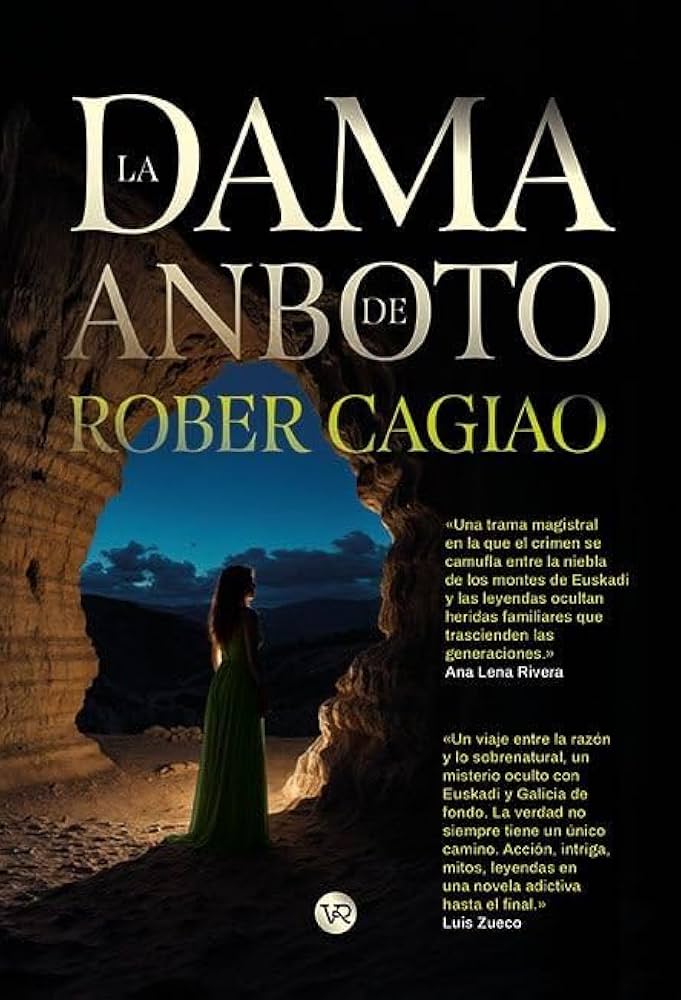
Two identical disappearances, the same day of the year, and a cave marked by an ancestral legend. When one of the bodies appears years later, an inspector discovers that the myth was used for decades to cover up a network of abuse, silence, and complicity spanning the Basque Country and Galicia.
Two women disappear on the summer solstice, twenty-one years apart. Both absences are linked to the same place, heavy with symbolism: the cave on Mount Anboto in the Basque Country, dwelling of Mari, the mythical figure who, according to legend, punishes lies, does not tolerate broken oaths, and demands sacrifices when challenged.
Of the two disappearances, the most recent resurfaces in 2019, hundreds of kilometers from Anboto, in Galicia, when the discovery of a mummified woman’s body in an abandoned house breaks a silence that seemed unbreakable. The victim is Deva, who disappeared on June 21, 2012. Her death forces attention back to the Basque Country and reopens a wound never closed: the disappearance of Amalur, which also occurred on June 21, in 1991, during a family hike in the mountains. Since then, her family has lived trapped in a grief without a body, marked by guilt, fragmented memory, and the suspicion that something happened there that no one wanted to confront.
For years, both disappearances were interpreted under the shelter of the myth. The fog, the mountain, and the legend of Mari offered an acceptable explanation for horror and turned silence into a form of collective protection. The sacred served as a way not to look.
The police investigation, led from Galicia by Inspector Bibiana Galdós and her partner Hidalgo, begins to lift that symbolic veil. They soon discover that Deva and Amalur not only shared the date of their disappearance: they were adoptive sisters, bound by a past of abuse and abandonment that had marked them since childhood. Vulnerable women, raised to remain silent, trapped in a system that preferred to look the other way.
As the investigation advances, the myth cracks and a much darker truth emerges. In Anboto there was no divine punishment, but the origin of a chain of crimes. In 1991, Amalur was kidnapped by a network of Guardia Civil officers led by Lieutenant Colonel Clemente, who organized clandestine parties in the mountain area where drugs, sexual violence, and torture mixed. Rodrigo “Rodri” Rekarte, then a young witness to those atrocities, secretly recorded them; years later he would fake his own death to escape.
In 2012, history repeats itself. After one of those parties, Deva is forcibly taken out of the Basque Country to prevent her from speaking. During the transfer she suffers a panic attack that causes her accidental death. Her body is hidden in Galicia, far from Anboto, reinforcing the appearance of a new disappearance linked to the myth.
The discovery of the body in 2019 definitively breaks the pact of silence. It forces remembrance, speech, and accountability. Rodri reappears with the evidence he had kept for decades, finally willing to face the truth.
The ending opens a crack of hope. Amalur did not die in the cave nor was she devoured by legend. She has spent twenty-eight years locked in the basement of a Galician house, prisoner of those who took part in her kidnapping and used the myth of Mari to protect themselves.
With Amalur freed, the evidence in police hands, and the perpetrators before justice, the legend regains its place—not as a refuge for executioners, but as the symbolic memory of a wounded land and a warning of how far horror can go when it hides behind the sacred.
RELEVANT FACTS: Rober Cagiao is one of the strongest emerging voices in contemporary Galician noir fiction. A writer, cultural communicator, and declared lover of Atlantic legends, he has built a literary universe that combines crime, territory, and tradition with a deeply recognizable voice. He has won the Círculo Rojo Award for Best Mystery Novel.
The Lady of Anboto has enormous audiovisual potential as a thriller thanks to its blend of dramatic and mythological elements. The novel weaves a powerful plot that alternates between two visually rich territories—the rural landscapes of Galicia and the Anboto massif in the Basque Country—using Basque folklore and mythology as a narrative catalyst that gives the work a distinctive tone. The investigation provides a structure perfectly suited for a high-impact series or miniseries, with multiple timelines, complex characters with strong arcs, progressive revelations, and a deeply cinematic central mystery.
AUDIOVISUAL POTENTIAL: TV series, Miniseries, Feature film, TV film.
AVAILABLE LANGUAGES: Spanish.
Adquirir los derechos
Para ponerte en contacto con nosotros completa el siguiente formulario y te responderemos en breve.
Error: Contact form not found.
