
When a well-established Andalusian politician receives a message that resurrects a crime he believed buried since 1990, his life spirals into blackmail, scams, and betrayal. As he tries to buy the silence of the past, he discovers that his enemies are not outside—but within his closest circle.
Mario Mesa was once Minister of Health for the Regional Government of Andalusia. Today, he occupies a powerless office in a foundation the party keeps open simply to avoid firing him. He lives with his wife, Tati, in a marriage worn down by time, and sees his son Óscar only from afar since he left to study in Boston. Now, Mario tries to fill the void left by power through discreet encounters with prostitutes. He believes he has survived the worst of politics and still considers himself untouchable.
Until he receives an anonymous message: a photo of the beach in Mijas with a name and a date. Helen, August 6, 1990.
Mario needs no further explanation. That night, he and his two childhood friends—Rafa, whom Mario always treated condescendingly, and Luis, who depended on Mario to keep his job—struggled with a young British woman named Helen. She fell, hit her head, and died instantly. Panicked, they moved the body to a boat, tied it to an anchor, and threw it into the sea. Rafa later called a contact to ensure no trace remained. The body was never found. The accident became a disappearance. And silence sealed the bond among the three men.
But thirty-four years later, someone has decided to break that pact.
The blackmailer demands €80,000 in exchange for keeping the secret. The threat is not only legal—it includes exposing everything to Mario’s wife, his party, and his entire network. As he scrambles to gather the money and contain the damage, Mario suffers another blow: the President of the Regional Government—whom he once attempted to kiss without consent—announces she will shut down the foundation. He loses his last political refuge just as the past begins to suffocate him.
Then comes a call from Boston. His son Óscar has been arrested after a fight in which a young woman was seriously injured. A lawyer contacts Mario demanding €150,000 to silence a witness and keep Óscar out of prison. Mario pays without hesitation. Soon after, he discovers that Tati has withdrawn €80,000 from their joint account. She explains she is being blackmailed with photos of Mario with a prostitute and had to pay to prevent their release. For Mario, everything fits into the same logic: the crime in Mijas has opened a crack through which his entire life is now collapsing.
However, Óscar calls again from the United States and reveals the truth: he was never arrested. It was all an elaborate scam by fraudsters posing as lawyers. They isolated him in Boston, convinced him he was facing real criminal charges, and while keeping him frightened and cut off, persuaded Mario to transfer €150,000 to resolve a nonexistent case. The money vanished within hours.
As if that were not enough, Mario enters Óscar’s room and finds neo-Nazi propaganda. He learns that his son and a group of friends humiliated Mina, a Colombian domestic worker, filming her as they forced her to kiss a Nazi flag. Mina was prepared to press charges. Although Tati did possess genuine photos of Mario with a prostitute, she used them as a cover story to justify paying the €80,000 and prevent a scandal that would definitively destroy their son.
With all the pieces now on the table, only one question remains: who sent that first message about what happened in 1990?
As Mario tries to trace its origin, a figure who has always been too close to the secret resurfaces: Rafa, the childhood friend turned police commissioner. His knowledge of that night in Mijas, his access to contacts, and his ease operating on the margins of legality place him at the center of suspicion. And eventually, the truth emerges.
Rafa had spent months preparing the blow, reconstructing the events in Mijas and gathering real evidence. He kept Helen’s belongings and used intermediaries to orchestrate the blackmail and manage the payments. He waited until the foundation was about to close before sending the first message, leaving Mario with no room to maneuver. The Boston scam and the episode involving Mina were not part of his plan—they came later, once Mario was already exposed. Rafa only needed to reopen the right wound and watch the rest of the collapse unfold. He did not act for money—the cash ultimately ended up in third parties’ hands—but for revenge. After years of enduring the contempt of the brilliant politician, he wanted to see Mario humiliated, ruined, and finally forced to confront his guilt.
Mario ends up without office, without prestige, and with a marriage sustained only by their mutual need for silence. He has lost hundreds of thousands of euros and any remaining authority. Rafa, meanwhile, has achieved what he wanted: to prove that real power does not lie in offices, but in whoever holds the keys to the past. And Mario understands, too late, that the crime he believed buried in Mijas is now the chain that keeps him bound—and that the man he despised for decades is the only one who can still destroy him whenever he chooses.
RELEVANT INFORMATION: Salvador Gutiérrez Solís is a Spanish writer, literary critic, and cultural manager, recognized for his extensive body of work spanning contemporary fiction, suspense, and social criticism. He has received multiple literary awards, including the Premio Andalucía de la Crítica, the Premio Juan Valera, and the Premio Leonor de Córdoba. His work has been translated into several languages.
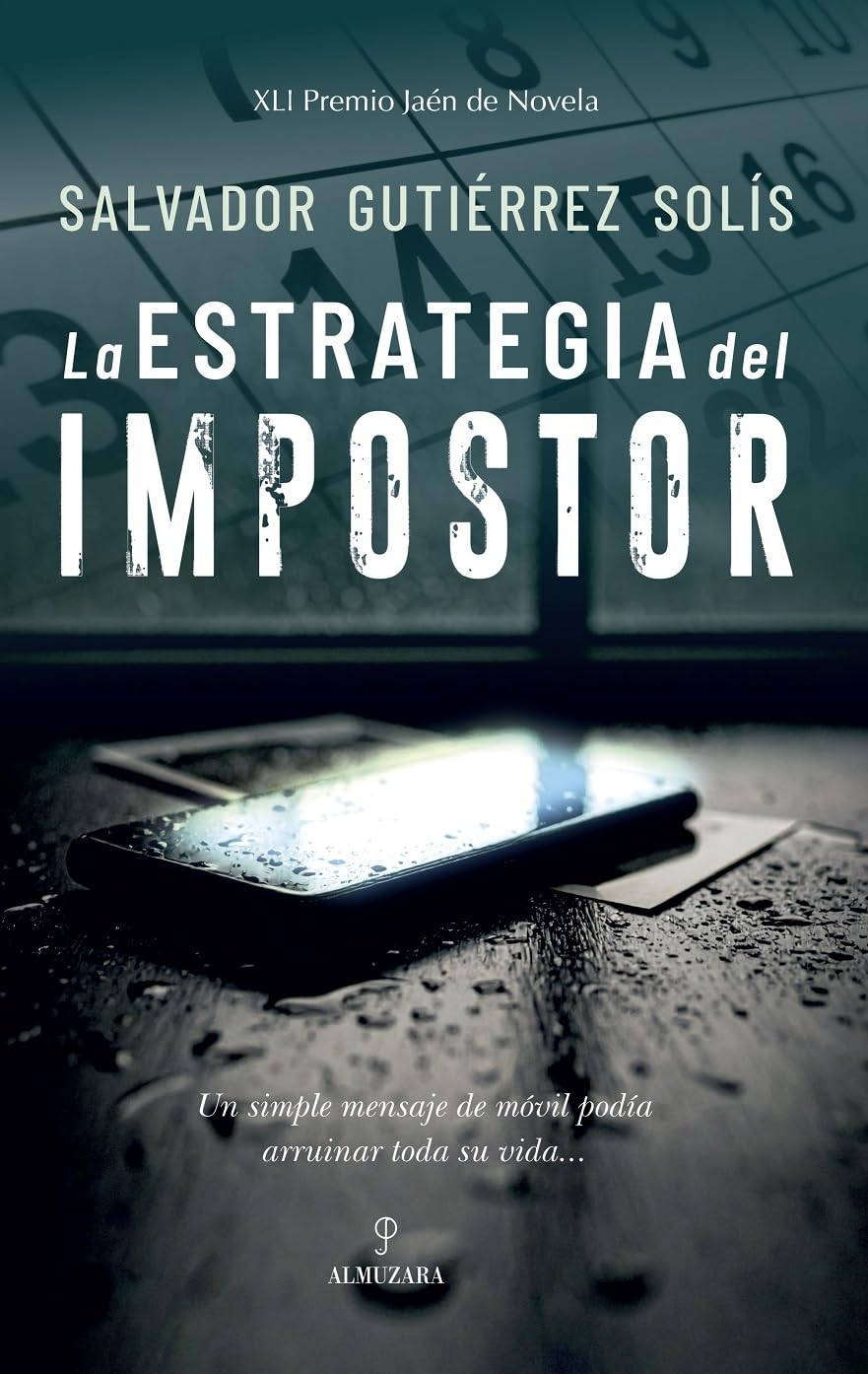
La estrategia del impostor, winner of the Premio Jaén de Novela 2025, is a gripping thriller that hooks readers from the very first pages. The author handles suspense with precision: blackmail, fraud, and family drama intersect in a tightly paced plot filled with clear twists and morally ambiguous characters, driven by sharp irony and subtle touches of dark humor. The underbelly of politics, the role of the media, unchecked ambition, and the eroticism of power intertwine with a realist tone, generational conflict, and the protagonist’s gradual downfall, creating a tense yet accessible narrative that is easily adaptable to other settings and holds strong audiovisual potential.
AUDIOVISUAL POTENTIAL: TV Series, Miniseries, Feature Film, TV Movie
AVAILABLE LANGUAGES: Spanish
Adquirir los derechos
Para ponerte en contacto con nosotros completa el siguiente formulario y te responderemos en breve.
Error: Contact form not found.
