
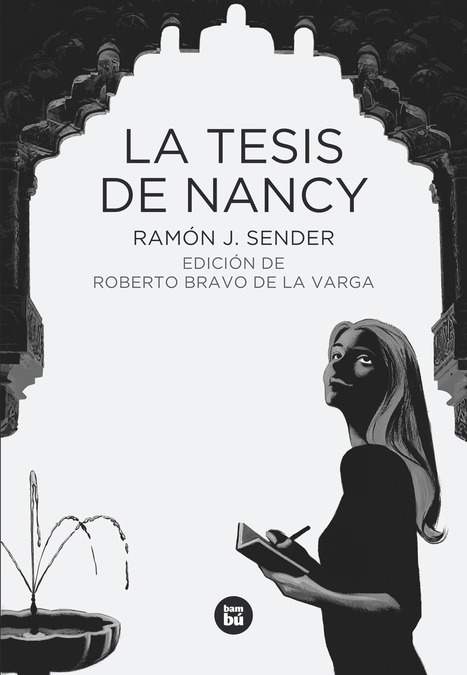
An American college student arrives in a small Andalusian town to research Spanish culture and finds herself immersed in a world of customs, expressions, and unwritten rules far more difficult to decipher than she expected. As she struggles to adapt to her new surroundings, her relationship with a young Romani man forces her to confront two radically different ways of understanding life. One of Ramón J. Sender’s most emblematic novels and a classic of twentieth-century Spanish literature.
Nancy, a young American student, arrives in Alcalá de Guadaíra, Andalusia, with the goal of gathering material for her doctoral thesis on Spanish culture. From there, she writes a series of letters to her cousin Betsy, recounting her experiences and the constant bewilderment caused by the local language and customs. Andalusian idioms, regional expressions, and traditional practices lead to one misunderstanding after another, especially as Nancy tends to interpret literally the figures of speech she cannot quite grasp.
Gradually, Nancy immerses herself in Andalusian life and comes into contact with the worlds of the Romani community and flamenco culture. She attends dances, gatherings, and local festivities while trying to decipher the customs and mindset of those around her. Among her new acquaintances, Curro stands out: a young Romani man who introduces her to new ways of feeling, expressing herself, and understanding life, bringing her ever closer to the reality she originally travelled to study.
Her stay in Andalusia also begins to challenge the certainties of the world she left behind. Richard, her former boyfriend in the United States, reads some of her letters and proposes marriage from afar. Nancy finds herself torn between her past and the new relationships and experiences she has discovered in Spain. At the same time, her connection with Curro grows increasingly profound, evolving into an intense love story shaped by passion, jealousy, and uncertainty about the future.
As the weeks pass, Nancy becomes familiar with a society that at first seemed strange and difficult to interpret, eventually falling in love not only with Curro but also with the world that had fascinated her from afar for so long. Her perception of Spain gradually changes, and the differences between her new life and her former one become increasingly apparent. Almost without realizing it, what she had initially approached as an academic subject becomes a transformative experience that forever changes her understanding of the world.
RELEVANT INFORMATION: Ramón J. Sender was not only a journalist but also one of the most important Spanish writers of the twentieth century, awarded the National Prize for Literature in 1935. Exiled after the Spanish Civil War, he spent most of his life in Mexico and the United States.
Nancy’s Thesis is a humorous and satirical epistolary novel that follows the journey of a young American woman through 1960s Andalusia. Its letter-based structure supports an agile, episodic narrative built around anecdotes, everyday situations, and cultural misunderstandings arising from the clash between two worlds.
Its audiovisual potential lies precisely in this cultural contrast, as well as in the richness of its characters and its Andalusian settings, which offer abundant opportunities for comedy and a distinctive visual identity. A film or television adaptation could place particular emphasis on the relationship between Nancy and Curro, developing their gradual emotional connection and transforming their romance into one of the story’s central narrative pillars.
AUDIOVISUAL POTENTIAL: TV Series, Limited Series, Feature Film, TV Movie.
AVAILABLE LANGUAGES: Spanish.
Adquirir los derechos
Para ponerte en contacto con nosotros completa el siguiente formulario y te responderemos en breve.
