
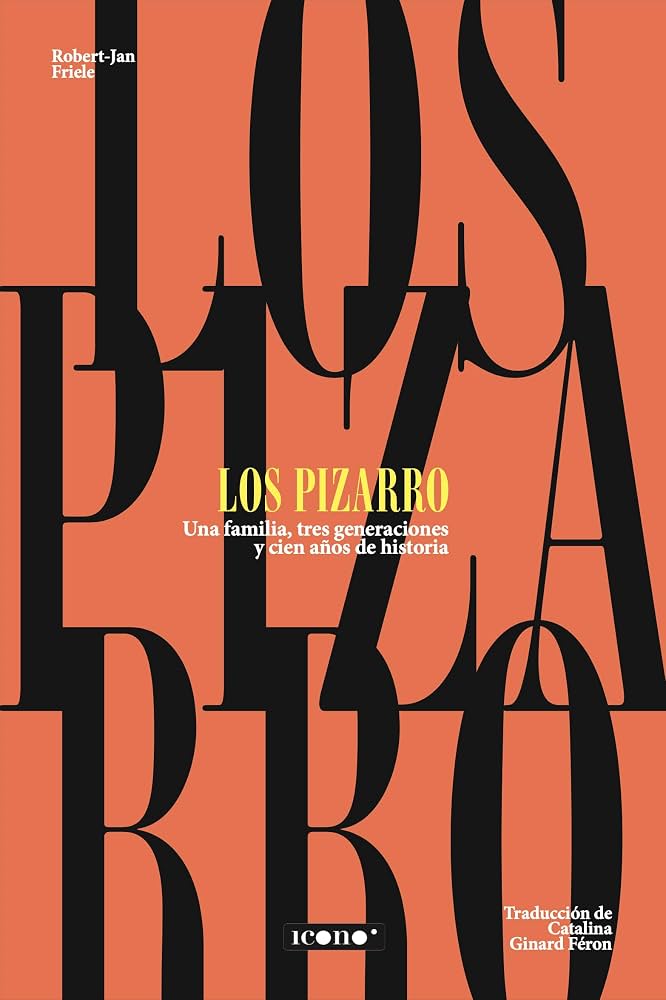
Based on an extraordinary true story, The Pizarros chronicles the journey of a family that, over the course of nearly a century, endures wars, revolutions, tragedies, and peace processes while its members struggle to build the Colombia they dream of. A sweeping family saga in which the intimate story of parents, children, and grandchildren ultimately mirrors the destiny of an entire nation.
The story of The Pizarros spans almost a century of Colombian history, yet it is always experienced from within a single family. What begins as the intimate chronicle of a marriage gradually becomes the portrait of a country torn apart by political violence, social struggles, and revolutionary dreams.
At the heart of the story are Juan Antonio Pizarro, known as “the Admiral,” an honorable military officer who deeply believes in institutions, and his wife Margoth Leongómez, a charismatic, generous, and free-spirited woman who becomes the true soul of the family. Together they build a large and close-knit household, convinced that their children will grow up in a better country. Yet as Colombia passes through decades of conflict and inequality, the outside world inevitably enters their home.
Coming of age during the 1960s and 1970s, the Pizarro children begin to follow very different paths. Eduardo gravitates toward political thought and intellectual debate; Juan Antonio becomes deeply involved in trade union activism; but Carlos, Nina, and Hernando reach the conclusion that democratic avenues no longer offer meaningful solutions. Like many young people of their generation, they embrace revolutionary struggle and ultimately join the guerrilla movement.
The decision changes the family forever. Life underground, arrests, exile, and imprisonment become part of the daily reality for parents forced to watch their children risk their lives for their ideals. Although ideological disagreements are constant, the family bond endures. The Pizarros discover that love and loyalty can survive even the deepest divisions.
Gradually, Carlos Pizarro’s journey becomes the story’s central thread. After breaking away from the FARC, he finds in the M-19 a movement more closely aligned with his political vision and eventually rises to become one of its principal leaders. Nina follows a similar path. Both place their hopes in a revolution capable of creating a more just society. Hernando, however, embarks upon an increasingly radical and darker course, convinced that any means are justified in the pursuit of change.
During the 1980s, Colombia appears to move simultaneously toward peace and toward catastrophe. The amnesty promoted by President Belisario Betancur creates an unprecedented opportunity for guerrilla groups to lay down their arms and enter legal politics. Carlos and Nina regain their freedom and participate in this attempt at national reconciliation. Yet violence persists. Political assassinations, the growth of paramilitary groups, and mutual distrust undermine the process. The country once again descends into a spiral of confrontation that culminates in some of the most traumatic episodes in its history, including the Palace of Justice siege.
At the same time, the family faces an even more devastating crisis. Hernando becomes associated with the Tacueyó Massacre, one of the most brutal episodes of guerrilla violence. For the first time, the Pizarros must confront not only the pain of war but also profound moral doubts about the cause for which some of them have sacrificed their lives. The fracture proves irreparable.
With time, Carlos arrives at an unexpected conclusion: the revolution he has fought for all his life can only survive if it abandons armed struggle. By then the leader of the M-19, he spearheads negotiations with the government, oversees the movement’s demobilization, and transforms it into a legal political party. His commitment to reconciliation turns him into one of Colombia’s most hopeful and popular public figures. For the first time, it seems possible to reconcile revolutionary ideals with democracy.
When he announces his candidacy for the presidency, Carlos comes to embody the promise of a new Colombia. Yet in 1990, he is assassinated during the electoral campaign. His death shocks the nation and shatters many of the hopes invested in the peace process. For the Pizarro family, it is the ultimate tragedy: the son who dedicated his life to revolution dies precisely when he has finally found an alternative to war.
In the final section of the story, the narrative passes to a new generation. Sons, daughters, and grandchildren inherit a legacy marked by sacrifice, ideals, mistakes, and loss. Some become political leaders, others artists and activists, but all must decide what to do with the legacy of a family that spent decades trying to change Colombia. The weapons are gone, yet the questions remain the same.
Through multiple generations, The Pizarros becomes a sweeping family saga where political epic and intimate drama coexist. It is the story of parents watching their children choose irreconcilable paths; of siblings united by affection and divided by ideology; and of a family whose trajectory ultimately reflects the wounds, contradictions, and hopes of an entire nation.
RELEVANT INFORMATION: Robert-Jan Friele is a Dutch writer and journalist who worked as a correspondent in Latin America between 2008 and 2012. His journalistic career has been shaped by a strong interest in political and social conflicts. In 2012, he was nominated for the De Tegel Journalism Prize for an interview with Tanja Nijmeijer.
His literary work focuses on narrative non-fiction and historical investigation, with a particular emphasis on Latin America. In 2021, he published The Pizarros, based on the real history of the family at its center, combining the rigor of non-fiction with the tools of the novel and dramatic storytelling.
Through an ensemble and multigenerational structure, Friele intertwines the intimate story of a family with the political history of Colombia, creating a narrative driven by powerful dramatic momentum, vivid scenes, dialogue, and ideological conflicts that evolve clearly from one generation to the next.
Its audiovisual potential is extraordinary. The material combines a large-scale family saga, complex and contradictory characters, compelling transformation arcs, and historical events of enormous dramatic power, all united by the epic ambition of telling a century of history through the bonds, fractures, and loyalties of a single family.
WHAT THE CRITICS SAY
“A page-turner that reads like a breathtaking novel.” — Trouw
“Each of its 46 chapters is written like a Netflix episode, with its own beginning and resolution, making it highly accessible and engaging.” — El Colombiano
“A family chronicle that encompasses the history of an entire country, with family members who become as beloved as Colombia itself.” — Humo
AUDIOVISUAL POTENTIAL: TV Series, Limited Series, Feature Film, TV Movie.
AVAILABLE LANGUAGES: Spanish, Dutch.
Adquirir los derechos
Para ponerte en contacto con nosotros completa el siguiente formulario y te responderemos en breve.
