
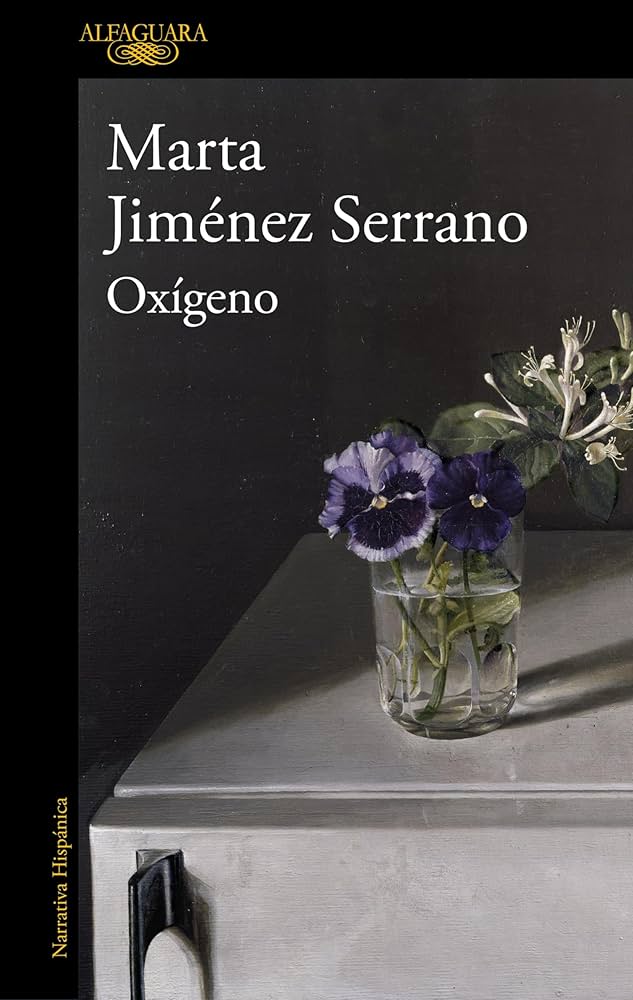
In November 2020, Marta Jiménez Serrano almost died from carbon monoxide poisoning in the apartment she had just rented with her boyfriend. From that accident begins an obsessive reconstruction: an investigation into the hours that nearly killed her, a silent denunciation of the precarious rental system, and, above all, a love story that sustains her as she tries to understand why she is still alive. A story from one of the most talented voices in contemporary Spanish literature.
On November 7, 2020, Marta Jiménez Serrano nearly died. Her boyfriend Juan found her lying unconscious on the bathroom floor of their apartment, with a head injury. He called 112. What seemed like a domestic accident was in fact carbon monoxide poisoning: the boiler had been poisoning them for hours while they, hungover, blamed their headache on the night before. Marta had 46% carbon monoxide in her blood. If Juan had not gone out to do the shopping and the SUMMA emergency team had not activated their detectors upon entering, neither of them would have survived to tell the story.
They had rented that apartment only a few months earlier, excited to finally build a home together after years of moving, borrowed rooms, and precarious contracts. Sitting on a bar terrace, they had toasted with hope: “To the apartment.” What they didn’t know was that this home was poisoned.
Behind the white walls and wooden floors was a boiler that had not been inspected since 2014, that had already shown signs of emitting carbon monoxide, and whose gas connection was illegal. The landlady, who lived in California, made it clear from the beginning that she did not want to take responsibility for anything. During the negotiation, they overlooked warning signs that now seem obvious: that she required them to pay for any repairs, that the gas bills never arrived because they were in her mother’s name, and that the actual maintenance of the apartment fell on people who were only passing through. The precariousness of the rental system—abusive contracts, absent landlords, unmonitored apartments—reveals itself here as more than a generational inconvenience: it can be a real threat. Marta and Juan almost paid for it with their lives.
Marta survives, and that is where the story changes direction. Because she does not remember the most important moment: the moment she was about to die. The center of the story lies outside her memory. So she begins to reconstruct it. She interviews Juan as if he were a witness. She tracks down the nurse who treated her in the ambulance. She reads medical reports, SUMMA protocols, scientific articles on carbon monoxide. She tries to piece together, fragment by fragment, the hours she did not see and the decisions that made it possible for her to stay alive.
In that process, another love story emerges: that of those who support her after everything has happened. Juan waits for her on a stretcher beside hers in the hospital corridor, holds her in bed when she cannot sleep for fear of disappearing, and accompanies her through silence and therapy. There are also other forms of love: that of her psychologist José, who helps her understand that her fear is not madness but a survival mechanism; that of the friends who were there, like Parra, who rescued her cat Canapé from the sealed apartment; and the love for herself, which she rebuilds through writing.
Through flashbacks, Marta connects this near-death experience with other moments in her life: her mother’s fainting spells when she was a child, the fear of falling asleep, the heavy blankets and dangerous braziers in the family home in the village, the “see you tomorrow, God willing” with which her grandmother Concha said goodnight every evening. Little by little, she understands that the awareness of fragility has always been there.
As she reconstructs what happened, anger also emerges: toward a rental system that normalizes unsafe housing, toward the chain of small acts of negligence that made the accident possible, and toward a landlady who sent a bouquet of flowers but refused to pay for the move when they had to leave the apartment.
And, above all, there is astonishment. The miracle—sometimes absurd—of being alive.
RELEVANT INFORMATION: Marta Jiménez Serrano is a Spanish writer, poet, and editor. For her work as a poet, she was awarded the runner-up prize of the 2020 Adonáis Poetry Prize, one of the most important awards for young authors in the Spanish language.
Oxygen is an autobiographical novel that, based on a near-death experience, reflects on themes such as love, friendship, family, and precarity. It has extraordinary audiovisual potential because its strength does not lie in a complex plot, but precisely in the power of its images and the universality of its themes.
The opening scene is a highly impactful cinematic beginning. From there, the narrative is built through flashbacks and a deep reflection on precarity, negligence, and the miracle of being alive. An intimate story that speaks to a structural problem affecting an entire generation.
What critics say:
“An emotional, precise, and literary text.” — Alana Portero
“A brilliant book… Memory, novel, and exploration of trauma. A beautiful hymn to life.” — Barnes & Noble
“A beautiful love story… balanced by a lucid analysis.” — El Cultural
“One of the most talented and intelligent writers of her generation.” — Laura Barrachina
AUDIOVISUAL POTENTIAL: TV Series, Miniseries, Film, TV Film.
AVAILABLE LANGUAGES: Spanish.
Adquirir los derechos
Para ponerte en contacto con nosotros completa el siguiente formulario y te responderemos en breve.
Error: Contact form not found.
