
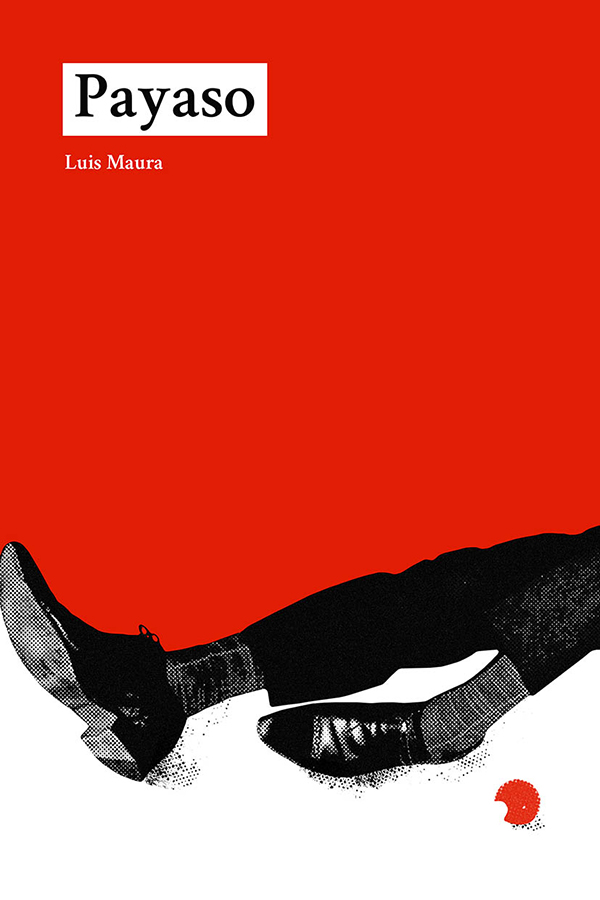
Miki, a struggling actor, flees through a shopping mall dressed as a clown, convinced the police are after him. And he’s not wrong: there’s a corpse in his fridge. To get rid of it, two friends will dress the body as a clown and parade it through Madrid as if it were a drunk friend, in a plan that becomes increasingly absurd and dangerous.
Miki García, a thirty-something actor in professional free fall, scrapes by in a tiny attic flat in Chueca, juggling precarious jobs that have little to do with his vocation. His latest gig borders on humiliating: dressed as a clown, he hands out balloons in a shopping mall in the middle of July. But that day, as he rushes frantically through families and strollers, one thought dominates his mind: the police are coming for him.
He hides in the bathroom, rips off his wig, wipes away his makeup with trembling hands, and calls his best friend Loreto, an eccentric crochet artist with green hair. When she arrives at his flat, Miki blurts out the truth: he has killed a man. Or at least, he thinks he has.
The story then flashes back to the previous night. Trapped in a life of failed auditions and relationships that never quite work out, Miki stumbles upon an art gallery in his neighborhood and becomes fascinated by a self-portrait of Bosco Moriarty, a magnetic red-haired painter. Hours later, chance—or bad luck—brings them together in a bar. Bosco is with his partner Chema, an arrogant TV producer who flaunts his connections and power.
What begins as a potential professional opportunity turns into an increasingly murky and uncomfortable night. Amid alcohol, cocaine, and vague job promises, the three end up in Miki’s tiny apartment. There, in the bathroom, Chema uses his position of power to corner him. The encounter is confusing, violent, degrading. Chema repeatedly asks Miki to strangle him. Overwhelmed, Miki squeezes too hard. When he snaps out of it, Chema has stopped breathing.
In shock, Miki drags the body and hides it in the only possible place: his oversized red refrigerator, absurdly disproportionate to the size of the flat. That’s where Loreto finds it hours later—Miki frozen, with a corpse beginning to smell in his kitchen.
Loreto doesn’t panic. She thinks. Then she acts. She decides to help him and comes up with a plan as ridiculous as it is effective: get the body out of the house by dressing it as a clown and passing it off as a drunk friend. To complete the operation, she calls her ex-girlfriend “the Butcher,” an Andalusian butcher who drives a van and handles knives with ease.
The plan goes wrong from the start. Bosco, alarmed by his partner’s disappearance, shows up at the building and grows suspicious. He begins to follow them. From that moment on, the situation turns into a chaotic nighttime chase across Madrid: a costumed corpse in the back seat, a makeshift getaway van, and a BMW tailing them.
The pursuit ends when Loreto and the Butcher manage to corner Bosco. They drag him out of the car at knifepoint, intimidate him, and make it clear that if he talks, he goes down too: he was there, involved in everything, and has too much to lose. Besides, Chema’s death conveniently erases a significant debt Bosco owed him. Trapped between fear and self-interest, Bosco decides to keep quiet.
With the problem seemingly under control, they head to a reservoir to dispose of the body. But there, Miki breaks down. He can’t take it anymore. He wants to confess, to stop. Loreto won’t allow it. Before he can react, she knocks him out cold with a sharp punch to the face.
When Miki wakes up hours later, he’s alone in the van, in his underwear, sweating, with a black eye. The body is gone. No one explains anything. Loreto and the Butcher are calmly swimming nearby as if it were just another Sunday.
Miki doesn’t understand what has happened, but he no longer has the strength to ask.
Back in Madrid, life goes on. Standing in front of the mirror, wearing his clown nose, he receives a call from his agent: he didn’t get the sausage commercial he was hoping for. Silence. Miki hangs up.
He has just killed a man, crossed the city with a corpse in disguise, lost it in a reservoir… and the only thing that truly bothers him is not getting cast in a sausage commercial.
RELEVANT INFORMATION: Luis Maura is a Spanish writer, actor, and teacher. His work explores identity, memory, and queer experience. Throughout his career, he has received several awards, including first prize in the Young Artists competition of Cáceres (2010) and third prize in the II Pocket Theatre Festival (2018).
Clown is a novel that masterfully blends thriller and outrageous dark comedy, with a fast-paced rhythm and charismatic characters: Loreto, the fiercely loyal friend capable of anything; the Butcher, an Andalusian butcher with knives in her glove compartment; and Bosco, the handsome, classist villain who sets the tragedy in motion.
The clown costume as a unifying visual element, the nocturnal chase, the cemetery reckoning, and the final catharsis at the reservoir all shape a story perfectly suited for the screen. With sharp dialogue, strong doses of dark humor, and an open ending, Clown has everything needed to become an addictive series or film for streaming platforms.
AUDIOVISUAL POTENTIAL: TV Series, Miniseries, Film, TV Movie
AVAILABLE LANGUAGES: Spanish
Adquirir los derechos
Para ponerte en contacto con nosotros completa el siguiente formulario y te responderemos en breve.
Error: Contact form not found.
