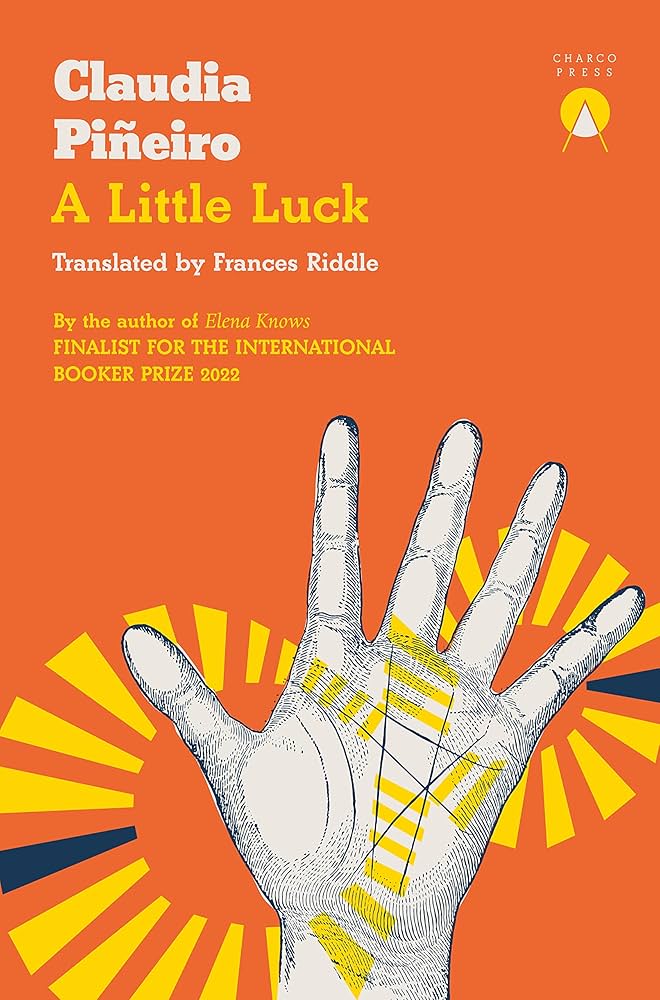
Twenty years after fleeing the place she once called home, a woman returns. But the person who comes back is no longer the same: she looks different, her voice has changed, and she no longer even uses her real name. She believes no one will recognize her, until the gaze of someone who was once her entire world forces her to ask whether her return was chance, fate, or simply a stroke of small luck.
Mary Lohan, an Argentine professor living in Boston, returns to her homeland after twenty years. But Mary is not who she appears to be. Her real name is María Elena, and she has come back to Buenos Aires with a very specific mission. Representing the prestigious Garlic Institute, she has been assigned to evaluate the academic standards of Saint Peter School in Temperley.
Yet the trip is far from accidental. Before his death, her husband Robert Lohan made sure the assignment would land in her hands. It was his final gift to her: one last push to confront the event that divided her life in two and haunted her relentlessly for two decades. The death of a child, the rejection of an entire community, and above all, the devastating decision to leave behind her six-year-old son, Federico.
It all began twenty years earlier. María Elena was driving to the movies with Federico and Juan, a childhood friend who had joined them for the outing. At a railway crossing, with the barriers already lowered, the car became stranded on the tracks as a train approached. In a panic, María Elena managed to pull Federico out of the vehicle, but she could not save Juan, who remained trapped inside and was killed by the train.
The tragedy unleashed a devastating backlash. The community made her the target of all blame, and the condemnation was relentless. Mariano, her husband at the time, could offer no refuge. Though he never openly accused her, he held her responsible for what had happened. He refused to leave and start over elsewhere, making it clear that if she could no longer endure the social punishment, she would have to leave alone.
Convinced that the hatred directed at her would eventually poison Federico’s life as well, María Elena made the most painful decision she would ever face. She disappeared. She moved to the United States, where she met Robert Lohan, and rebuilt her existence as best she could, though she never truly escaped her past.
Now, twenty years later, she has returned to Buenos Aires. During interviews with teachers at Saint Peter School, she watches Federico walk into her office. He is now a history teacher at the institution. He appears not to recognize her. Yet the following day he hands her a manuscript he has been working on for years: a meticulous reconstruction of the accident as seen through the eyes of the child he once was. The text ends with a question that has haunted him all his life: why did his mother leave after they had survived such a terrible tragedy together?
Deeply moved, María Elena retreats to write her own account of what happened. In its pages, she tries to explain that she did not leave because she loved him too little, but because she loved him too much. Her love was so desperate that she convinced herself her absence was the only way to free him from the suffering she believed she had caused. When she finishes, she signs the manuscript with her real name, María Elena Pujol, and leaves it for him before returning to Boston.
Weeks later, she receives an email from Federico. He will be traveling to Boston as Saint Peter’s representative to sign institutional agreements. Accompanying him are his wife, Ariana, and their young daughter, Amelia.
At Logan Airport, María Elena waits for them. When Ariana places the baby in her arms, she holds her silently while watching her son and daughter-in-law walk ahead of her, embracing each other. After twenty years of silence, guilt, and an absence she once believed irreversible, she finally possesses an image that belongs not to the past, but to the future. A small piece of luck.
RELEVANT INFORMATION: A Little Luck is a family drama with strong emotional undertones that explores guilt, forgiveness, and the different ways people confront adversity.
Its protagonist, a mother who abandoned her son in an attempt to protect him, is a complex female character ideally suited for a feature film or an intimate limited series. The reunion with her son years later sustains the story’s central tension, while the contrast between Boston and Temperley provides a visually rich atmosphere. At its core, it is a story about motherhood and the possibility of forgiving oneself.
Claudia Piñeiro, known as The First Lady of Argentine Crime Fiction, is one of the most acclaimed voices in contemporary Latin American literature. She is the most translated Argentine author after Borges and Cortázar and one of the most frequently adapted Spanish-language writers for film and television today.
Among her many distinctions are the Clarín Prize, the Latin American Prize for Children’s and Young Adult Literature, the Pléyade Prize, the ACE Award, the LiBeraturpreis, the Sor Juana Inés de la Cruz Prize, and the Pepe Carvalho Prize. She has also been shortlisted for the Planeta Argentina Prize and the La Sonrisa Vertical Prize and was selected in the Edebé Publishing Competition.
CRITICAL ACCLAIM
“Piñeiro employs a repetitive style that emphasizes both the atrocity of the events and the intensity of the pain […] She explores with remarkable credibility the abyss of difficult feelings and disturbing emotions. A great novel.” Ascensión Rivas, El Cultural
“Piñeiro is a deservedly celebrated voice who, beyond delighting us with outstanding literature, has helped empower and internationalize the Argentine feminist movement. […] Her plots reject intolerance and reflect a sharp, biting reality that drags the reader in and tears at the soul through a distinctive, daring, and unmistakable style.” Marta Grau, Núvol
“Hitchcock is a woman living in Buenos Aires.” Antonio D’Orrico, Corriere della Sera
“A Little Luck is a story that captivates readers from its opening lines. The author manages to draw us into the events so irresistibly that their memory lingers long after the novel has ended.” Javier Pintor, Qué Leer
“The dramatic and unexpected personal ordeal triggered by the recognition of her son gives rise to the novel’s finest passages.” Nicolás Miñambres, Filandón
AUDIOVISUAL POTENTIAL: In development.
AVAILABLE LANGUAGES: Spanish, English, Portuguese, Italian, Hebrew, Dutch, German, French, Bulgarian, Polish.