
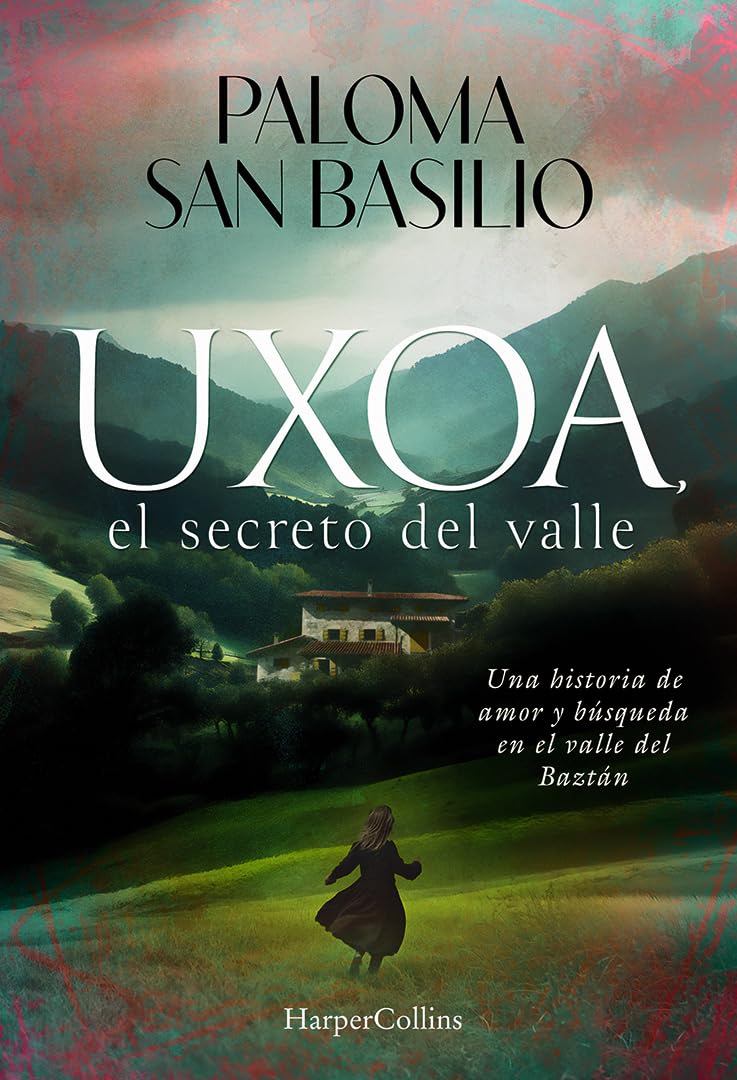
After losing her sister, Ágara leaves Madrid and retreats to a farmhouse in the Baztán Valley, where the silence of the landscape awakens questions about her past. As she investigates the origins of the farmhouse and her family, she finds in Íñigo, the village librarian, an unexpected ally. A new and deeply emotional novel by Paloma San Basilio—a romantic and moving drama about grief, identity, and memory.
After the death of her sister Ainoa and her father Ramón, Ágara leaves Madrid and returns to the family farmhouse, Uxoa, in the Baztán Valley. She arrives during the pandemic, exhausted and emotionally adrift, seeking silence and a way to rebuild herself. The house has been closed for years and seems frozen in time. As she cleans and begins to inhabit it again, Ágara senses that the place holds a sorrow older than her own grief. What begins as a refuge soon becomes a deeper necessity: to understand who the farmhouse’s first inhabitants were and why it was abandoned.
In that search she meets Íñigo, the village librarian, a young Argentine descended from immigrants who has returned to the valley to take charge of a family inheritance. A relationship grows between them, built on complicity, attentive listening, and mutual support. Together they begin to investigate Uxoa’s past through archives, parish records, and old letters. They discover that, at the end of the 18th century, the farmhouse’s original heir was expelled from the valley after falling in love with Ainara, a young agote woman. The agotes were a historically marginalized community in Navarre, considered impure and socially segregated, making any union with them impossible. Forced to leave, the young man emigrated first to Cádiz and later to Peru, promising to return for her.
Ainara became pregnant and, completely alone, gave birth to a daughter she named Uxoa. To protect her from social stigma, she was forced to give the child up for adoption to a family in Pamplona. From Lima, the father maintained an intense correspondence with Ainara and struggled for years to rebuild his life. Eventually, he located his daughter and made a decisive choice: he sold the farmhouse on the express condition that ownership legally pass to the girl. That girl is the origin of Ágara’s maternal lineage. Ainara later managed to travel to Peru to reunite with him, leaving Uxoa with her adoptive family. As an adult, that daughter would return to Baztán as the rightful owner of the farmhouse, closing a circle begun by a thwarted love and social injustice.
As the past comes back into focus, the present grows unsettling. In the family apartment in Madrid, Ágara finds coded messages her father left hidden among his papers. With Íñigo’s help, she deciphers them, and they discover that Ramón did not die in an accident. Following the clues, they travel to Lhasa, capital of Tibet, under Chinese control, where they learn that Ramón had been recruited as an intermediary thanks to his deep knowledge of the region and was collaborating with a clandestine network seeking to expose the plans of a radical faction within the Chinese government. After coming into contact with that information, he and others involved were murdered. Watched and threatened, Ágara and Íñigo survive an assassination attempt and flee by road to Nepal before managing to return to Spain.
Back in Madrid, they hand over all documentation and evidence to Fernando, Ramón’s lawyer and close friend, who submits it to the authorities to initiate an official investigation. Finally freed from the mystery surrounding her family, Ágara makes a definitive decision: she sells her Madrid apartment and settles permanently in Uxoa with Íñigo, committing to a shared life in the valley.
The last letters arriving from Peru confirm the sacrifice that couple once made to secure their daughter’s future. Reconciled with her heritage and with herself, Ágara announces her pregnancy. She will name her daughter Uxoa. The farmhouse finally beats again as a home: a place where an interrupted love finds repair, and where past and present merge into a tangible and living hope.
RELEVANT INFORMATION: Paloma San Basilio is a Spanish singer, composer, actress, and writer, recognized as one of the most emblematic figures of melodic music and musical theater in Spain and the Spanish-speaking world. She has received numerous awards and distinctions, including the Antena de Oro, the Latin Grammy Award, the Medalla de Oro al Mérito en las Bellas Artes, the Premios ACE, and other honorary recognitions for her contribution to culture and the performing arts. Alongside her artistic career, she has developed a literary facet that combines personal essays on music and creativity with emotionally charged novels and complex plots.
Uxoa: el secreto del valle is a deeply moving novel that skillfully blends family drama with elements of romance and contemporary-historical thriller, supported by a powerful dual timeline. Ágara’s emotional journey offers a strong protagonist arc, reinforced by her love story with Íñigo, which mirrors the impossible love of Ainara and Asier. The use of the past as the key to the present generates constant suspense and a mystery that sustains tension throughout. It is a proposal easily adaptable into an audiovisual project with strong emotional weight and thriller elements.
AUDIOVISUAL POTENTIAL: TV Series, Miniseries, Feature Film, TV Movie.
AVAILABLE LANGUAGES: Spanish.
Adquirir los derechos
Para ponerte en contacto con nosotros completa el siguiente formulario y te responderemos en breve.
Error: Contact form not found.
