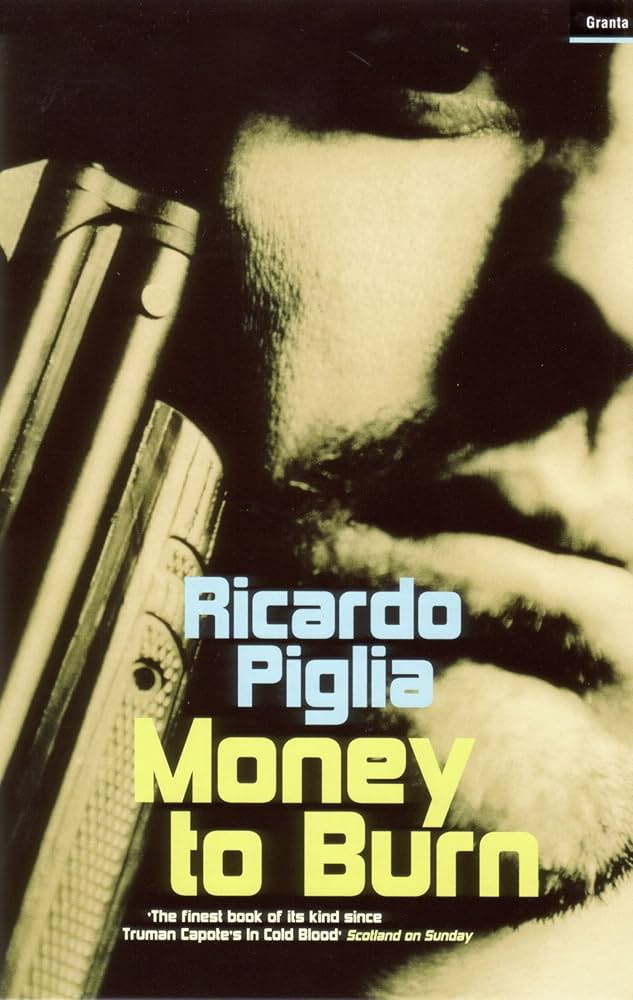
An extraordinary novel based on real events. The story of the robbery of an armored truck in Buenos Aires that escalates into a brutal police siege. A gripping narrative, full of unexpected twists, from the internationally acclaimed and award-winning pen of Ricardo Piglia.
Set in the 1960s and based on real events, Burnt Money tells the story of a robbery of an armored truck in San Fernando, in the province of Buenos Aires. The heist, meticulously planned, is carried out by a gang of professional criminals led by Malito, a strategist obsessed with precision, safety, and control. Among the most prominent members are Nene Brignone and Gaucho Dorda, known as “the twins,” though they are not related; they are lovers and central figures in the story.
The gang plans the robbery with military precision. They obtain inside information through Fontán Reyes, a washed-up tango singer who acts as the informant. On the day of the heist, September 27, 1965, they strike in broad daylight, stealing over seven million pesos and killing several guards and a civilian in a brutal burst of violence.
During their escape, the robbers evade multiple police checkpoints and manage to reach Montevideo, Uruguay. There, they rent an apartment using the stolen money while Argentine and Uruguayan authorities launch an intense manhunt. The confinement and pressure begin to take their toll. Gaucho’s mental state deteriorates, while Nene spirals under drug dependency and mounting tension. Malito, cold and methodical, tries to maintain control, but paranoia spreads.
Eventually, the Uruguayan police surround the apartment in a spectacular operation broadcast live on the radio. The gang barricades themselves inside and resists for hours. The situation ends in a massacre: all of them are either gunned down or take their own lives before being captured, while the money burns in a fire set by the fugitives themselves. Only the echo of the tragedy remains.
RELEVANT INFORMATION: Ricardo Piglia (Adrogué, 1941 – Buenos Aires, 2017) is widely regarded as a classic of contemporary Spanish-language literature and the recipient of numerous prestigious awards, including the Premio Rómulo Gallegos, Premio Planeta Argentina, Premio José Donoso, Premio Formentor de las Letras, and Premio Casa de las Américas, among many others.
Money to Burn recreates one of the most famous heists in Argentine history. Straddling the line between fiction and nonfiction narrative, Piglia constructed the novel using privileged access to confidential materials: judicial files, transcripts of secret police recordings during the siege of the Herrera y Obes apartment, witness testimonies, and journalistic chronicles. With this material, he reconstructed not only the events but also the voices of the characters, the atmosphere of the time, and the drama with remarkable precision. The result is a raw, powerful, and deeply moving novel with an unrelenting pace.
Its narrative and dramatic strength, along with its masterful combination of intense action scenes, sustained tension, complex characters, and a layer of social critique, make it particularly suitable for adaptation. Its fragmented, almost documentary-like structure allows for multiple perspectives and a visually striking narrative—ideal for a true crime or action-driven adaptation.
PRESS REVIEWS:
“In the best tradition of Argentine literature that engages with unlawful violence, Piglia has written a great amoral novel. He writes with the sole conviction of observation, stripping away stylistic decorum and relying on the intelligence and practical skill of storytelling.” (Graciela Speranza, Clarín).
“Harsh, rigorous, forceful, Money to Burn reconstructs a police event of almost operatic proportions from the 1960s, which Piglia investigated over a long period.” (Hugo Caligaris, La Nación).
“Crime, paranoia, conspiracy, and marginality: Ricardo Piglia found in the real story of bank robbers the essence of his own literature.” (Martín Kohan, Los Inrockuptibles).
“Artificial Respiration, The Absent City, and Eternal Prison are by now essential classics of national literature, and Ricardo Piglia has become—perhaps despite himself—an unavoidable reference in the Argentine literary landscape.” (Astrid Pikielny, La Nación).
AUDIOVISUAL POTENTIAL: TV Series, Miniseries, Film, TV Film.
AVAILABLE LANGUAGES: Spanish, English, Italian, Dutch, Indonesian, Greek, French, German, Arabic, Polish, Croatian, Russian, Chinese, Vietnamese.