
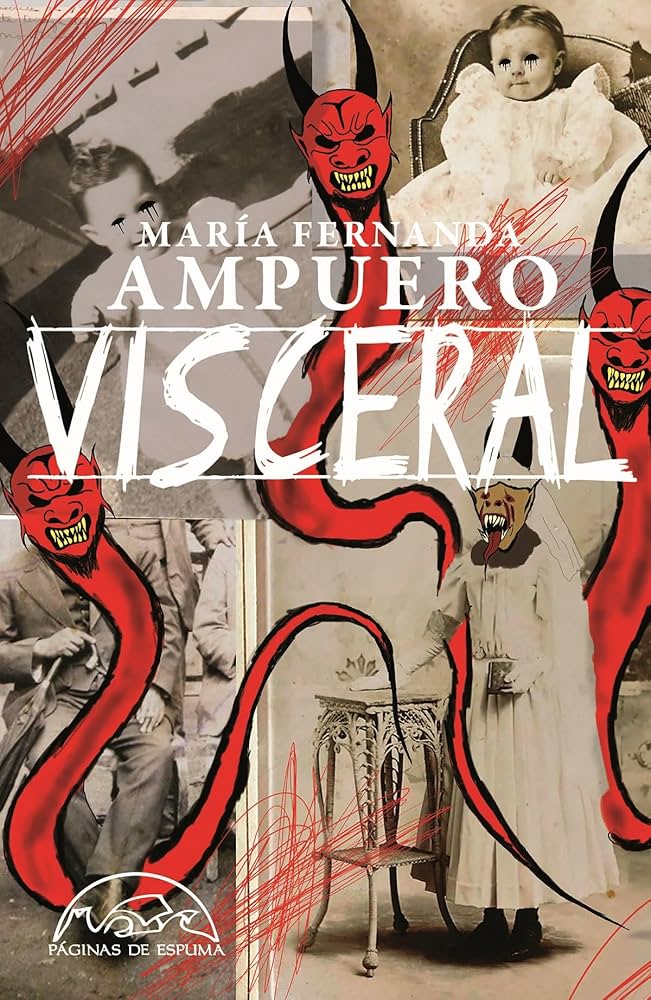
Between autobiography and a furious manifesto, María Fernanda Ampuero strips bare her violated and rejected body to explore gender-based violence, mental health, frustrated motherhood, and exile. A raw journey through her obsessions and memories that becomes a monstrously honest cry against everything that tried to silence her.
Visceral is María Fernanda Ampuero opening herself up completely. It is not just a collection of short essays: it is a self-performed autopsy, page after page.
The writer takes her body, her childhood, her experiences of violence, and lays them out as if placing entrails on a table for someone to truly look at. The book has no linear plot, but rather a memory that twists in on itself, moving from a collective scream to an intimate whisper, from political denunciation to the most domestic pain.
It begins with rage. Rage because women are still forbidden from deciding over their own bodies, because in Ecuador raped girls are forced to give birth, because in the United States the right to abortion has been overturned and the far right advances trampling over bodies. Ampuero draws on the literature of other women who have written about the horror of unwanted pregnancy and turns that anger into the driving force of everything that follows. But this rage is not abstract: it has the shape of a body. Hers.
The fat body her mother—former beauty queen—gestated through midnight cravings for chocolate cake, and later punished with diets, amphetamines, and injections of who-knows-what. The body that classmates chased shouting “Ampuerca,” the body men always assumed was available. She recounts abuse at age eight in a park while her friend Genoveva watched; the harassment by a friend’s brother who locked her in a bedroom repeating “there’s no age for love”; the rape in adulthood after a Tinder date. She also tells of a relationship with a nearly forty-year-old teacher when she was eighteen—a man who took her to porn cinemas and seedy bars, who called her his “lover” and forced her to prove she wasn’t a “scared little rich girl.”
Migration is another wound. She leaves Guayaquil—a tropical city where dreams suffocate in heat and conformity—and crosses the Atlantic to become a “barbarian” in the Empire. In “Barbarians,” she writes to her dead father: she tells him what it is like to live as a foreigner who is always asked where she comes from, who must justify her presence, who hears “if you don’t like it, leave.” Madrid both shelters and strips her, but she walks its streets until they become hers. She builds a life with a man who does not want children. At thirty-seven, she discovers she no longer has viable eggs. A dry womb. The relationship breaks apart. She is left with a stuffed mouse named Mauri—the symbolic child they shared—eventually given to an immigrant family when she decides to leave Madrid.
Mental health is another haunting presence. Her father made it clear: “there will be no crazy women in my house.” But the “crazy woman” is there, with diagnoses of depression and bipolar disorder, taking seven pills a day, wearing a mask so no one notices she is burning inside. She denounces stigma, lack of resources, and loneliness. The pandemic finds her locked down with a stranger—a man she had a date with the night curfew was declared. Seven months together in a Madrid apartment. Seven months of fear, sex, role play, mutual care, and a fog that covered everything. He nearly dies of COVID. When the fog lifts, he leaves. He never said “I love you.”
Ampuero writes as if pulling out nails one by one. There is no redemption, no comfort. There is a woman looking at her life and telling it with the same fury with which she has lived it. Because, as she says, she does not want peace or mindfulness: she wants to embrace her anger, dance it, write it. And in the end, after wandering among the corpses of Madrid, the madness of the upstairs neighbor, the trees dying in autumn, and the bonsai that did not survive confinement, the only certainty is that the end of the world is not a cataclysm: it is continuing to be here, carrying fragility, learning to live with one’s own monsters.
RELEVANT INFORMATION: María Fernanda Ampuero is an Ecuadorian writer and journalist who has collaborated with numerous international media outlets. She has received the Hijos de Mary Shelley Prize, the Cosecha Eñe Prize, and the Joaquín Gallegos Lara Prize, awarded by the Municipality of Quito.
Visceral is a work composed of several essays and narratives that sit between autobiography, memoir, and autofiction. It travels through episodes, experiences, fears, and obsessions of the author to reflect on violence against women, the body, colonialism, childhood, motherhood, and more. A true manifesto of brutal and raw honesty, with strong audiovisual potential: its fragmented structure and its vivid, cinematic imagery could translate into a production that lies somewhere between gritty realism and the oneiric.
AUDIOVISUAL POTENTIAL: TV Series, Miniseries, Film, TV Movie.
AVAILABLE LANGUAGES: Spanish and Portuguese.
Adquirir los derechos
Para ponerte en contacto con nosotros completa el siguiente formulario y te responderemos en breve.
