
In the near future, a revolutionary technology turns the minds of people in vegetative states into the world’s most exclusive tourist destination. But when an investigator begins encountering the same figure in every mind he visits, he uncovers a secret capable of erasing the boundaries between victims, perpetrators, and memories.
In the near future, a revolutionary technology opens humanity’s last unexplored territory: the human mind. Thanks to this breakthrough, it becomes possible to explore the remnants of brain activity in people living in vegetative states, transforming their consciousness into mental landscapes that can be navigated as if they were real places. Other people’s memories have become a new tourist destination. Among the Explorers tasked with testing the system is Lucas Terán, one of the project’s most skilled pioneers.
During his journeys, Lucas discovers a presence that defies explanation. Across mental landscapes belonging to different individuals, the same young girl always appears: a black-haired child with a mark on her cheek and the unsettling habit of eating ground glass. While the project’s leaders dismiss these visions as mere side effects, Lucas becomes convinced that all the minds he explores are connected by something far deeper and more disturbing than the technology can explain.
As testing progresses, the Explorers begin suffering intrusive memories, hallucinations, physical alterations, and increasing fractures of identity. The experiences no longer remain confined to the system and start bleeding into reality. Obsessed with discovering who the girl is and what her presence means, Lucas comes into conflict with Mariela Lugones, the scientist overseeing the project and his former partner, who remains committed to finding rational explanations for phenomena that are becoming increasingly impossible to control.
Each new immersion brings Lucas closer to a truth no one wants to hear. Convinced that the anomalies are not technical failures but evidence of something real, he continues investigating until he suffers a collapse that leaves him trapped inside the system itself, becoming one of the bodies whose consciousness can now be explored. Determined to uncover what he learned before disappearing, Mariela secretly accesses the remnants of his mind. There, she encounters a young woman capable of remembering other people’s lives, speaking in different voices, and revealing impossible details about her past. Her investigation leads her to Soledad, Mariela’s long-lost sister, and to a crime hidden for years: her abduction and murder at the hands of a group of men that included Lucas himself.
Yet the truth proves even more disturbing than the solution to a crime. The technology has opened a network of shared memories where pain, violence, and trauma from countless people remain alive, circulating from one mind to another. What seemed to be a tool for exploring isolated consciousnesses becomes a gateway into a collective memory impossible to contain.
When the technology eventually escapes the laboratory, underground networks emerge that allow anyone to connect to the minds of people in vegetative states. Within a few years, the experience becomes a global phenomenon. Millions of users turn to it as a form of entertainment, escapism, or addiction, visiting other people’s memories as easily as they once consumed digital content. But every connection leaves traces behind. People begin absorbing emotions, obsessions, desires, and memories they never experienced. Some develop entirely new identities, while others become trapped by self-destructive impulses or recurring visions that invade their everyday lives. Little by little, the boundary between one’s own experiences and those of others begins to dissolve, drawing humanity into a vast network of contaminated consciousnesses.
At the center of this process remains the girl who eats glass. What first appears to be the fragmented memory of a single victim ultimately reveals itself to be something far more complex: a presence that moves across countless minds, carrying the traces of many different lives. Soledad’s figure ceases to represent only one murdered young woman and comes to embody every forgotten victim, every buried trauma, and every story someone tried to erase. As individual identities dissolve into this shared memory, the expansion of the system permanently transforms the way human beings remember, feel, and relate to one another. The crime that sparked the investigation can no longer be hidden, yet it can never truly be resolved either. It becomes part of a collective wound that continues to grow.
The novel concludes with a disturbing certainty: the world has changed irreversibly. There are no longer clear boundaries between victims and perpetrators, between memories that belong to us and those that do not, between the living and the dead. Everyone has become part of the same network, where experiences continue to be transmitted and transformed. Where technology once promised to conquer human memory, something impossible to control emerges instead: the constant return of everything the world would rather forget.
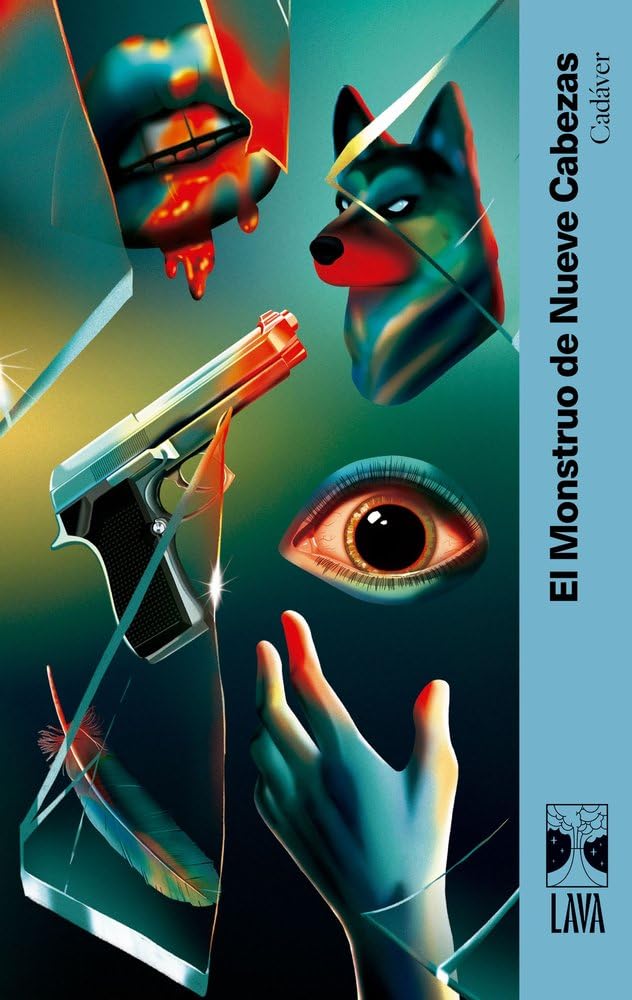
RELEVANT INFORMATION: Corpse is the first novel by El Monstruo de Nueve Cabezas (The Nine-Headed Monster), a collective formed by nine of the most prominent voices in Spanish-language science fiction, horror, and weird fiction: Maximiliano Barrientos, Lucila Grossman, Lola Ancira, Giovanna Rivero, Luis Carlos Barragán, Karen Andrea Reyes, Mafe Moscoso, Elisenda Solsona, and Elaine Vilar Madruga. Coming from different countries and literary traditions, their creative visions converge in a narrative experiment of extraordinary thematic and formal ambition.
Beneath the surface of a science-fiction thriller, Corpse evolves into an unsettling horror novel about memory, guilt, and the exploitation of suffering. The work possesses enormous audiovisual potential as either a series or a feature film thanks to its highly visual and commercially compelling premise. The central investigation, the mystery connecting every exploration, and the final revelation build a gripping thriller with powerful dramatic impact, while its science-fiction and horror imagery evokes contemporary touchstones such as Black Mirror, Severance, and Dark. Added to this is an emotional and political undercurrent that transcends genre and gives the story universal resonance.
WHAT READERS ARE SAYING
“An outstanding novel from beginning to end.” Sueños entre letras
“A highly original and daring proposal that truly works.” Sueños entre letras
“The novel achieves remarkable cohesion.” Y Qué Leo Yo (Goodreads)
AUDIOVISUAL POTENTIAL: TV Series, Limited Series, Feature Film, TV Film.
AVAILABLE LANGUAGES: Spanish.
Adquirir los derechos
Para ponerte en contacto con nosotros completa el siguiente formulario y te responderemos en breve.
