
Women and children on the edge of the abyss, migrants, girls, and sacrificed bodies inhabit these stories where real violence surpasses supernatural terror. A visceral collection that explores how the deepest horror does not come from outside, but from the homes that are meant to protect us.
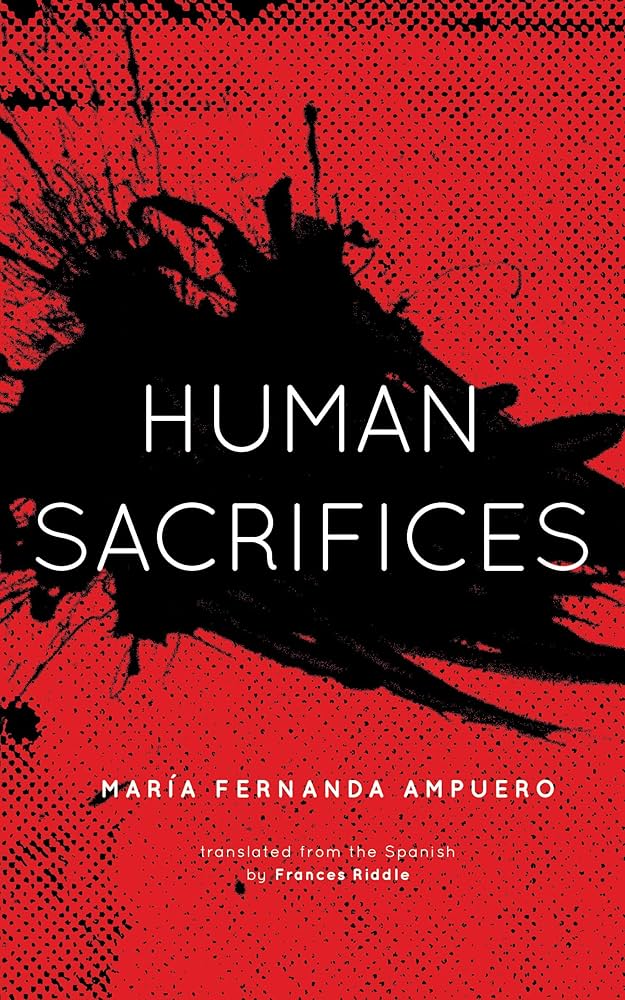
Human Sacrifices, María Fernanda Ampuero’s second short story collection following the international success of Cockfight, explores structural violence, the body as a territory of domination, and the fragility of those living on the margins.
With visceral prose and a tone that oscillates between the raw and the lyrical, the stories delve into lives marked by forced migration, abuse, poverty, and domestic horror—where monstrosity often lurks within the home itself.
In “Biography,” an undocumented woman accepts a job from a man named Alberto to write his life story in a remote house. There, she discovers that he and his twin brother—a violent presence—have collected passports and locks of hair from missing migrant women. Terrified, she escapes at dawn as the shadows of other “sisters” whisper for her to tell their story.
In “Believers,” a young girl takes refuge at her grandmother’s house during violent protests. There, she meets Marisol, the maid’s daughter, and together they spy on “The Believers,” two blond men renting a storage unit. As the city burns, the men bring children, and Marisol senses the horror the narrator refuses to see.
“Whistles” tells of a mother recounting her youth in the countryside, where her grandmother warned her about “The Whistler,” an entity that mimics familiar voices to lure girls outside, never to return. As a teenager, she heard a whistle and looked—but saw no one. That disobedience foreshadowed a life of silence.
In “The Chosen,” a group of marginalized girls gather in a cemetery where four idolized surfers are buried. On a blood-moon night, they dance naked on the graves and possess the corpses in an act of revenge.
“Little Sister” portrays three teenage girls bound by a cruel friendship. One cousin, obsessed with thinness, mistreats the narrator and uses Mariela as a servant. When they play with a Ouija board, they awaken something evil. Mariela leads them to a hidden room where her decomposing parents guard a cradle holding her “little sister,” who has chosen the cousin to feed on.
In “Leeches,” a boy forced to include Julito—a disabled child rejected by everyone—in his games takes revenge by locking him in a broken refrigerator. At dusk, when Julito’s mother searches desperately, the narrator, pressured by his own mother, reveals the hiding place.
“Invasions” follows a couple in crisis who cannot find their car in an empty parking lot. As they argue over infidelity, the lights go out and they hear a hoofed creature approaching.
In “Pietà,” Edith, the wife of an old man who abuses his daughters, maintains a secret relationship. When she confesses the horror to her lover, he disappears. One night, upon catching her husband about to assault the youngest girl, he ties Edith up and sends her away on a donkey, warning her not to look back. She hears her lover’s voice, turns—and becomes a pillar of salt.
“Sacrifices” tells the story of Lorena, an immigrant who marries John, a soldier. Their initial passion turns into alcoholism, beatings, and systematic rape. One night, after an assault, she takes a knife.
Finally, in “Freaks,” a boy rescues a “big-headed” deformed child abandoned among pigs in a circus and flees with him toward a cliff. As they leap into the sea, their legs merge into a fishtail.
RELEVANT INFORMATION: María Fernanda Ampuero is an Ecuadorian writer and journalist who has collaborated with numerous international media outlets. She has received the Hijos de Mary Shelley Prize, the Cosecha Eñe Prize, and the Joaquín Gallegos Lara Prize, awarded by the Municipality of Quito.
Human Sacrifices is an anthology of social horror that portrays everyday violence with a rawness that turns the domestic into nightmare. Ampuero uses the body as a battlefield: migration, abuse, poverty, and real monsters that coexist with the supernatural. Its audiovisual potential is immense—each story functions as a standalone short film filled with oppressive atmospheres, pure tension, and striking endings.
About María Fernanda Ampuero:
“Stories always clinging to that gelatinous membrane we call reality […] distinctly poetic, symbolically powerful, tense, sometimes even nervous.” — Jorge Carrión, The New York Times
“An ethical response in readers who do not turn away from the violence of capitalism and patriarchy in societies increasingly vulnerable to poverty and fear.” — Marta Sanz, Babelia
“Her characters are broken, violated women, and desperate, sunken men. Sensitive monsters who clash, live, and kill, driven by the undeniable power of knowing themselves as both victims and executioners.” — Antonio Ortuño, Tales
AUDIOVISUAL POTENTIAL: TV series, miniseries, film, TV movie
AVAILABLE LANGUAGES: Spanish, English, Portuguese, Italian, Greek
Adquirir los derechos
Para ponerte en contacto con nosotros completa el siguiente formulario y te responderemos en breve.
