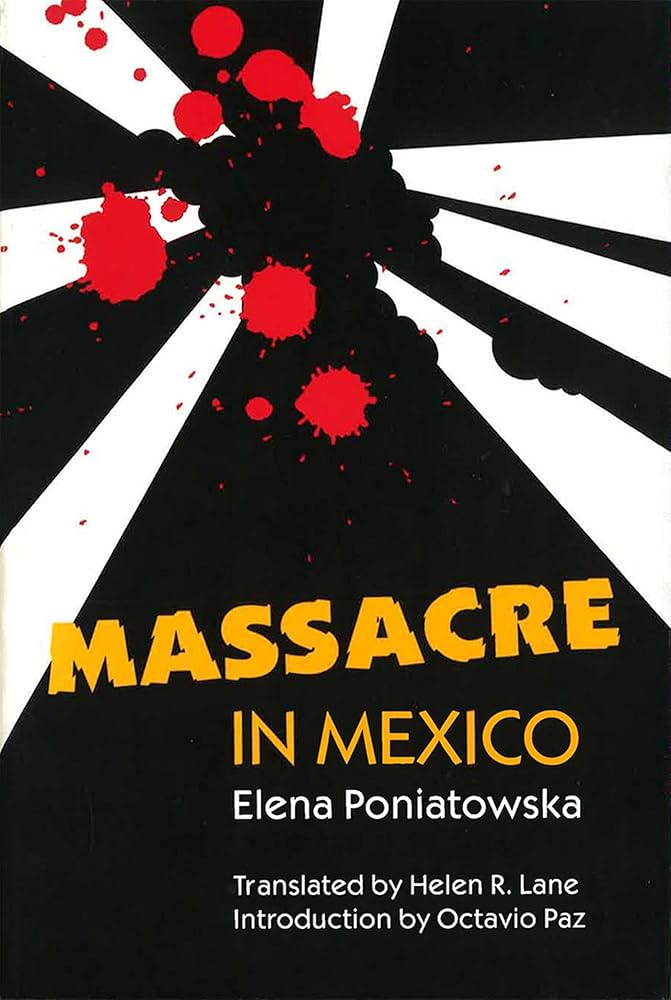
Through dozens of real voices—students, mothers, witnesses, and survivors —Elena Poniatowska reconstructs with rawness and humanity the massacre of October 2, 1968, in Mexico.
Massacre in Mexico is a unique work in contemporary narrative: a collective portrait of the tragedy of October 2, 1968, in Mexico, told from within, through the voices of those who lived it. Elena Poniatowska constructs a powerful, moving, and deeply human account of the Mexican student movement and the brutal repression that culminated in a massacre at the Plaza of the Three Cultures. This is neither a novel nor a conventional chronicle: it is a polyphonic testimonial that shapes the memory of a nation.
Divided into two parts—“Taking the Streets” and “The Night of Tlatelolco”—the book begins with the fervor of the movement: students organizing, debating politics, marching through the streets of Mexico City with banners, slogans, and a shared dream of transformation. The author gathers their words exactly as they were spoken, without filters or embellishment, revealing both the strength and vulnerability of a generation that chose to raise its voice. The first part takes us to the heart of the movement: rallies, assemblies, police repression, arbitrary arrests, solidarity with other social sectors, and above all, the political awakening of thousands of young people.
The second part descends brutally into horror: October 2. From the first gunshots to the final hours of the night, the square becomes a stage of chaos, fear, and bloodshed. Students running, hiding, being hunted. Mothers desperately searching for their children. Witnesses watching bodies fall from their windows. Detainees recounting beatings, torture, and humiliation. In the midst of that long night, the government issues cold statements, minimizes the events, and blames the victims themselves.
Throughout its pages, Massacre in Mexico alternates testimonies, official documents, newspaper headlines, military statements, lists of detainees, and photographs. This combination of materials creates a fragmented yet powerful narrative, in which the reader does not simply learn what happened, but feels it, experiences it, and understands it in all its complexity. There is no omniscient narrator: it is the victims, witnesses, and survivors themselves who tell the story. And that makes every page resonate with authenticity.
RELEVANT INFORMATION: Elena Poniatowska is one of the most important writers of recent decades, internationally renowned. She was born in Paris in 1932, but moved to Mexico at the age of nine. Her career began in journalism. She has been awarded the National Prize for Linguistics and Literature (2002), the Mazatlán Prize (twice), the Xavier Villaurrutia Prize, the Alfaguara Prize, and the Rómulo Gallegos Prize. Her work has been translated into more than a dozen languages, and her career as both journalist and writer has been recognized with numerous national and international awards. In 2013, she was awarded the Cervantes Prize.
Massacre in Mexico belongs to the genres of testimonial chronicle and documentary literature, but transcends both through its innovative narrative structure and choral construction, which give it a unique character. The book, which became one of the first comprehensive accounts of the October 2, 1968 massacre, places the voices of the witnesses—students, mothers, workers, intellectuals, soldiers—at the center, allowing the story to be built from lived experience.
Its historical setting, the dramatic tension of October 2, and the richness of its documentary material provide a strong foundation for an adaptation that combines dramatization, archival material, and testimony, in the vein of productions such as When They See Us or Argentina, 1985.
AUDIOVISUAL POTENTIAL: In development.
AVAILABLE LANGUAGES: Spanish, English, Arabic, French.