
All the women in a village claim to have conceived the son of God on the same night. Years later, the only girl who does not belong to that miracle will challenge a community consumed by violence and fanaticism. The most ambitious novel by Elaine Vilar Madruga, one of the most original voices in contemporary Latin American literature.
In a remote village high in the mountains, where the land is harsh, doves die in the square, and violence is part of everyday life, everything changes after an event the inhabitants will call the Golden Night. During that night, an inexplicable heat engulfs the valley, and the women, seized by an uncontrollable desire, leave their homes and wander naked into the mountains. They return at dawn. Months later, many of them are pregnant.
Iván Roca, a priest who has lost his faith after being humiliated years earlier by the owner of a brothel, sees in this phenomenon an opportunity for redemption. He proclaims it a divine intervention: God has chosen the village, and each of those women will give birth to a Messiah. The lie takes hold because it gives meaning to the incomprehensible, and from then on, the life of the village organizes itself around that belief.
Among the children born from the Golden Night is Federico, raised by his mother Regina as the one true chosen. From an early age, he shows a disturbing gift—he turns water into rum—which fuels the surrounding fanaticism and reinforces his central role. Federico grows convinced that his destiny is to impose himself over others, even over the other messiahs born alongside him.
Into this same household arrives Puma, a young woman abandoned by her father and taken in by the family. There she meets Maná, a girl whose body is directly connected to the earth: wherever she sweats, the soil blooms. Between them arises a secret, intense relationship that defies all norms. From that relationship, a miracle child is born: Junco.
This birth disrupts the symbolic order the village has constructed. Junco does not come from the Golden Night and therefore does not fit into the narrative that sustains the priest Iván’s power, nor in Regina’s faith, built on the belief that her son is the only Messiah. The girl introduces a dangerous fracture: the possibility of another origin, another meaning. Regina sees her as a direct threat to Federico’s centrality. The tension becomes unbearable, and Puma is expelled. She flees with Maná and their daughter.
Time passes, and the outside world breaks in: a war in the lowlands drives thousands of people toward the mountains. Puma and Junco return to the village as part of that wave of displaced people. Maná has been killed during the escape. External and internal violence have merged.
The village they return to is no longer the same. Federico has been elevated to a messianic figure, surrounded by followers and rituals, while Manuel Cajús—Puma’s father, absent for years—has returned as a military leader. The tension between Federico and Manuel is inevitable: two forms of power that exclude each other—faith and force, myth and war. Even without direct confrontation, their worlds collide, dragging the village into an increasingly brutal spiral of violence.
The death of Regina marks a turning point. From her grave grows an extraordinary corn that soon becomes communal food. But that corn has a devastating effect: those who consume it begin to forget. First details, then events, until even their own memories fade. Pain disappears, but so does memory. The village enters a state of deceptive calm, sustained on emptiness.
The deterioration becomes unstoppable. Struggles for power multiply, loyalties break, and Federico is ultimately killed by his own followers, unable to sustain the myth that united them. The village, stripped of memory and ravaged, can no longer recognize itself.
In that world without history emerges Junco, now an adult. Unlike the other children of the night, her gift is not about domination or visible miracles. Her gift is memory. Wherever she acts, what has been forgotten returns.
When violence reaches its peak—with the burning of the brothel, one of the last places preserving stories and living bodies—Junco walks through the flames. She rescues the women, restores life to some of them, and above all reinstates memory. People recover what they have lived, what they have lost, what they have done. There is no easy redemption: pain returns with memory, but so does awareness.
Junco withdraws into the mountains. There she understands that her power does not serve to erase or to heal, but to rebuild from what has been lived. From that revelation, she creates a new space: a village built on memory, where the living and the dead coexist in continuity, where history does not disappear, but is integrated.
RELEVANT INFORMATION: Elaine Vilar Madruga is a Cuban novelist, poet, and playwright considered one of the most important voices in contemporary Latin American literature. Her work, marked by a critical perspective on social and political realities, moves across horror, speculative fiction, science fiction, and magical realism, addressing themes such as violence, motherhood, the female body, and power structures.
She has received numerous awards, including the Premio Pinos Nuevos (2013), the Premio Cálamo for Best Book of the Year (2021) for The Tyranny of Flies, the Nollegiu Prize for Best Novel in Spanish (2023), and the Premio 42 for Best Work in Spanish.
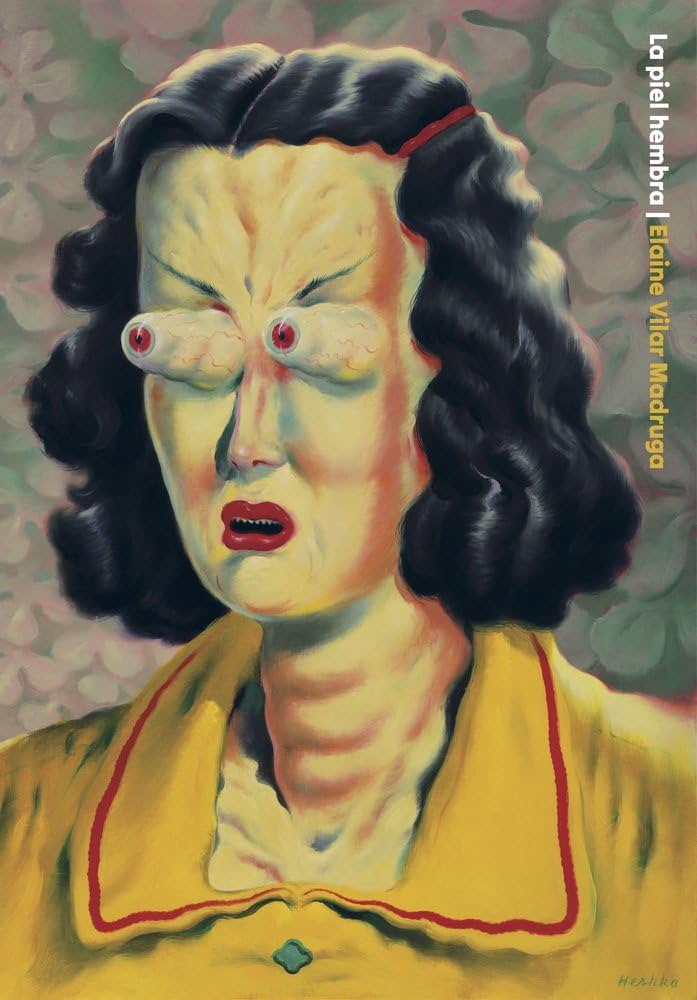
La piel hembra is a complex, multi-layered novel where the fantastic and the unsettling intertwine with a strong feminist and social critique. The story traces the transformation of an isolated village over time, where desire, violence, and false miracles reshape reality until the boundary between the living and the dead dissolves. Through multiple generations, it follows characters marked by belief, trauma, love, faith, and memory. The novel also stands out for its highly visual nature, built on powerful symbolic imagery that drives the narrative. All of this gives it strong audiovisual potential, as the story unfolds almost like a sequence of scenes capable of generating intense atmospheres and high-impact visual sequences.
AUDIOVISUAL POTENTIAL: TV Series, Miniseries, Film, TV Film.
AVAILABLE LANGUAGES: Spanish.
Adquirir los derechos
Para ponerte en contacto con nosotros completa el siguiente formulario y te responderemos en breve.
