
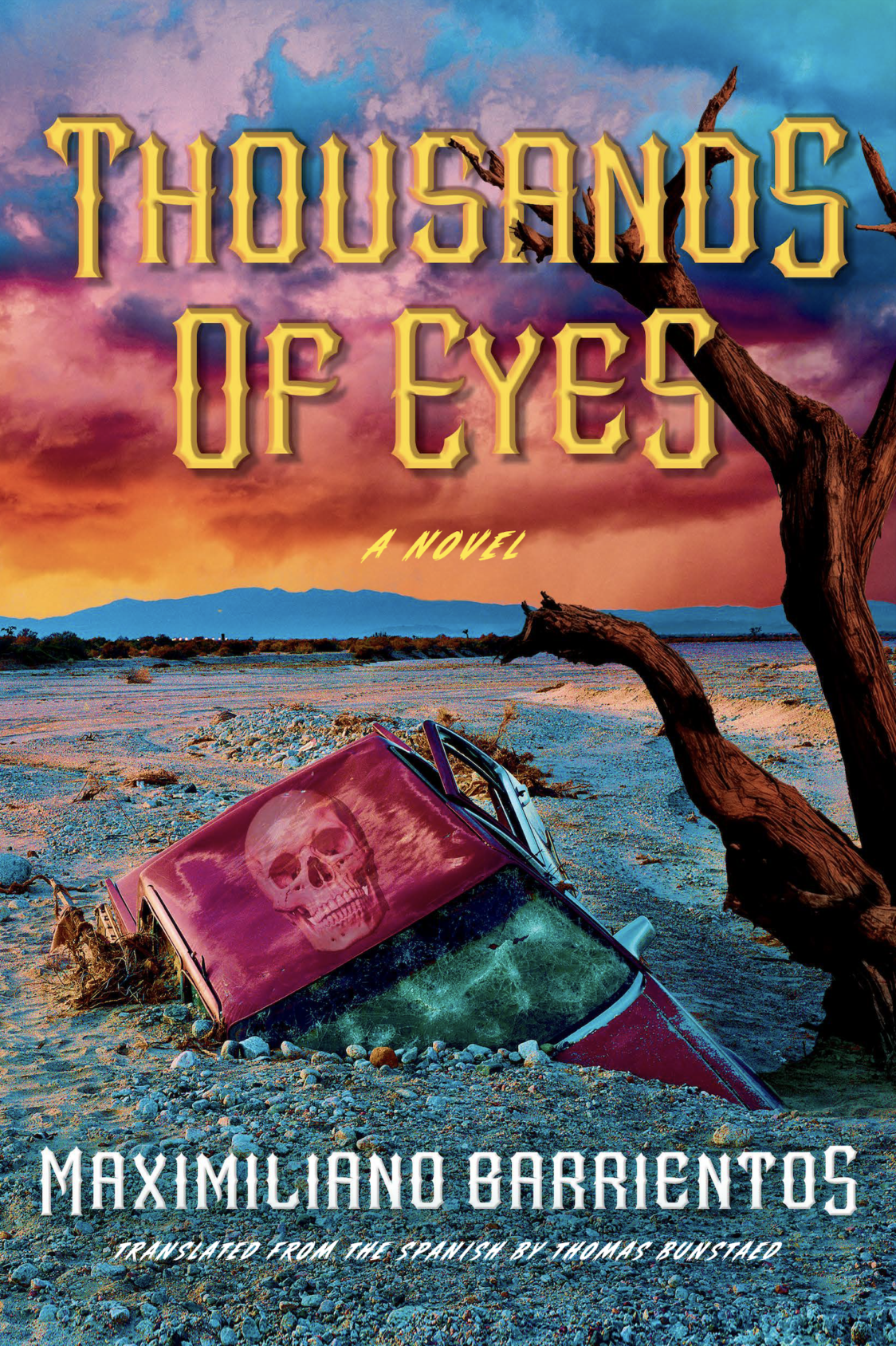
The novel that established Maximiliano Barrientos as one of the most powerful voices in contemporary Latin American literature. A fascinating dystopia where speed is a religion and an automobile becomes the instrument of a sacrifice meant to change the world.
In an unnamed country made up of isolated towns and dusty roads operates the Brotherhood, a cult that conceives speed as a sacred force. Its goal is to bring into the world an entity known as “the Dream” through a strange ritual: a specific car—a modified Plymouth Road Runner—must be driven by a chosen chauffeur and deliberately crashed into a particular tree. The collision is not symbolic but physical: the driver’s body fuses with the machine and the environment, opening a threshold.
The ritual has already marked several lives, and the novel focuses on one of them: that of a nameless man whose childhood was shaped by the Brotherhood. His father was part of the cult and was destined to drive the Road Runner once the sacred tree was located, but he broke with the organization when his wife discovered its location and refused to reveal it. The Brotherhood murdered the woman and, years later, captured and executed the father for betrayal. Before dying, he told his son that he had hidden the incomplete car to prevent the ritual from being carried out and entrusted him with one final task: recover the Road Runner before the Brotherhood does, restore it to working order, and reach the site of the sacrifice in an attempt to block the ritual.
As an adult, the protagonist takes on this task as an inherited debt. He recovers the car and takes to the road. From that moment on, the journey becomes a constant flight. The Brotherhood actively pursues him in other vehicles to reclaim the Road Runner, which they consider indispensable to fulfilling their objective. The story unfolds through high-speed chases, deliberate crashes, and executions on the highway. At the same time, the car begins to behave like a living being. The engine seems to breathe, speed alters the driver’s perception, and the radio transmits the voices of cult members who call out to him and threaten him. The protagonist’s body starts to respond as if directly connected to the machine, to the point where the boundary between driver and vehicle begins to blur.
Along the way, he picks up Luisa, a young woman fleeing a rural environment marked by abuse and threats. Luisa knows nothing about the cult or the ritual, but she becomes trapped in a journey that allows no detours. The relationship between them introduces constant tension: she wants to survive and escape; he is driven by a mission he cannot abandon. After a roadside ambush in which the protagonist is gravely injured by the Brotherhood’s pursuers, they reach an isolated farm where Toro lives—an old man who was also once a member of the cult and now acts as a dissident. Toro guards the place where the sacrifice was meant to take place and knows that the Brotherhood is close and that there is no real possibility of escape.
At the farm, a final attempt is made to break the cycle. The Plymouth Road Runner’s engine is removed from the car and connected directly to the protagonist’s body through cables and blood, in an improvised ritual that does not seek to summon “the Dream,” but to prevent its arrival. As the protagonist enters a feverish, hallucinatory state, the Brotherhood’s members surround the place in their own vehicles, ready to reclaim the engine and complete the sacrifice. But something happens: they all die burned alive inside their cars, as if the very force they worshipped turned against them. The ritual is not completed, but neither is it definitively annulled.
The second part of the novel moves back in time and reveals the origin of this cycle. The protagonist is now Federico, an adolescent living in an urban environment shaped by fights, everyday violence, and a physical relationship with pain.
Federico lost his older brother, Lucas, who died in what was supposedly a car accident after crashing his Road Runner into a tree. After Lucas’s death, Federico begins to experience disturbing changes: he hears voices on the road, his perception shifts, and physical injuries give him a new clarity.
Through dreams and fragmented memories, he discovers that his brother’s death was not an accident, but a sacrifice carried out by the Brotherhood. Lucas was not the final chosen one: Federico always was. Adolescence, rage, the attraction to speed, and violence were all preparing his body to become the chauffeur.
The connection between the two parts of the novel makes it clear that the story of the nameless man does not close the ritual, but represents a temporary interruption within a broader process. Even if the Brotherhood is neutralized at that point, the logic of sacrifice persists. “The Dream” does not need to manifest itself to exist: it is already embedded in bodies, in speed, and in the repetition of the crash. The world is not destroyed, but it remains marked by that presence.
Miles de ojos combines chases, violence, and body horror with a clear, visual mythology centered on a car, a sacrifice, and an extreme faith in speed. It is a dark, contemporary road movie, adaptable to film or series.
RELEVANT INFORMATION: Maximiliano Barrientos is one of Bolivia’s most promising authors. In 2009, his short story collection Diario won the Santa Cruz National Literature Prize.
Miles de ojos is a cult horror novel with a very strong visual identity, easily translatable to cinema. It embraces a dark, physical, and violent atmosphere, with its own mythology and aesthetic. Its tone and imagery connect with references such as Mad Max: Fury Road. It is a project designed to make an immediate visual impact and to build an extreme, recognizable experience with a distinct personality.
What the critics say about Miles de ojos:
“This fascinating novel by Maximiliano Barrientos brings together his always elegant writing, full of references. The cult of cars and speed elevated to religion, black metal, and Mad Max in Bolivia.” — Mariana Enríquez
AUDIOVISUAL POTENTIAL: TV Series, Miniseries, Feature Film, TV Film.
AVAILABLE LANGUAGES: Spanish, English
Adquirir los derechos
Para ponerte en contacto con nosotros completa el siguiente formulario y te responderemos en breve.
