
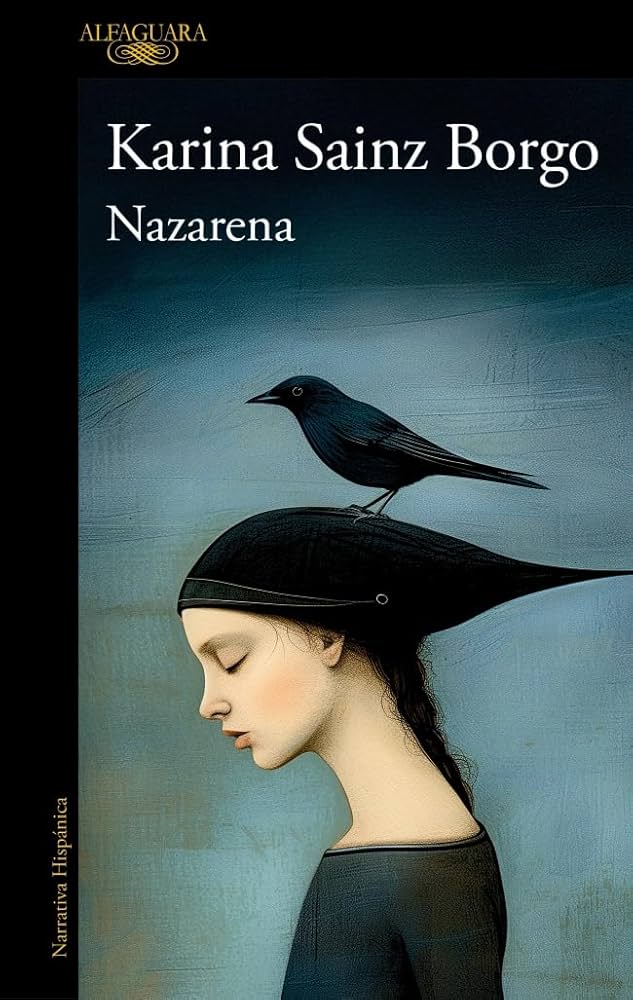
In an isolated house, eight sisters live under the weight of an ancient curse and the rule of a mother consumed by madness. Nazarena, the seventh daughter, struggles to survive in a world of secrets, jealousy, and superstition. But when a mysterious stranger arrives and an unexpected pregnancy upends their fragile balance, a tragedy is set in motion that may destroy the entire family. Karina Sainz Borgo delivers a powerful story with echoes of García Márquez and García Lorca.
In La Araira, a town that grew around a railway line, live the eight Della Vincenza sisters, known throughout the region as “the Vicentas.” An old curse hangs over the family: any man who falls in love with one of them is doomed to die, disappear, or lose everything. Their mother, Inocenta, has descended into madness and wanders the nights armed with a machete and an oil lamp, convinced that Judas is prowling around the house in search of coins buried by their ancestors. Porcia, the eldest daughter, rules the family with an iron hand. Nazarena, one of the younger sisters, spends her days and nights sweeping the courtyards and corridors of the house while sensing that disaster is drawing ever closer.
Everything changes when Klaus Krugman, a mysterious German traveler, arrives as a lodger. Nazarena begins a secret relationship with him, but shortly afterward Krugman disappears without a trace. It is then that Nazarena discovers she is pregnant. Unable to tolerate the scandal, Porcia expels her from the family home, forcing her to seek refuge with her sister Bendita. There, Nazarena gives birth to a baby girl believed by everyone to have died during childbirth. In reality, the child survives. Bendita and Heracles Venturi, an old friend and protector of the family, decide to keep her existence a secret. Pretending that the infant has been buried, they raise her in hiding for years. The child is named Brígida.
Years later, on Ash Wednesday, Bendita returns to the family home accompanied by Brígida and Heracles Venturi. Trapped within her delusions, Inocenta mistakes Venturi for Judas and hurls her oil lamp to the ground. The resulting fire spreads instantly through the house. As Nazarena runs after Brígida, who has escaped into the garden, the flames engulf the building and destroy the entire family. Heracles manages to rescue the little girl and takes her to the orphanage of El Guarapo, where she grows up unaware of her true origins. Brígida becomes the sole survivor of the Vicenta bloodline.
At the orphanage, Brígida grows up marked by the scars of the fire and haunted by visions that have followed her since childhood: eight dead women who repeatedly appear in her dreams and memories, whom she calls the muerticas, “the little dead ones.” These unsettling presences seem connected to a forgotten past that constantly calls out to her. Her only refuge is Mendito, a gypsy violinist whose vitality and imagination make him her closest companion.
As an adult, Brígida returns to La Araira with Mendito. Among the ruins of the old family home, she discovers a photograph of the eight Vicenta sisters. The moment she sees it, she realizes that these women are the very same figures who have haunted her visions for years. The ghosts she believed to be nameless apparitions are, in fact, part of her own history.
Soon afterward, Heracles Venturi reappears and finally reveals the truth. Brígida is Nazarena’s daughter. Her entire family perished in the fire. It was he who carried her out of the flames and took her to the orphanage after everyone assumed she had died. The scars covering her body are the only physical reminder of that tragedy.
At last understanding who she is and where she comes from, Brígida abandons the stones she has spent years using to defend herself against the muerticas and embraces the memory of the women who came before her. While Mendito plays the violin among the ruins of the house, she dances with a broom in her hands. In a place where death, madness, and desolation reigned for generations, music and imagination finally open the possibility of a new life.
RELEVANT INFORMATION: Karina Sainz Borgo is a Venezuelan writer and journalist. Her debut novel was translated into more than twenty languages and received the Grand Prix de l’Héroïne Madame Figaro. She is also the recipient of the Jan Michalski Prize, was a finalist for the Prix Grand Continent, and in 2023 received the David Gistau Journalism Prize.
Nazarena combines magical realism, family saga, and mystery to portray a family haunted by tragedy, secrets, and madness. The power of its imagery and the presence of raw, complex characters burdened by guilt and grief give the novel remarkable audiovisual potential.
The House of the Vicentas, the visions of the muerticas, the devastating fire, and the contrast between the darkness of the story and its magical dimension create a striking visual universe and an unsettling atmosphere that could be brought to the screen with a distinctive identity of its own.
CRITICAL ACCLAIM:
“Nazarena is the story of a family that devours itself […] Sainz reproduces the despair and fractures of inhabiting a hostile mind.” Martina Castro, Elle España
“Karina Sainz Borgo has the gift of storytelling in her veins.” Jorge Franco
“Echoes of Borges. […] Her writing is as tense and complex as Coetzee’s.” The New York Times
“Sainz Borgo speaks as though drawing words from the deepest of her entrails.” Antonio Lucas, El Mundo
AUDIOVISUAL POTENTIAL: TV Series, Limited Series, Feature Film, TV Film.
AVAILABLE LANGUAGES: Spanish.
Adquirir los derechos
Para ponerte en contacto con nosotros completa el siguiente formulario y te responderemos en breve.
