
Casandra, the eldest of three siblings, harbors an obsessive fascination with a bridge. Caleb, the middle child, kills any animal that comes into contact with him. And Calia, the youngest, draws with a precision that is deeply unsettling. Their father, a disgraced, stuttering military man, turns into a domestic tyrant. Faced with a mother who despises all three of her children, the siblings will forge an alliance to bring down the family dictatorship.
In a summer that seems endless, flies buzz over everything that breathes, and Casandra, a teenager in love with a rusted bridge, tells the story of her family.
Her brother Caleb possesses a sinister gift: any animal that touches him drops dead instantly. With these corpses, he builds a macabre puzzle in the basement, an installation that grows with each new victim.
Little Calia, only three years old, has never spoken a word, but she draws animals with a chilling perfection. The entire family fears one particular drawing: butterflies. According to a legend their mother has carried since childhood, when the girl begins to draw butterflies, it will signal that the time of death has arrived for them all.
Their father, a stuttering military man who has fallen from grace after being suspected of participating in an attempted assassination of the dictator known as “Grandpa Mustache,” decides to lock his family inside the house. Frustrated and terrified, he transforms: he stops stuttering, grows a mustache to imitate the tyrant, and imposes a domestic dictatorship with roll calls at dawn, physical punishment, food rationing, and boarded-up windows.
Casandra, fed up with confinement, runs away, escaping briefly to reach her beloved bridge, where she masturbates herself over it, channelling her most intimate impulses. But her father discovers her, drags her back home, and locks her in her room. Caleb, desperate to complete his puzzle, clings to the front door to lure in a stray dog. His father finds him and, as in his days as a torturer, crushes his hand with his boot until the bones crack. He then decrees that only the mother will receive food, leaving the children starving.
Then what everyone feared happens. Calia begins to fill page after page with butterflies. The mother, who as a child survived the collective suicide of her entire family, panics. She destroys the drawings, but Calia continues sketching butterflies endlessly. Meanwhile, Casandra and Caleb, exhausted by their father’s tyranny, plot his murder. She confesses that she was the one who reported him to “Grandpa Mustache,” and now they search for a hammer or a shovel to kill him. But before they can act, the mother, overwhelmed by the prophecy of the butterflies, goes down to the basement, climbs onto a chair in front of Caleb’s puzzle, and hangs herself. Her body, covered in insects, becomes the final piece of her son’s macabre work. The father finds the corpse, takes it down, and cremates it without any wake, ordering the children back to their rooms.
The next day, Calia speaks for the first time: “Fly God says the time has come. Yours. The time to die.” She was not drawing butterflies, but flies—and they come to life. A swarm invades the house, covers the father, enters his mouth, and renders him powerless, reduced to a nearly inert figure, just another piece of furniture. Casandra takes his keys, and at last they leave the house.
Years later, the father works cleaning excrement at a zoo, forever haunted by flies. The children make a pact with the insects. Casandra continues to love her bridge, and the flies sing her a romantic song while the world slowly rots around them.
RELEVANT INFORMATION: Elaine Vilar Madruga is a Cuban writer, poet, and playwright considered one of the most important voices in contemporary Latin American literature.
Her work, marked by a critical gaze on contemporary social and political realities, moves between horror, speculative erotica, science fiction, and magical realism, addressing themes such as violence, motherhood, the female body, and structures of power. She has received several awards, including the Premio Pinos Nuevos (2013), the Nollegiu Award for Best Novel in Spanish (2023), and the Premio 42 for Best Work in Spanish.
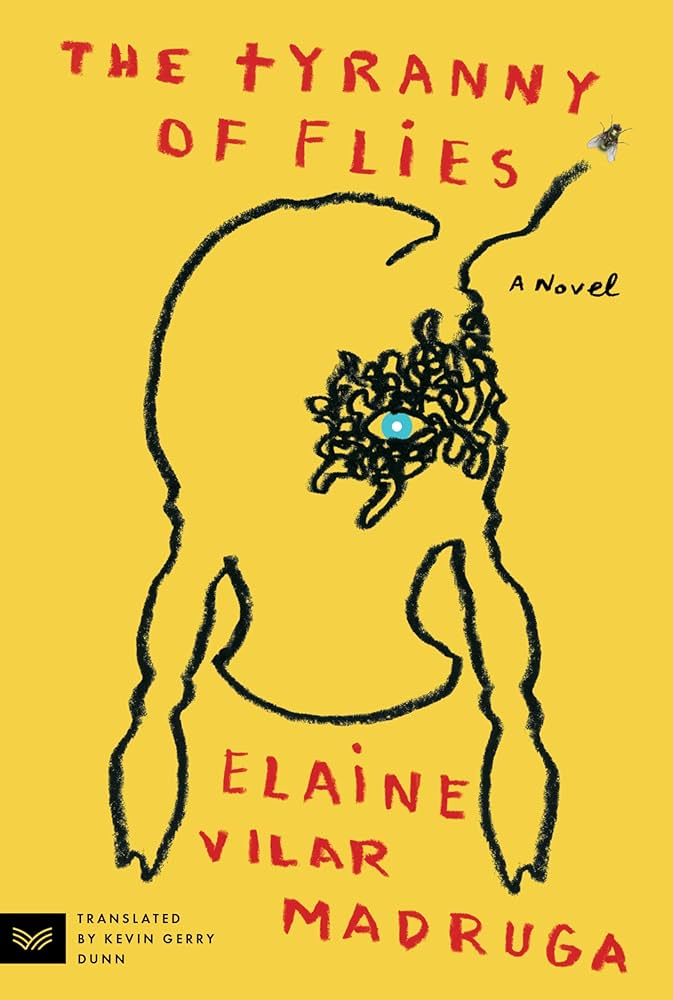
The Tyranny of Flies, winner of the Premio Cálamo for Best Book of the Year, is a suffocating and fierce exploration of inherited trauma and the reproduction of dictatorship in the most intimate space: the family. Its audiovisual potential is enormous. The confined structure (a house, a summer, a family) makes it ideal for a film with a claustrophobic atmosphere bordering on psychological horror. The perpetual heat, the sweat, the decay of Caleb’s puzzle, and the relentless advance of the flies create a visually rich universe.
Critical acclaim:
“A provocative and necessary novel.” — Libros por Doquier
“A brilliant novel.” — Más Leer
“Brilliant and fierce.” — eldiario.es
The Tyranny of Flies “is a philosophy of life.” — Killed by Trend
“A dark and sensual fable. I wish I had read it when I was younger.” — Cristina Morales
AUDIOVISUAL POTENTIAL: TV Series, Miniseries, Film, TV Film.
AVAILABLE LANGUAGES: Spanish, English, Portuguese, Italian, Russian.
Adquirir los derechos
Para ponerte en contacto con nosotros completa el siguiente formulario y te responderemos en breve.
